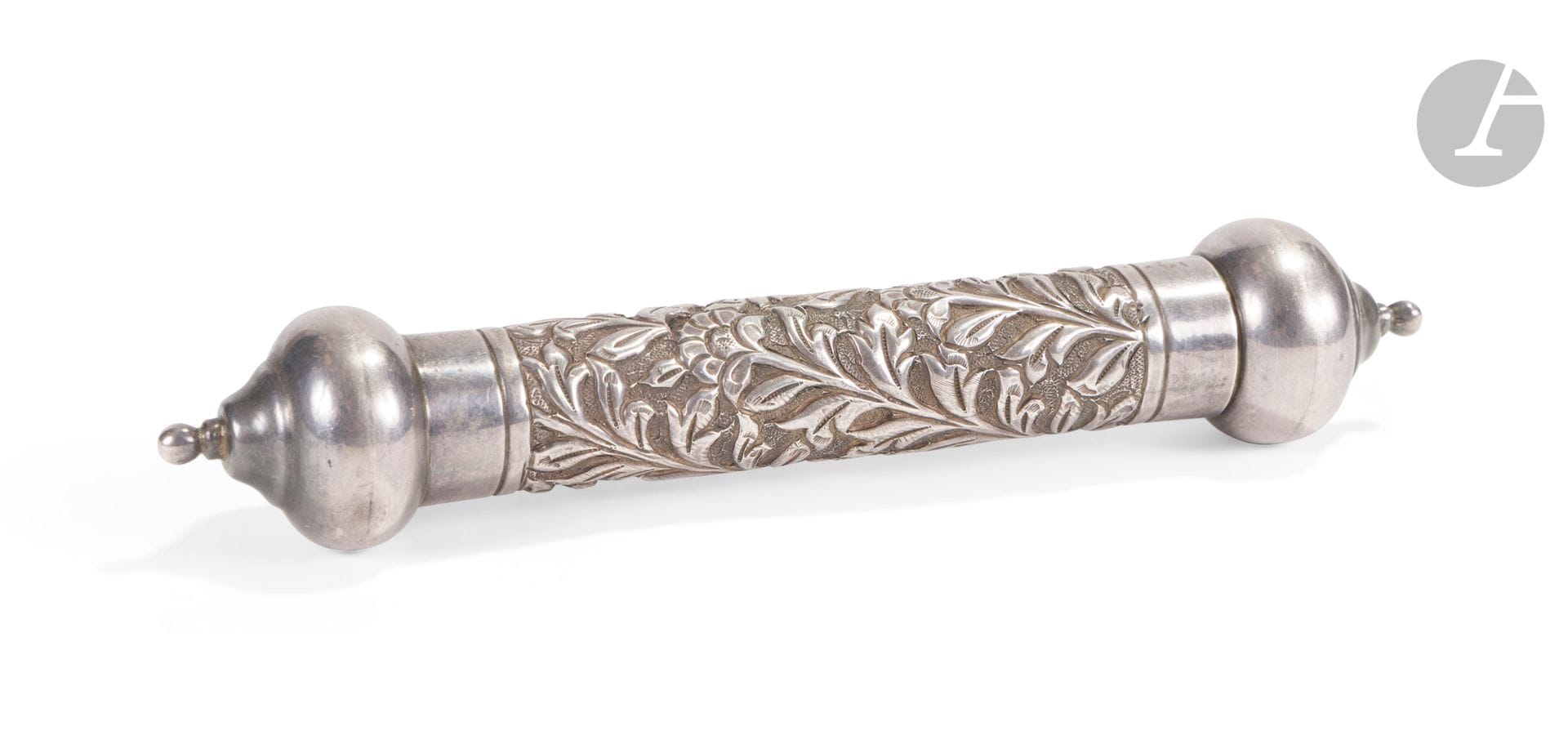
Shajarat Tayyiba" genealogical scroll of the shaykhs of the Naqshbandiyya tariqa, India, located in the Bhuj fortress, signed and dated 1881 Calligraphic cardboard scroll with a 40-line text in cursive Arabic in black ink, framed by two panels painted with floral decoration in gouache and gold spread around the title "Shajarat Tayyiba" ("Good, pure tree") at the head of the scroll and a floral medallion at the end of the scroll, which indicates the copy by Najm al-Hassan Naqshbandi at the fortress of Bhuj in the month of Safar of 1299 H / December 1881. The main text is a series of religious invocations naming various religious figures of Islam such as the Prophet Muhammad, Abu Bakr Siddiq, Ja'far al-Sadiq, Abu'l Hassan al-Kharaqani, Yusuf Hamdani, etc... In its silver cylindrical case, with bulbous ends and molded and chased floral decoration. On the back, a large floral composition painted in gouache and gold in continuity with the illuminated panels on the front. 70 x 12 cm, L. case: 20 cm; gross weight case: 135 g Wear, a few ink and polychrome chips, minor dents on the case. The Tariqa Naqshbandiyya is a Sufi brotherhood founded in the 12th century and named after the Uzbek Khwaja Shâh Bahâ'uddîn Naqshband (1317-89), considered by his followers to be their master. The title of this scroll, "Shajarat Tayyiba", literally means "The Good Tree". It is mentioned in the Koran, Sura Ibrahim, verses 24-25. In Sufism, this is an initiatory chain (silsila) comparable to a family tree, linking disciples to their master, all the way back to the Prophet Muhammad cited here in the first of the forty invocations. The fortress of Bhuj mentioned in the colophon may refer to an eponymous town in Gujarat.
Estimate
€600 - €800
Result
€780
Buyer's premium
30%
Shajarat Tayyiba" genealogical scroll of the shaykhs of the Naqshbandiyya tariqa, India, located in the Bhuj fortress, signed and dated 1881
Calligraphic cardboard scroll with a 40-line text in cursive Arabic in black ink, framed by two panels painted with floral decoration in gouache and gold spread around the title "Shajarat Tayyiba" ("Good, pure tree") at the head of the scroll and a floral medallion at the end of the scroll, which indicates the copy by Najm al-Hassan Naqshbandi at the fortress of Bhuj in the month of Safar of 1299 H / December 1881. The main text is a series of religious invocations naming various religious figures of Islam such as the Prophet Muhammad, Abu Bakr Siddiq, Ja'far al-Sadiq, Abu'l Hassan al-Kharaqani, Yusuf Hamdani, etc... In its silver cylindrical case, with bulbous ends and molded and chased floral decoration. On the back, a large floral composition painted in gouache and gold in continuity with the illuminated panels on the front.
70 x 12 cm, L. case: 20 cm; gross weight case: 135 g
Wear, a few ink and polychrome chips, minor dents on the case.
The Tariqa Naqshbandiyya is a Sufi brotherhood founded in the 12th century and named after the Uzbek Khwaja Shâh Bahâ'uddîn Naqshband (1317-89), considered by his followers to be their master. The title of this scroll, "Shajarat Tayyiba", literally means "The Good Tree". It is mentioned in the Koran, Sura Ibrahim, verses 24-25. In Sufism, this is an initiatory chain (silsila) comparable to a family tree, linking disciples to their master, all the way back to the Prophet Muhammad cited here in the first of the forty invocations.
The fortress of Bhuj mentioned in the colophon may refer to an eponymous town in Gujarat.
Sale
Thursday 18 December 2025・14:00 (Europe/Paris)
Salle 15 - Hôtel Drouot
9, rue Drouot
75009 Paris