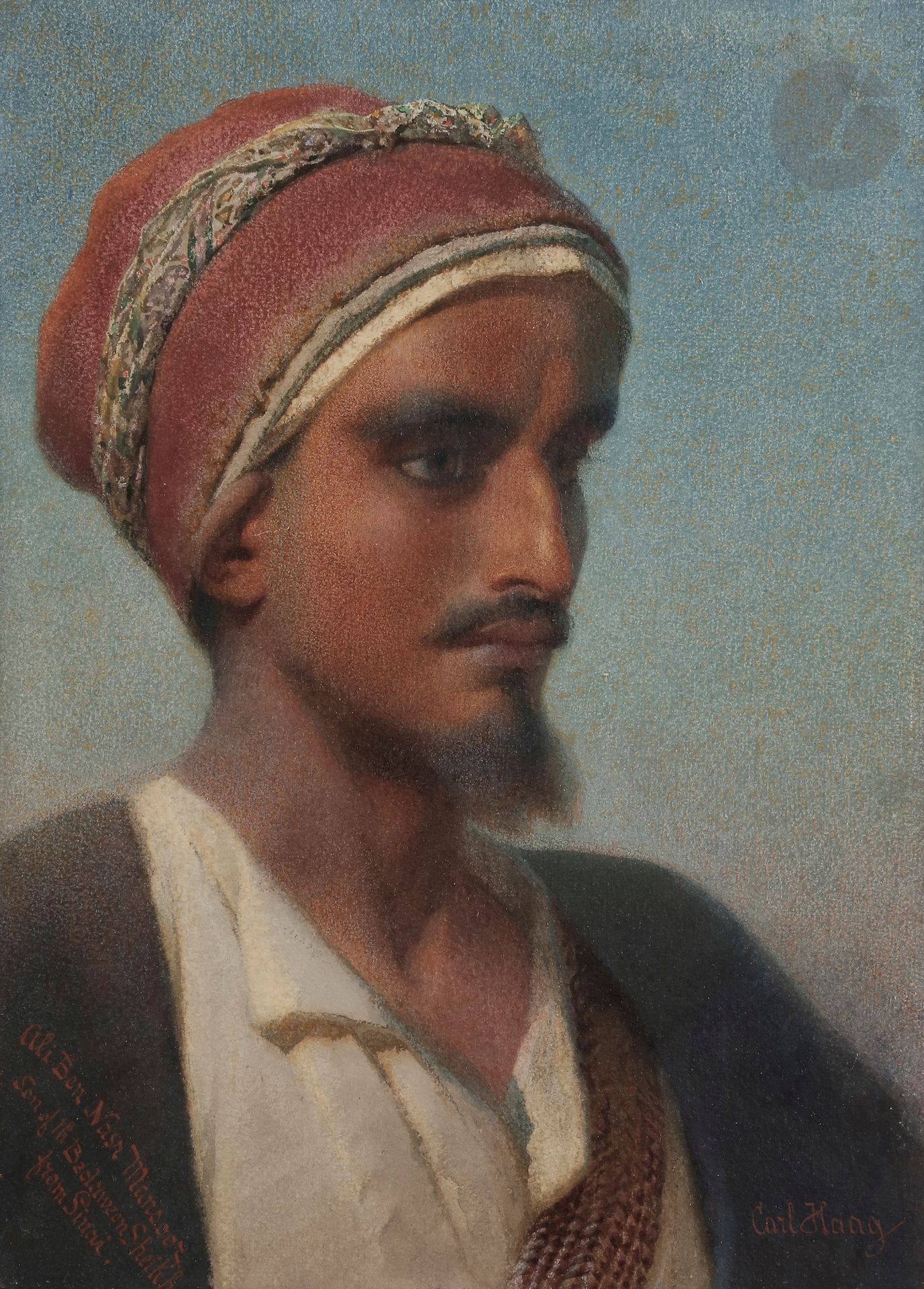
Carl HAAG (1820-1915) Portrait of Ali Ben Nasr Mansour, 1858 Watercolor. Signed lower right. Titled lower left. Signed, dated, titled and located on the back. (Minor restorations). 34.5 x 24.5 cm Provenance : Sotheby's London sale, April 29, 1982, no. 21. Exhibitions: Galerie Goupil, London, 1885, no. 24. German Athenaeum, 1876. Dudley Gallery, London, 1887. Goupil Gallery, London, 1895. Royal Watercolour Society, London, 1899. Bibliography : KARBACH, Walter, ALLISON, Catherine, Carl Haag: Victorian Court Painter and Travelling Adventurer between Orient and Occident, 2019. THORNTON, Lynne, Les orientalistes peintres voyageurs, 1828-1908, 1983. Born in Bavaria in 1820, Carl Haag studied at the academies of Nuremberg and Munich, where his talent as a miniaturist was discovered. Quickly attracted to other worlds, he left his native Germany at the age of 26 to travel around Europe. It was in England that he trained in watercolor, a technique that he mastered particularly well locally, and which he eventually made his own, adding his own variations on pure, mineral colors. His talent as a watercolorist brought him into the service of the Victorian court, painting for the Duke of Saxe-Coburg and Gotha and fulfilling commissions from Queen Victoria herself for her Scottish residence at Balmoral. Works produced during this period are now part of the Royal Collection. Always in search of new subjects and stimulated by his thirst for travel, Carl Haag decided in 1857 to turn his attention to the Orient, exchanging his court painter's frock coat for the chèche of the traveling artist. He set out to discover Egypt and the Mediterranean, with a first visit to Cairo in January 1858, followed by trips to Greece and Turkey. In November of the same year, he once again set foot on Egyptian soil to stay longer. He shared a studio in a house in Cairo's Coptic quarter with the English artist Frederick Goodall (1822 - 1904), son of the renowned steel engraver Edward Goodall. Together, the pair enjoyed sketching the people of Cairo and the surrounding countryside, and made regular excursions to Giza, Suez and the Sinai to share in the life of the Bedouins. The discovery of these regions and their sojourns there proved to be a real source of artistic inspiration for the two painters, who delivered travel souvenirs, desert landscapes, scenes of life and numerous portraits, such as that of Ali ben Nasr Mansoor, son of a Bedouin Sheikh from Sinai. Our watercolor, which according to the caption on its reverse was executed during his first month in Egypt, was exhibited extensively in London, where Haag returned to live after his stay in the Middle East, which included excursions to the Holy Land, Syria and Lebanon. In 1876, the artist lent his work to the German Athenaeum (German Association for Art and Science). In 1885, it was exhibited at the Galerie Goupil as "The Son of Sheikh Mansoor" (catalog no. 24), and in 1887 at the Dudley Gallery as "Nasir Mansoor, a Bedawee from Sinai". Ten years after its first exhibition at the Galerie Goupil, the work was shown there again in 1895 under the title "The Son of Sheikh Mansoor", then reappeared in 1899 at the Royal Watercolour Society, of which the artist had been a member since 1853, under the title "Ali Ben Nasr Mansoor, the Son of the Bedawee". The work remained in the hands of the artist's descendants until it was sold at auction by Sotheby's on April 29, 1982, under no. 21 in a catalog that included other family possessions. Today, Carl Haag's Orientalist works can be admired in prestigious institutions such as the Victoria and Albert Museum in London, the British Royal Collection and the Tareq Rajab Museum in Kuwait.
Estimate
€10,000 - €15,000
Result
Not sold
Buyer's premium
30%
Carl HAAG (1820-1915)
Portrait of Ali Ben Nasr Mansour, 1858
Watercolor.
Signed lower right.
Titled lower left.
Signed, dated, titled and located on the back.
(Minor restorations).
34.5 x 24.5 cm
Provenance :
Sotheby's London sale, April 29, 1982, no. 21.
Exhibitions:
Galerie Goupil, London, 1885, no. 24.
German Athenaeum, 1876.
Dudley Gallery, London, 1887.
Goupil Gallery, London, 1895.
Royal Watercolour Society, London, 1899.
Bibliography :
KARBACH, Walter, ALLISON, Catherine, Carl Haag: Victorian Court Painter and Travelling Adventurer between Orient and Occident, 2019.
THORNTON, Lynne, Les orientalistes peintres voyageurs, 1828-1908, 1983.
Born in Bavaria in 1820, Carl Haag studied at the academies of Nuremberg and Munich, where his talent as a miniaturist was discovered. Quickly attracted to other worlds, he left his native Germany at the age of 26 to travel around Europe. It was in England that he trained in watercolor, a technique that he mastered particularly well locally, and which he eventually made his own, adding his own variations on pure, mineral colors. His talent as a watercolorist brought him into the service of the Victorian court, painting for the Duke of Saxe-Coburg and Gotha and fulfilling commissions from Queen Victoria herself for her Scottish residence at Balmoral. Works produced during this period are now part of the Royal Collection. Always in search of new subjects and stimulated by his thirst for travel, Carl Haag decided in 1857 to turn his attention to the Orient, exchanging his court painter's frock coat for the chèche of the traveling artist. He set out to discover Egypt and the Mediterranean, with a first visit to Cairo in January 1858, followed by trips to Greece and Turkey. In November of the same year, he once again set foot on Egyptian soil to stay longer. He shared a studio in a house in Cairo's Coptic quarter with the English artist Frederick Goodall (1822 - 1904), son of the renowned steel engraver Edward Goodall. Together, the pair enjoyed sketching the people of Cairo and the surrounding countryside, and made regular excursions to Giza, Suez and the Sinai to share in the life of the Bedouins. The discovery of these regions and their sojourns there proved to be a real source of artistic inspiration for the two painters, who delivered travel souvenirs, desert landscapes, scenes of life and numerous portraits, such as that of Ali ben Nasr Mansoor, son of a Bedouin Sheikh from Sinai. Our watercolor, which according to the caption on its reverse was executed during his first month in Egypt, was exhibited extensively in London, where Haag returned to live after his stay in the Middle East, which included excursions to the Holy Land, Syria and Lebanon. In 1876, the artist lent his work to the German Athenaeum (German Association for Art and Science). In 1885, it was exhibited at the Galerie Goupil as "The Son of Sheikh Mansoor" (catalog no. 24), and in 1887 at the Dudley Gallery as "Nasir Mansoor, a Bedawee from Sinai". Ten years after its first exhibition at the Galerie Goupil, the work was shown there again in 1895 under the title "The Son of Sheikh Mansoor", then reappeared in 1899 at the Royal Watercolour Society, of which the artist had been a member since 1853, under the title "Ali Ben Nasr Mansoor, the Son of the Bedawee". The work remained in the hands of the artist's descendants until it was sold at auction by Sotheby's on April 29, 1982, under no. 21 in a catalog that included other family possessions. Today, Carl Haag's Orientalist works can be admired in prestigious institutions such as the Victoria and Albert Museum in London, the British Royal Collection and the Tareq Rajab Museum in Kuwait.
Sale
Thursday 18 December 2025・14:00 (Europe/Paris)
Salle 15 - Hôtel Drouot
9, rue Drouot
75009 Paris