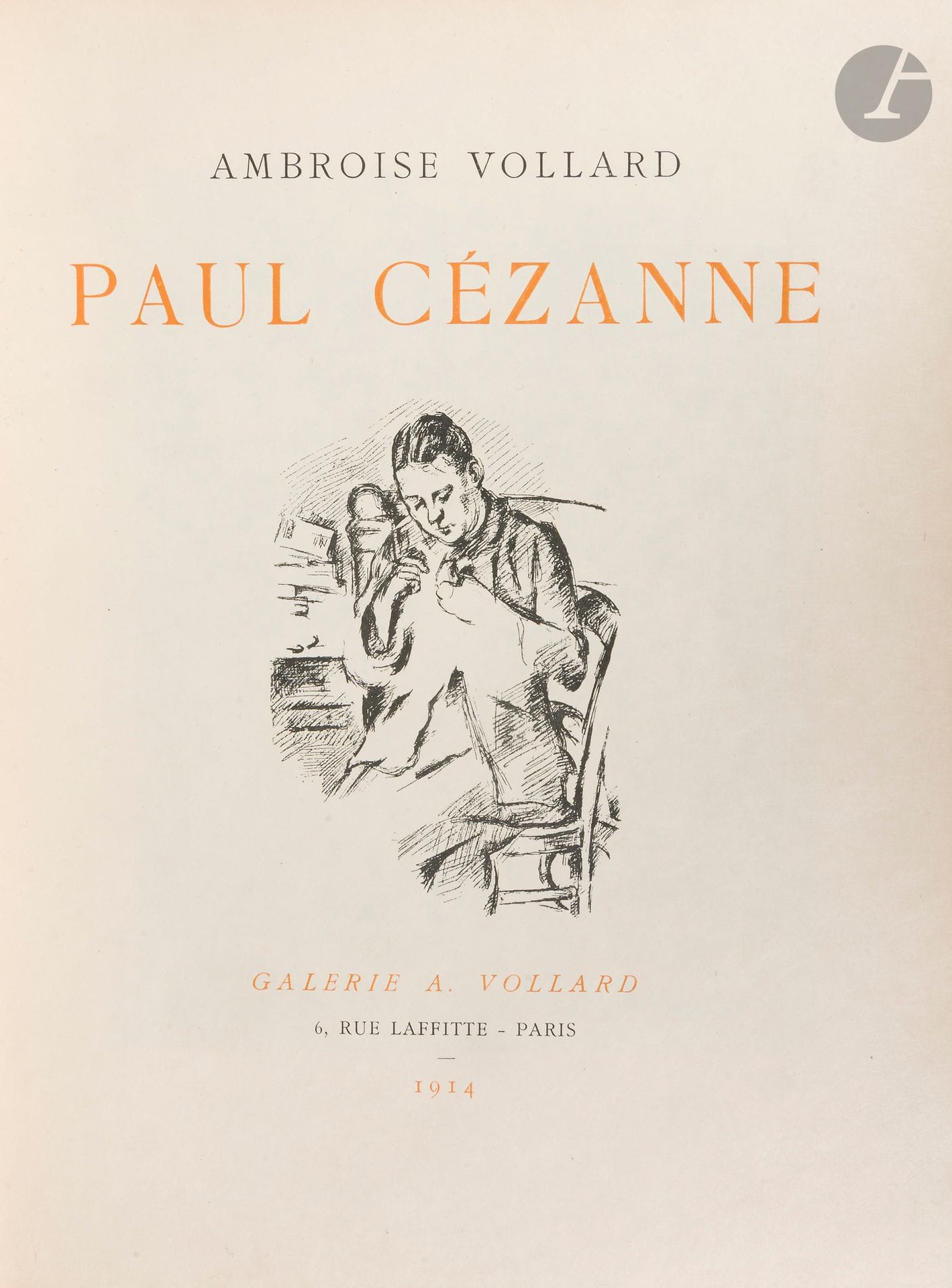
VOLLARD (Ambroise). Paul Cézanne. Paris: Galerie A. Vollard, 1914. - In-4, 320 x 250: frontispiece, (2 ff.), 187 pp., (1 f.), 58 plates, illustrated cover. Havana half-calf with corners, gilt fillets, spine ribbed and decorated, gilt head, untrimmed, cover preserved (period binding). An original edition of 1,000 copies, illustrated with numerous reproductions of the artist's works in the text and full-page reproductions, and 59 captioned plates, including an original etching of a woman's head by Paul CÉZANNE in the frontispiece. One of the first 150 copies on Japan paper from the Shizuoka factory (no. 20). Provenance: label from the Swedish bookshop Nordiska Bokhandeln in Stockholm. Jean-Loup Philippe, actor, director and poet, grew up in a literary environment thanks to his mother, who ran a salon that welcomed Jules Supervielle, Blaise Cendrars, Jean Paulhan, Charles-Albert Cingria and Henri Michaux. He began his career at the Paris theater, appearing for two years with Ingrid Bergman in Robert Anderson's "Thé et sympathie", a success that opened the door to further success, notably with Micheline Presle. In 1963, his trajectory changed when he met a group of poets, including William Burroughs, Brion Gysin, Gherasim Luca, François Dufrêne, Robert Filliou and Bernard Heidsieck, who sought to go beyond mere writing to express themselves in other ways. He then abandoned the theater to take part in the creation of a Domaine Poétique, where he stages each poet and their universe with innovative means such as sound recording, video and scenography, thus contributing to the emergence of sound poetry and poetic performances. Thereafter, he seeks a new form of writing based on sensation, creating artists' books in collaboration with visual artists, in order to give birth to a sensitive language, where text, image and matter merge. These works become inner journeys, inviting meditation and dreaming. Some of his books, such as "L'Homme qui a perdu sa tête" (The Man Who Lost His Head) and "Le Chapeau vert de Juanito" (Juanito's Green Hat), are inspired by his friendship with Antonio Segui, blending the Argentine world, its landscapes and characters with his own fantasies. His love of the mineral world is evident in works such as "Le Peuple des pierres" (The Stone People) and "Le Vaisseau de pierre" (The Stone Vessel), in which he explores the secret life of these silent elements, which he sees as bearers of the secrets of time. In 1991, he adapted Roger Caillois' "L'Écriture des pierres" into a stage piece, combining light sculpture and performance, an extension of this fascination. In 2012, he collaborated with Isabel Echarri on a book entitled "Blanc", a meditation on the purity and secrecy contained in white, the symbol of sleep and silence. His interest in matter continues with projects in which text becomes a basis for visual art, such as "Traces" with Laurence Imbert or "Krakana" with Horst Haack, which mixes writing, painting, photography and digital art to explore the language of insects, a universe he has explored since childhood, fascinated by their social organization and symbolism. He has also created books in dialogue with artists such as Jean-Paul Riopelle, Henri Chopin and Gianni Bertini, offering a diversity of universes, from the musical to the poetic, from the microcosm to the infinite. In all, nearly fifty works illustrated or supported by artistic creations enrich his oeuvre, each book being a unique object, combining paper, typography, layout and sometimes casing, transforming reading into a sensory and artistic experience.
Estimate
€1,000 - €1,500
Result
Not sold
Buyer's premium
30%
VOLLARD (Ambroise).
Paul Cézanne.
Paris: Galerie A. Vollard, 1914. - In-4, 320 x 250: frontispiece, (2 ff.), 187 pp., (1 f.), 58 plates, illustrated cover. Havana half-calf with corners, gilt fillets, spine ribbed and decorated, gilt head, untrimmed, cover preserved (period binding).
An original edition of 1,000 copies, illustrated with numerous reproductions of the artist's works in the text and full-page reproductions, and 59 captioned plates, including an original etching of a woman's head by Paul CÉZANNE in the frontispiece.
One of the first 150 copies on Japan paper from the Shizuoka factory (no. 20). Provenance: label from the Swedish bookshop Nordiska Bokhandeln in Stockholm.
Jean-Loup Philippe, actor, director and poet, grew up in a literary environment thanks to his mother, who ran a salon that welcomed Jules Supervielle, Blaise Cendrars, Jean Paulhan, Charles-Albert Cingria and Henri Michaux. He began his career at the Paris theater, appearing for two years with Ingrid Bergman in Robert Anderson's "Thé et sympathie", a success that opened the door to further success, notably with Micheline Presle.
In 1963, his trajectory changed when he met a group of poets, including William Burroughs, Brion Gysin, Gherasim Luca, François Dufrêne, Robert Filliou and Bernard Heidsieck, who sought to go beyond mere writing to express themselves in other ways. He then abandoned the theater to take part in the creation of a Domaine Poétique, where he stages each poet and their universe with innovative means such as sound recording, video and scenography, thus contributing to the emergence of sound poetry and poetic performances.
Thereafter, he seeks a new form of writing based on sensation, creating artists' books in collaboration with visual artists, in order to give birth to a sensitive language, where text, image and matter merge. These works become inner journeys, inviting meditation and dreaming. Some of his books, such as "L'Homme qui a perdu sa tête" (The Man Who Lost His Head) and "Le Chapeau vert de Juanito" (Juanito's Green Hat), are inspired by his friendship with Antonio Segui, blending the Argentine world, its landscapes and characters with his own fantasies.
His love of the mineral world is evident in works such as "Le Peuple des pierres" (The Stone People) and "Le Vaisseau de pierre" (The Stone Vessel), in which he explores the secret life of these silent elements, which he sees as bearers of the secrets of time. In 1991, he adapted Roger Caillois' "L'Écriture des pierres" into a stage piece, combining light sculpture and performance, an extension of this fascination.
In 2012, he collaborated with Isabel Echarri on a book entitled "Blanc", a meditation on the purity and secrecy contained in white, the symbol of sleep and silence. His interest in matter continues with projects in which text becomes a basis for visual art, such as "Traces" with Laurence Imbert or "Krakana" with Horst Haack, which mixes writing, painting, photography and digital art to explore the language of insects, a universe he has explored since childhood, fascinated by their social organization and symbolism.
He has also created books in dialogue with artists such as Jean-Paul Riopelle, Henri Chopin and Gianni Bertini, offering a diversity of universes, from the musical to the poetic, from the microcosm to the infinite. In all, nearly fifty works illustrated or supported by artistic creations enrich his oeuvre, each book being a unique object, combining paper, typography, layout and sometimes casing, transforming reading into a sensory and artistic experience.
Sale
Wednesday 26 November 2025・14:00 (Europe/Paris)
Sale location coming soon
3, rue Favart
75002 Paris