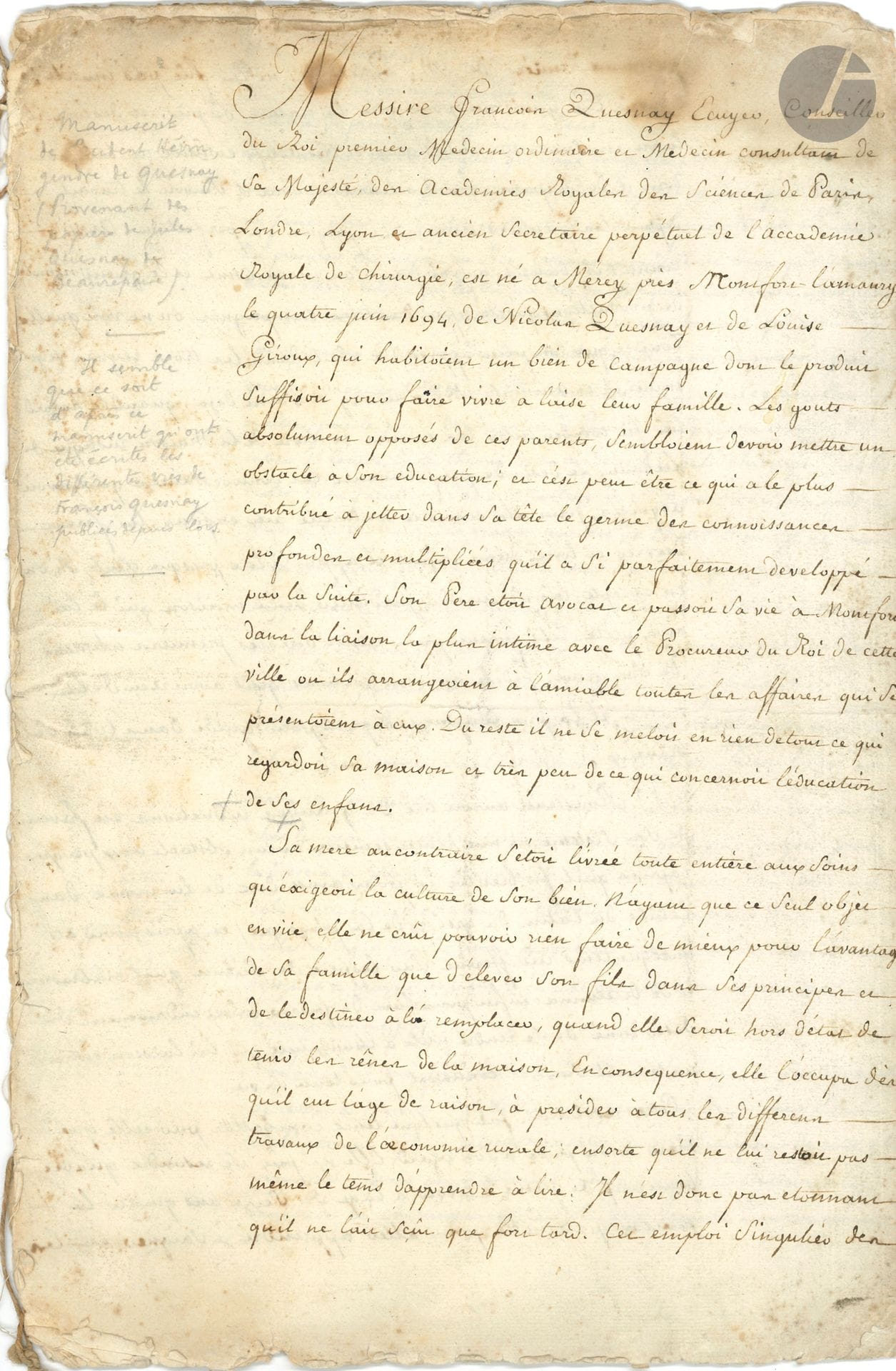
[François QUESNAY (1694-1774)]. Prudent HÉVIN (1715-1789) physician, son-in-law of François Quesnay. Autograph manuscript, [Vie de François Quesnay, circa 1774]; 16-page folio (33 x 22 cm); some wetness, top and bottom of ff. a little faded. First biography of the great physiocrat by his son-in-law. Marginal notes in pencil provide interesting details: "Manuscrit de Prudent Hévin, gendre de Quesnay (Provenant des papiers de Jules Quesnay de Beaurepaire). - The various lives of François Quesnay published since then appear to have been written from this manuscript. - It is Hévin's own manuscript, written at the request of those who wanted information to compose the Eloges de Quesnay"... The manuscript begins: "Messire François Quesnay Ecuyer, Conseiller du Roi, premier Medecin ordinaire et Medecin consultant de Sa Majesté, des Academies Royales des Sciences de Paris, Londres, Lyon et ancien Secretaire perpétuel de l'Accademie royale de chirurgie, est né a Merey près Montfort l'amaury, le quatre juin 1694, de Nicolas Quesnay et de Louise Giroux, qui habitoient un bien de campagne dont le produit suffisoit pour faire vivre à l'aise leur famille. The absolutely opposite tastes of these parents seemed likely to stand in the way of his education, and this is perhaps what contributed most to planting in his mind the seeds of the profound and multiplied knowledge he later developed so perfectly. His father was a lawyer, and spent his life in Montfort in close contact with the town's King's Prosecutor, where they amicably arranged all matters that came before them. Moreover, he never interfered in anything that concerned his home, and very little that concerned the education of his children"... Hévin describes Quesnay's upbringing under his mother's tutelage: "As soon as he reached the age of reason, she occupied him with all the different tasks of rural oeconomy, so that he didn't even have time to learn to read. So it's not surprising that he didn't learn until very late in life. This singular use of Mr. Quesnay's early years was not in vain: to open his eyes only to see nature up close: and from then on he saw it as an intelligent and very active scrutinizer, like a painting whose colors he decomposed, and whose work he followed from the first lineamens to its perfection. Quesnay, after reading Liébaut's Maison rustique, "finally decided on the art of healing, independently of the innate desire to make himself useful to humanity, which led him to foresee a lifetime of continuous work". He began his apprenticeship with a country surgeon, then moved to Paris "where he soon devoted himself entirely to studying the theory of medicine and surgery in the faculty schools and in the college of St Cosme; while he followed the practice of the great masters of the Hotel-Dieu. Throughout his stay in Paris, he did not neglect to apply himself to all the sciences he deemed relevant to his art, such as botany, pharmacy and chemistry, and particularly to all parts of mathematics and philosophy. Reading the works of Descartes and Father Malbranche, and especially the latter's book on the search for truth, was the favorite object of his meditations"... He settled in Mantes, where his reputation continued to grow, and where he became friends with the Marshal de Noailles. He made a name for himself by criticizing Silva's book on bloodletting, notably by La Peyronie, founder of the Académie royale de Chirurgie, of which Quesnay later became perpetual secretary. He defended his thesis in 1744, and was admitted to several learned societies. In 1736, he published his Essai physique sur l'œconomie animale, and contributed to the Encyclopédie. "He had acquired the greatest knowledge of political oeconomy; his physiocracy provides proof of this: it can even be said, without fear of contradiction, that few good works have been published on this subject, so interesting and so debated for a number of years, whose authors have not profited abundantly from his advice and reflections, either orally or in writing"... The testimony takes us into Quesnay's private life: "M. Quesnay had acquired, through habit, such a great facility for work that, forced to interrupt it often to fulfill the duties of his state, he would resume it on returning home and continue writing as if he had never left his work. He would even
Estimate
€1,500 - €2,000
Result
€1,800
Buyer's premium
30%
[François QUESNAY (1694-1774)]. Prudent HÉVIN (1715-1789) physician, son-in-law of François Quesnay. Autograph manuscript, [Vie de François Quesnay, circa 1774]; 16-page folio (33 x 22 cm); some wetness, top and bottom of ff. a little faded.
First biography of the great physiocrat by his son-in-law.
Marginal notes in pencil provide interesting details: "Manuscrit de Prudent Hévin, gendre de Quesnay (Provenant des papiers de Jules Quesnay de Beaurepaire). - The various lives of François Quesnay published since then appear to have been written from this manuscript. - It is Hévin's own manuscript, written at the request of those who wanted information to compose the Eloges de Quesnay"...
The manuscript begins: "Messire François Quesnay Ecuyer, Conseiller du Roi, premier Medecin ordinaire et Medecin consultant de Sa Majesté, des Academies Royales des Sciences de Paris, Londres, Lyon et ancien Secretaire perpétuel de l'Accademie royale de chirurgie, est né a Merey près Montfort l'amaury, le quatre juin 1694, de Nicolas Quesnay et de Louise Giroux, qui habitoient un bien de campagne dont le produit suffisoit pour faire vivre à l'aise leur famille. The absolutely opposite tastes of these parents seemed likely to stand in the way of his education, and this is perhaps what contributed most to planting in his mind the seeds of the profound and multiplied knowledge he later developed so perfectly. His father was a lawyer, and spent his life in Montfort in close contact with the town's King's Prosecutor, where they amicably arranged all matters that came before them. Moreover, he never interfered in anything that concerned his home, and very little that concerned the education of his children"...
Hévin describes Quesnay's upbringing under his mother's tutelage: "As soon as he reached the age of reason, she occupied him with all the different tasks of rural oeconomy, so that he didn't even have time to learn to read. So it's not surprising that he didn't learn until very late in life. This singular use of Mr. Quesnay's early years was not in vain: to open his eyes only to see nature up close: and from then on he saw it as an intelligent and very active scrutinizer, like a painting whose colors he decomposed, and whose work he followed from the first lineamens to its perfection. Quesnay, after reading Liébaut's Maison rustique, "finally decided on the art of healing, independently of the innate desire to make himself useful to humanity, which led him to foresee a lifetime of continuous work". He began his apprenticeship with a country surgeon, then moved to Paris "where he soon devoted himself entirely to studying the theory of medicine and surgery in the faculty schools and in the college of St Cosme; while he followed the practice of the great masters of the Hotel-Dieu. Throughout his stay in Paris, he did not neglect to apply himself to all the sciences he deemed relevant to his art, such as botany, pharmacy and chemistry, and particularly to all parts of mathematics and philosophy. Reading the works of Descartes and Father Malbranche, and especially the latter's book on the search for truth, was the favorite object of his meditations"...
He settled in Mantes, where his reputation continued to grow, and where he became friends with the Marshal de Noailles. He made a name for himself by criticizing Silva's book on bloodletting, notably by La Peyronie, founder of the Académie royale de Chirurgie, of which Quesnay later became perpetual secretary. He defended his thesis in 1744, and was admitted to several learned societies. In 1736, he published his Essai physique sur l'œconomie animale, and contributed to the Encyclopédie. "He had acquired the greatest knowledge of political oeconomy; his physiocracy provides proof of this: it can even be said, without fear of contradiction, that few good works have been published on this subject, so interesting and so debated for a number of years, whose authors have not profited abundantly from his advice and reflections, either orally or in writing"...
The testimony takes us into Quesnay's private life: "M. Quesnay had acquired, through habit, such a great facility for work that, forced to interrupt it often to fulfill the duties of his state, he would resume it on returning home and continue writing as if he had never left his work. He would even
Sale
Wednesday 5 November 2025・14:00 (Europe/Paris)
Sale location coming soon
3, rue Favart
75002 Paris