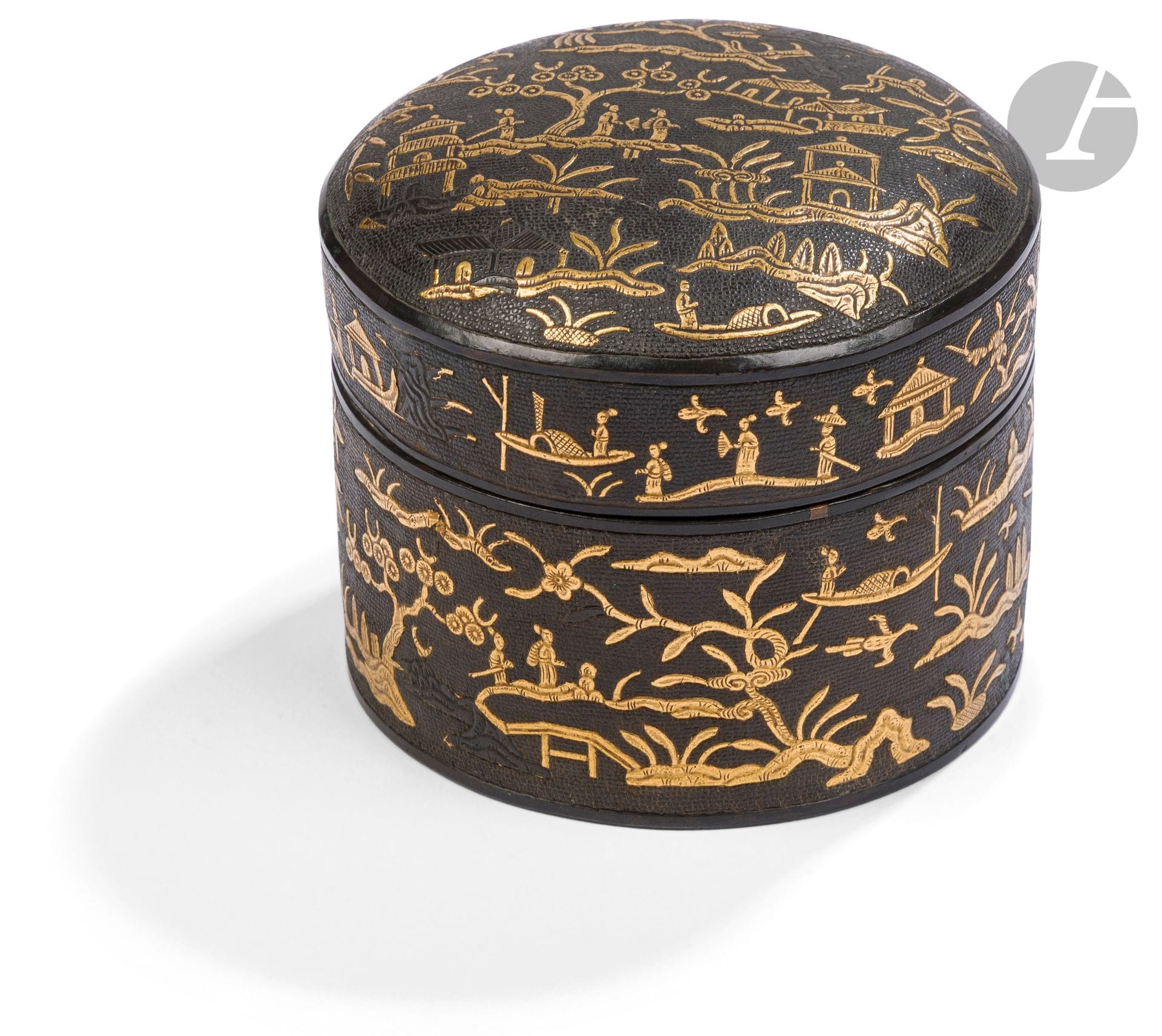
Betel box in sawasa, probably Vietnam, 18th-19th century Cylindrical in shape, the lid and body are covered with a light-relief gilded decoration on a black background treated with nanako (fish eggs), depicting lacustrine landscapes, fishermen on sampans, pavilions, pine trees, plum trees and bamboo. Comparison: For a very similar model, see : Bảo tàng Lịch sử Quốc gia, Đồ đồng Việt Nam từ thế kỷ 11 đến thế kỷ 19 - "Bronze objects from Vietnam from the 11th to the 19th century", National Museum of Vietnamese History. Height: 7 cm Production of sawasa objects, mainly concentrated in Nagasaki, was also present in Canton (Guangzhou) and Tonkin (Hanoi), and perhaps in Batavia (Jakarta), supplied by local Japanese and Chinese artisan communities; the main clientele was the expatriate Dutch colonial community, who used these objects for personal use and for European trade. The material used, similar to Japanese shakudō - an alloy of copper and gold with a black patina, had equivalents in China (wu tong), Tibet (dzne-ksim), Vietnam (on weapon mounts), Burma (dark blue patina alloys on dha bamar) and Korea (sword mounts, pipes and other objects from the 17th century), with styles varying from region to region.
Estimate
€2,000 - €300
Result
€1,950
Buyer's premium
30%
Betel box in sawasa, probably Vietnam, 18th-19th century
Cylindrical in shape, the lid and body are covered with a light-relief gilded decoration on a black background treated with nanako (fish eggs), depicting lacustrine landscapes, fishermen on sampans, pavilions, pine trees, plum trees and bamboo.
Comparison:
For a very similar model, see : Bảo tàng Lịch sử Quốc gia, Đồ đồng Việt Nam từ thế kỷ 11 đến thế kỷ 19 - "Bronze objects from Vietnam from the 11th to the 19th century", National Museum of Vietnamese History.
Height: 7 cm
Production of sawasa objects, mainly concentrated in Nagasaki, was also present in Canton (Guangzhou) and Tonkin (Hanoi), and perhaps in Batavia (Jakarta), supplied by local Japanese and Chinese artisan communities; the main clientele was the expatriate Dutch colonial community, who used these objects for personal use and for European trade. The material used, similar to Japanese shakudō - an alloy of copper and gold with a black patina, had equivalents in China (wu tong), Tibet (dzne-ksim), Vietnam (on weapon mounts), Burma (dark blue patina alloys on dha bamar) and Korea (sword mounts, pipes and other objects from the 17th century), with styles varying from region to region.
Sale
Friday 31 October 2025・14:00 (Europe/Paris)
Salle 4 - Hôtel Drouot
9, rue Drouot
75009 Paris