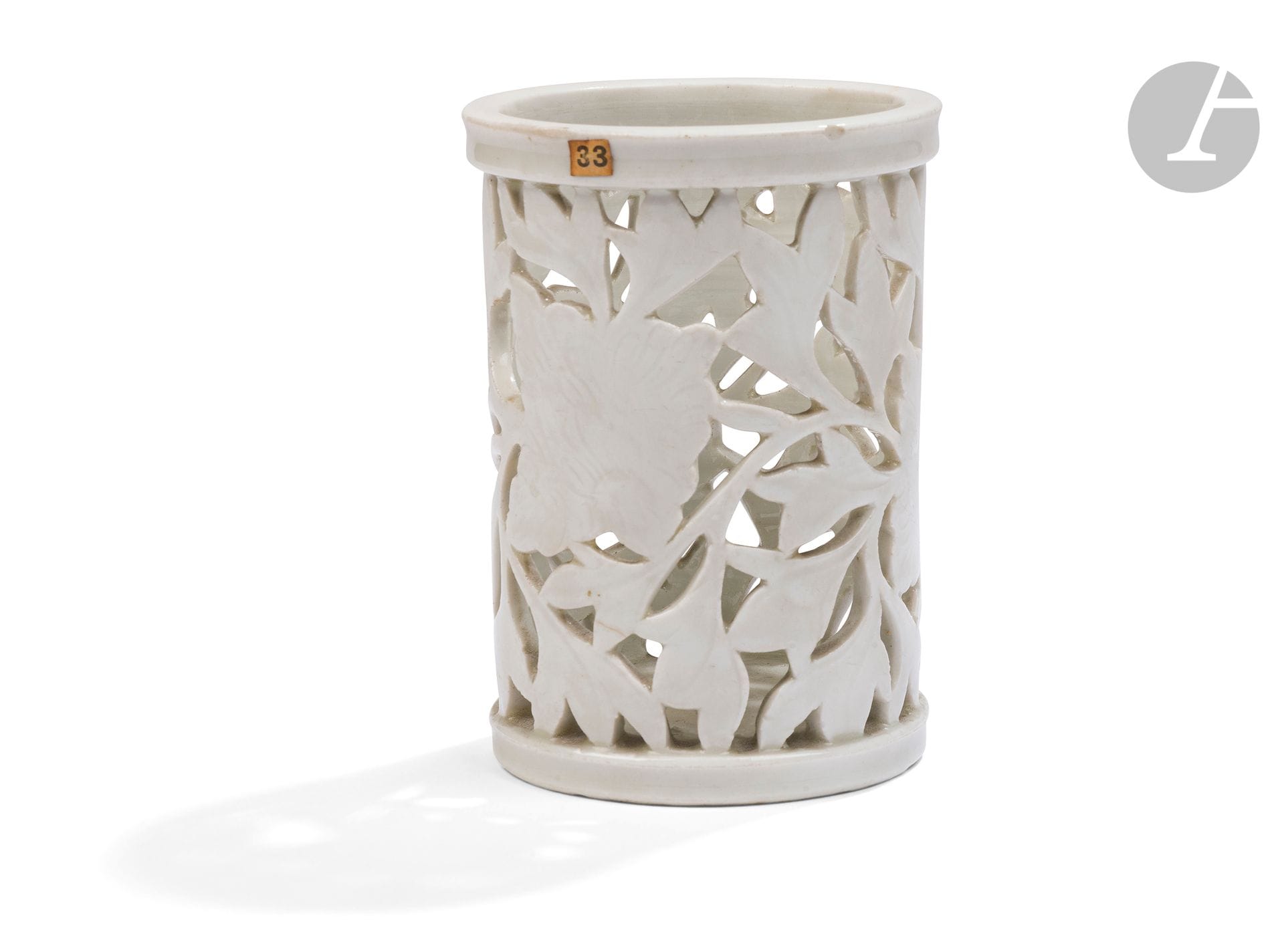
Brush pot, bitong, China, Dehua, Kangxi period (1662-1722) The body is covered with ivory-colored enamel, carved and openworked with peony flowers and foliage, with incised decoration on the surface. Old sales labels on the rim and underneath. Height: 13 cm Small chip on rim. The dating of certain groups of Chinese whites has been reassessed in recent decades, thanks in particular to the numerous pieces discovered in the wreck of the Hatcher, dated around 1643, and to the study of inscribed and dated pieces. Specialists such as John Ayers, as well as several exhibitions organized by S. Marchant & Sons, have established that much of this production dates back to the last years of the Ming dynasty. Another brush pot with openwork Greek decoration bears an inscription indicating that it was made by the Lin family during the reign of the Tianqi emperor (1620-1627). Another piece offered by S. Marchant & Sons in 2006 is dated to the summer of the Renzi year, i.e. 1612. A very similar brush pot, preserved in the Schatzkammer of the Munich Residenz with its matching basin, is adorned with rich silver-gilt mounts surmounted by an enamel frog, probably made by Parisian silversmiths. The object also features a glass lining, making it suitable for use as a ewer.
Estimate
€800 - €1,200
Result
€1,690
Buyer's premium
30%
Brush pot, bitong, China, Dehua, Kangxi period (1662-1722)
The body is covered with ivory-colored enamel, carved and openworked with peony flowers and foliage, with incised decoration on the surface. Old sales labels on the rim and underneath.
Height: 13 cm
Small chip on rim.
The dating of certain groups of Chinese whites has been reassessed in recent decades, thanks in particular to the numerous pieces discovered in the wreck of the Hatcher, dated around 1643, and to the study of inscribed and dated pieces. Specialists such as John Ayers, as well as several exhibitions organized by S. Marchant & Sons, have established that much of this production dates back to the last years of the Ming dynasty. Another brush pot with openwork Greek decoration bears an inscription indicating that it was made by the Lin family during the reign of the Tianqi emperor (1620-1627). Another piece offered by S. Marchant & Sons in 2006 is dated to the summer of the Renzi year, i.e. 1612.
A very similar brush pot, preserved in the Schatzkammer of the Munich Residenz with its matching basin, is adorned with rich silver-gilt mounts surmounted by an enamel frog, probably made by Parisian silversmiths. The object also features a glass lining, making it suitable for use as a ewer.
Sale
Friday 31 October 2025・14:00 (Europe/Paris)
Salle 4 - Hôtel Drouot
9, rue Drouot
75009 Paris