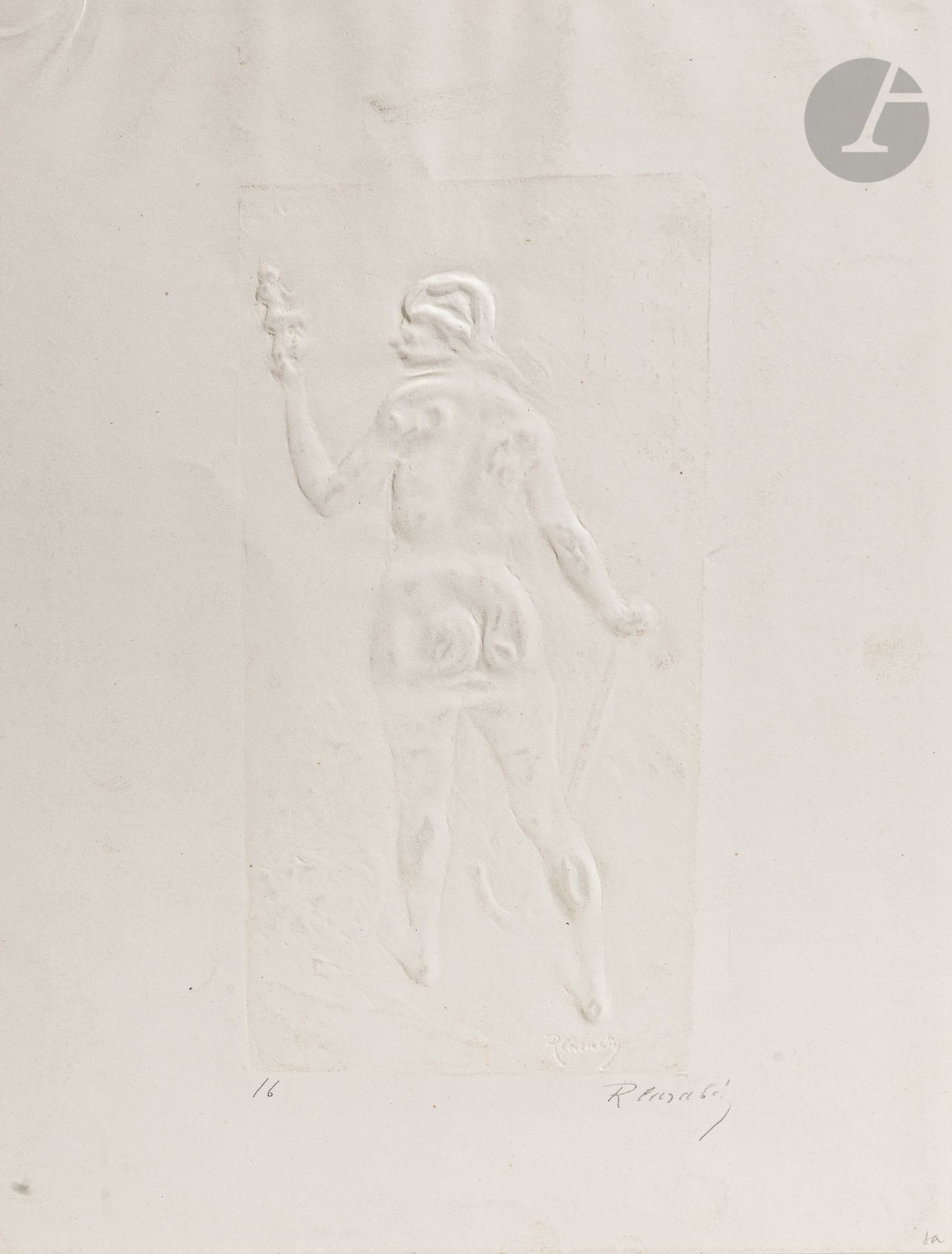
François-Rupert Carabin (1862-1932) Parque (Nude woman from behind, leaning on a scythe and holding a distaff). Circa 1900. Glyptograph. 110 x 225. Very fine proof on glazed vellum, numbered and signed in pencil. Full margins. Provenance: Michel Romand (1929-2013), great-grandson of Edmond Sagot (1857-1917).Embossed relief engraving, a technique favored by sculptors, was very popular around 1895-1900. Pierre Roche, Alexandre Charpentier, Henri Lefort des Ylouses, Oscar Roty, Maurice Dumont, and here Carabin, tried their hand at it. "In the Revue Encyclopédique of August 15, 1896, Roche describes his process in rather summary terms, in order to avoid forgeries: "A plaster mold is taken from a light bas-relief, the hollows of which are calculated to reproduce in the counterpart asperities suitable for retaining the ink. It is in this plaster that the hand-pressed paper must seek both the ink and the modeling." Despite these precautions and the complexity of the process, it proved a success, prompting many copies. The artist wrote in his diary on November 7, 1894: "Gypsographies are imitated; I saw Sagot advertising them; he calls this anything that is engraved with a projection on the paper. He traces its invention back to Roche and has no idea of the peculiarity of the process."" (Joëlle Raineau and Clara Roca, "À la découverte des secrets d'atelier de Pierre Roche", Nouvelles de l'Estampe, 2022, no. 268). The model for these sculpted prints can be traced back to the Japanese printmaking masters, who created their embossings from a Kara-zuri wooden matrix pressed directly onto the paper by hand. Europeans explored various techniques (wooden molds, plaster molds, wax molds, cigarette paper compression for Charpentier) to achieve this bas-relief effect.
Estimate
€600 - €800
Result
Not sold
Buyer's premium
30%
François-Rupert Carabin (1862-1932)
Parque (Nude woman from behind, leaning on a scythe and holding a distaff). Circa 1900. Glyptograph. 110 x 225. Very fine proof on glazed vellum, numbered and signed in pencil. Full margins.
Provenance: Michel Romand (1929-2013), great-grandson of Edmond Sagot (1857-1917).Embossed relief engraving, a technique favored by sculptors, was very popular around 1895-1900. Pierre Roche, Alexandre Charpentier, Henri Lefort des Ylouses, Oscar Roty, Maurice Dumont, and here Carabin, tried their hand at it. "In the Revue Encyclopédique of August 15, 1896, Roche describes his process in rather summary terms, in order to avoid forgeries: "A plaster mold is taken from a light bas-relief, the hollows of which are calculated to reproduce in the counterpart asperities suitable for retaining the ink. It is in this plaster that the hand-pressed paper must seek both the ink and the modeling." Despite these precautions and the complexity of the process, it proved a success, prompting many copies. The artist wrote in his diary on November 7, 1894: "Gypsographies are imitated; I saw Sagot advertising them; he calls this anything that is engraved with a projection on the paper. He traces its invention back to Roche and has no idea of the peculiarity of the process."" (Joëlle Raineau and Clara Roca, "À la découverte des secrets d'atelier de Pierre Roche", Nouvelles de l'Estampe, 2022, no. 268). The model for these sculpted prints can be traced back to the Japanese printmaking masters, who created their embossings from a Kara-zuri wooden matrix pressed directly onto the paper by hand. Europeans explored various techniques (wooden molds, plaster molds, wax molds, cigarette paper compression for Charpentier) to achieve this bas-relief effect.
Sale
Wednesday 28 May 2025・14:00 (Europe/Paris)
Sale location coming soon
3, rue Favart
75002 Paris