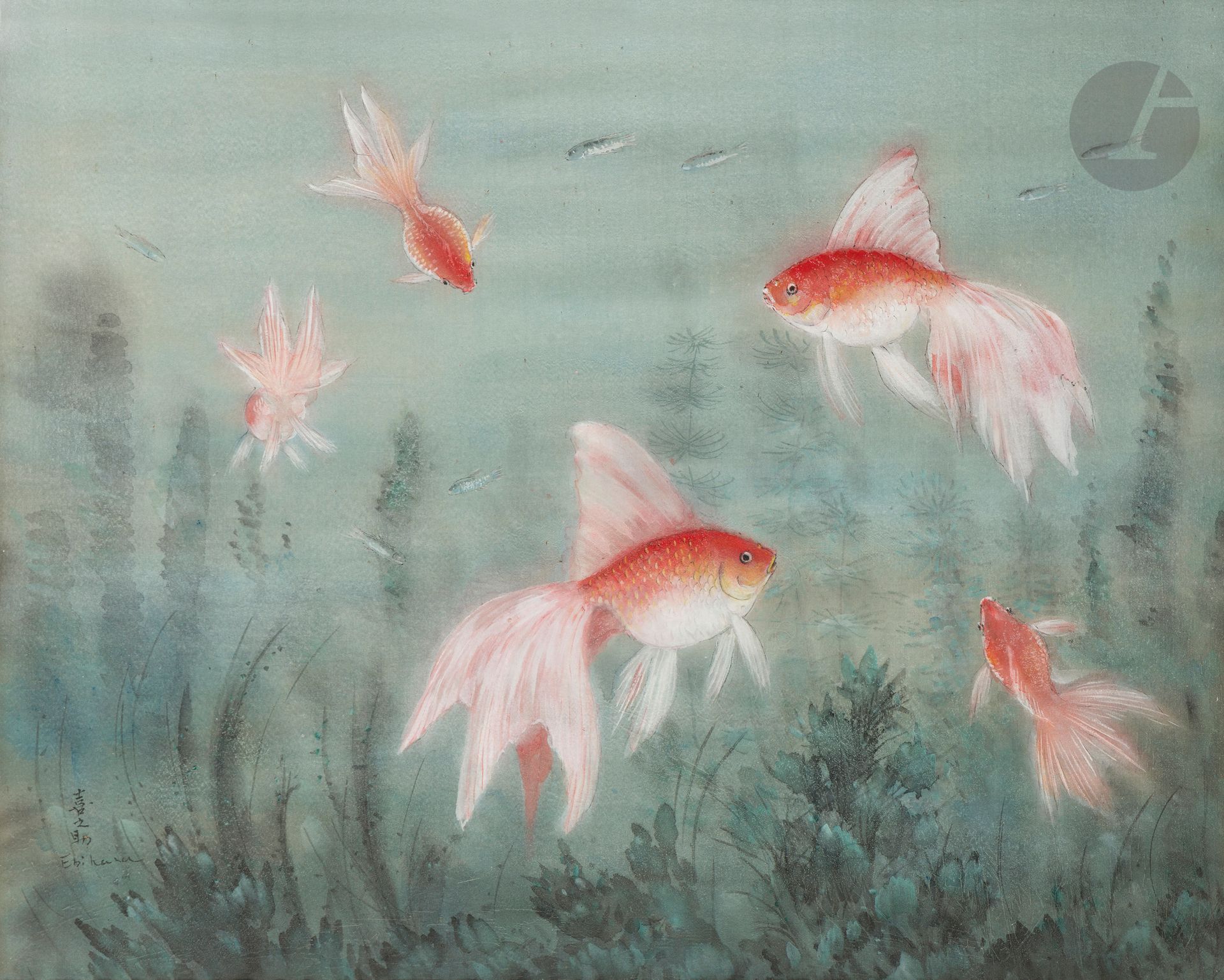
Kinosuke Ebihara -海老原 喜之助 (1904-1970), painting on paper, Japan, 20th century Watercolor on paper depicting kingyo - 金魚 (goldfish variety) swimming in seaweed. Signed lower left 喜之助 - (Kinosuke) Ebihara. Sight size: 46 x 56.5 cm Kinosuke Ebihara is a Japanese painter famous for his distinctive style, blending Western influences with traditional Japanese techniques and themes. His work illustrates the adaptation of modern artistic styles to Japanese culture during the 20th century. Born in 1904 in Kumamoto prefecture, in 1921 he left his hometown for Tokyo, where he studied at the School of Fine Arts. Early on, Ebihara showed an interest in Western painting (yōga), a movement that was gaining popularity in Japan at the time. In the 1920s, Ebihara traveled to Europe, mainly France, where he was influenced by artistic movements such as Impressionism and Post-Impressionism. In particular, he studied the works of Paul Cézanne, Vincent van Gogh and Pierre Bonnard. These influences are reflected in his compositions, characterized by a particular attention to color and form. During his stay in Paris in the 1920s, Kinosuke Ebihara was a pupil of Léonard Tsuguharu Foujita, then living in France and already well established in the Montparnasse artistic circle.
Estimate
€800 - €1,000
Result
€3,510
Buyer's premium
30%
Kinosuke Ebihara -海老原 喜之助 (1904-1970), painting on paper, Japan, 20th century
Watercolor on paper depicting kingyo - 金魚 (goldfish variety) swimming in seaweed. Signed lower left 喜之助 - (Kinosuke) Ebihara.
Sight size: 46 x 56.5 cm
Kinosuke Ebihara is a Japanese painter famous for his distinctive style, blending Western influences with traditional Japanese techniques and themes. His work illustrates the adaptation of modern artistic styles to Japanese culture during the 20th century. Born in 1904 in Kumamoto prefecture, in 1921 he left his hometown for Tokyo, where he studied at the School of Fine Arts. Early on, Ebihara showed an interest in Western painting (yōga), a movement that was gaining popularity in Japan at the time. In the 1920s, Ebihara traveled to Europe, mainly France, where he was influenced by artistic movements such as Impressionism and Post-Impressionism. In particular, he studied the works of Paul Cézanne, Vincent van Gogh and Pierre Bonnard. These influences are reflected in his compositions, characterized by a particular attention to color and form. During his stay in Paris in the 1920s, Kinosuke Ebihara was a pupil of Léonard Tsuguharu Foujita, then living in France and already well established in the Montparnasse artistic circle.
Sale
Friday 28 February 2025・14:00 (Europe/Paris)
Salle 6 - Hôtel Drouot
9, rue Drouot
75009 Paris