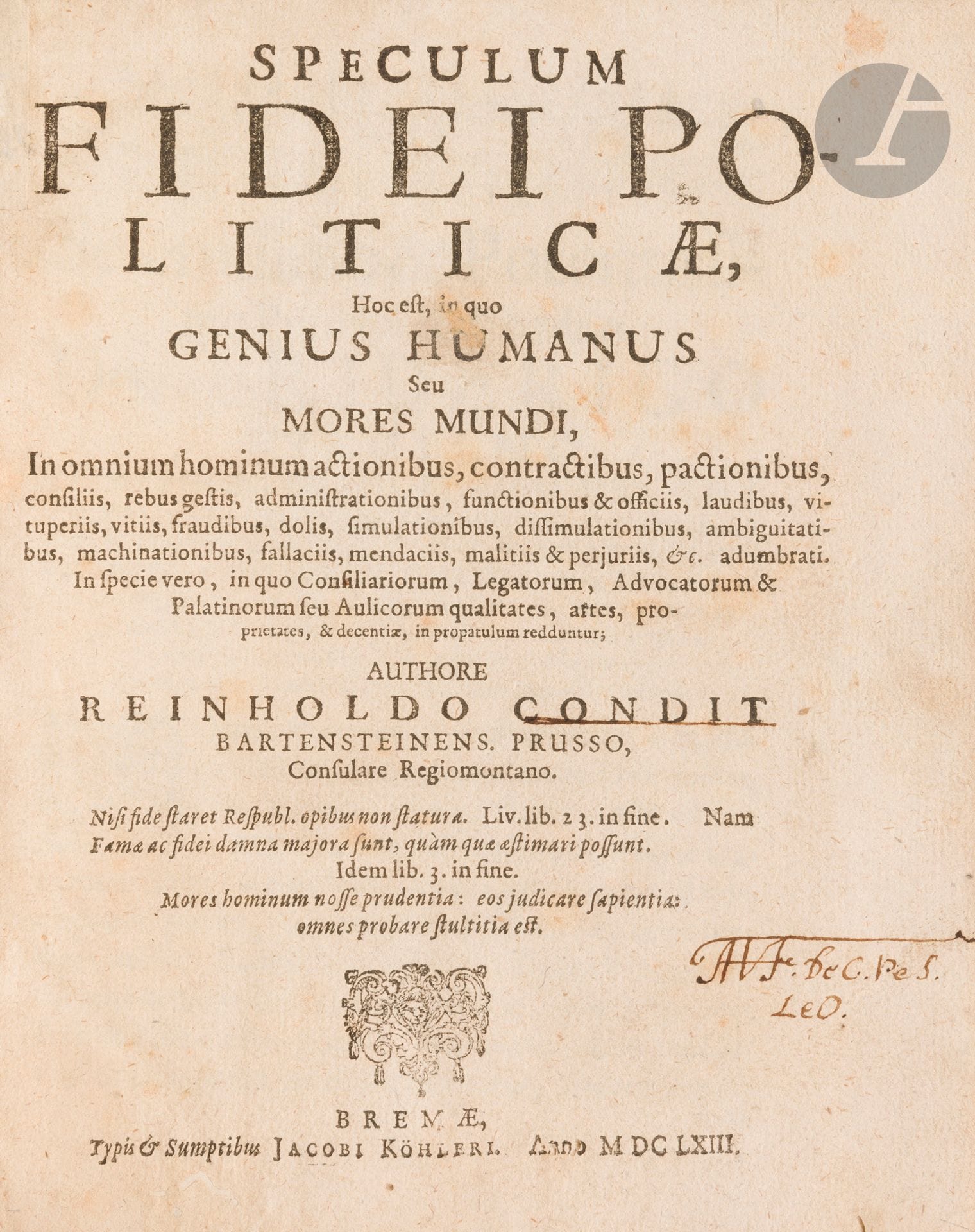
CONDIT (Reinhold). Speculum fidei politicae, hoc est, in quo Genius humanus seu mores mundi, in omnium hominum actionibus, contractibus, pactionibus... Bremen: Jacob Kohler, 1663. - 192 x 156 : (14 ff.), 632 pp. Sow skin on bevelled wooden boards, boards decorated with roulettes and framed cold fillets, with three compartments in the center including on the first board the cold mention "Anno 1695" and arms in smoke black in the center, and on the second plate the same arms in the center, but with cold irons in place of the year, fleur-de-lys in smoked black at the corners, spine ribbed with the title of the book inscribed in black ink, brass and leather clasps (late 17th century binding). First edition of this interesting work by the Prussian scholar and theologian Reinhold Condit, dedicated to Frederick William, Elector of Brandenburg (1620-1688). It was printed in Bremen, which at the time was one of the main northern European cities for publishing and disseminating religious and philosophical ideas after the Reformation, as well as an important center of Protestant trade and culture. The title of the book can be translated as follows: "Mirror of political faith, that is to say, in which the human genius or mores of the world are sketched in all actions, contracts, pacts, councils, acts, administrations, functions and offices, praises, criticisms, vices, frauds, deceits, simulacra, dissimulations, ambiguities, machinations, deceptions, lies, malice and perjury, etc. In particular, it exposes the qualities, skills, prerogatives and propriety of advisors, envoys, lawyers and palatines or courtiers." A choice copy, in contemporary binding, bearing the arms of the Austrian diplomat and nobleman Franz Ehrenreich (or François-Honoré), Count of Trauttmannsdorff (1662-1719), councillor and vice-president of the Austrian Inner House, then Austrian ambassador to the Diet in 1701. "Initially endeavoring to impose Swiss neutrality in the War of the Spanish Succession, he was unable to prevent the outbreak of the Second Villmergen War (1712) after siding with the Prince-Abbot of St. Gall. On the eve of the capture of Baden by Bern and Zurich, he fled to Waldshut in inner Austria. This failure prevented him from taking part in the Baden peace congress in 1714, as he had hoped, as Charles VI's plenipotentiary. He was recalled to Vienna at the end of 1715" (Dictionnaire historique de la Suisse). At the time of his death, his library contained over 8,000 printed volumes, more than 500 manuscripts and hundreds of maps, making it one of the largest libraries of the Habsburg monarchy in the late 17th and early 18th centuries. The copy subsequently came into the possession of the German jurist Friedrich August Hackmann (1670-1742), with an ex-dono in Latin to his name on the verso of the first endpaper, which reads: "Fridericus Augustus de Hackman, Baro de Friedenstein, Regia Majestatis Borussicae Consiliarius intimus, Septuagenario major. Scripsi Vienna die 12 Mensis Augusti 1739" ("Frederic Augustus de Hackman, Baron of Friedenstein, Intimate Advisor to His Royal Majesty of Prussia, aged over seventy. Written in Vienna on August 12, 1739"). He is best known for having rediscovered the Low German version of Reineke Fuchs, the main character of an epic dating back to the Middle Ages, and for having published Reineke de Vox in Wolfenbüttel in 1711, containing a previously unknown poem entitled Koker (The Quiver), largely composed of old sayings and proverbs, which he may have written. From 1718, he worked for a time at the Prussian court, as court advisor and chief librarian. Finally, above the first bookplate, we find this handwritten note: "ad usum S. Andrea Avellini ma Rezina ord. Men. Convert." This appears to be a reference to a Franciscan community or monastery under the patronage of Saint André Avellin (1521-1608). A choice copy in a very well-preserved and unrestored contemporary binding, complete with its original clasps. Some wear to the spines, headpieces and nerves, small wormholes on the spine. Two small restorations to last leaf. Provenance: Franz Ehrenreich, Count of Trauttmannsdorff, with his arms on the boards and two bookplates. - Friedrich August Hackmann, with handwritten ex-dono. - Colette Creuzevault.
Estimate
€600 - €800
Result
€505
Buyer's premium
26%
CONDIT (Reinhold).
Speculum fidei politicae, hoc est, in quo Genius humanus seu mores mundi, in omnium hominum actionibus, contractibus, pactionibus...
Bremen: Jacob Kohler, 1663. - 192 x 156 : (14 ff.), 632 pp. Sow skin on bevelled wooden boards, boards decorated with roulettes and framed cold fillets, with three compartments in the center including on the first board the cold mention "Anno 1695" and arms in smoke black in the center, and on the second plate the same arms in the center, but with cold irons in place of the year, fleur-de-lys in smoked black at the corners, spine ribbed with the title of the book inscribed in black ink, brass and leather clasps (late 17th century binding).
First edition of this interesting work by the Prussian scholar and theologian Reinhold Condit, dedicated to Frederick William, Elector of Brandenburg (1620-1688). It was printed in Bremen, which at the time was one of the main northern European cities for publishing and disseminating religious and philosophical ideas after the Reformation, as well as an important center of Protestant trade and culture.
The title of the book can be translated as follows: "Mirror of political faith, that is to say, in which the human genius or mores of the world are sketched in all actions, contracts, pacts, councils, acts, administrations, functions and offices, praises, criticisms, vices, frauds, deceits, simulacra, dissimulations, ambiguities, machinations, deceptions, lies, malice and perjury, etc. In particular, it exposes the qualities, skills, prerogatives and propriety of advisors, envoys, lawyers and palatines or courtiers."
A choice copy, in contemporary binding, bearing the arms of the Austrian diplomat and nobleman Franz Ehrenreich (or François-Honoré), Count of Trauttmannsdorff (1662-1719), councillor and vice-president of the Austrian Inner House, then Austrian ambassador to the Diet in 1701. "Initially endeavoring to impose Swiss neutrality in the War of the Spanish Succession, he was unable to prevent the outbreak of the Second Villmergen War (1712) after siding with the Prince-Abbot of St. Gall. On the eve of the capture of Baden by Bern and Zurich, he fled to Waldshut in inner Austria. This failure prevented him from taking part in the Baden peace congress in 1714, as he had hoped, as Charles VI's plenipotentiary. He was recalled to Vienna at the end of 1715" (Dictionnaire historique de la Suisse).
At the time of his death, his library contained over 8,000 printed volumes, more than 500 manuscripts and hundreds of maps, making it one of the largest libraries of the Habsburg monarchy in the late 17th and early 18th centuries.
The copy subsequently came into the possession of the German jurist Friedrich August Hackmann (1670-1742), with an ex-dono in Latin to his name on the verso of the first endpaper, which reads: "Fridericus Augustus de Hackman, Baro de Friedenstein, Regia Majestatis Borussicae Consiliarius intimus, Septuagenario major. Scripsi Vienna die 12 Mensis Augusti 1739" ("Frederic Augustus de Hackman, Baron of Friedenstein, Intimate Advisor to His Royal Majesty of Prussia, aged over seventy. Written in Vienna on August 12, 1739"). He is best known for having rediscovered the Low German version of Reineke Fuchs, the main character of an epic dating back to the Middle Ages, and for having published Reineke de Vox in Wolfenbüttel in 1711, containing a previously unknown poem entitled Koker (The Quiver), largely composed of old sayings and proverbs, which he may have written. From 1718, he worked for a time at the Prussian court, as court advisor and chief librarian.
Finally, above the first bookplate, we find this handwritten note: "ad usum S. Andrea Avellini ma Rezina ord. Men. Convert." This appears to be a reference to a Franciscan community or monastery under the patronage of Saint André Avellin (1521-1608).
A choice copy in a very well-preserved and unrestored contemporary binding, complete with its original clasps.
Some wear to the spines, headpieces and nerves, small wormholes on the spine. Two small restorations to last leaf.
Provenance:
Franz Ehrenreich, Count of Trauttmannsdorff, with his arms on the boards and two bookplates. - Friedrich August Hackmann, with handwritten ex-dono. - Colette Creuzevault.
Sale
Wednesday 5 March 2025・14:30 (Europe/Paris)
Sale location coming soon
3, rue Favart
75002 Paris