DIEGO GIACOMETTI (1902-1985) - COLLECTION Me R. I. ; PUIS COLLECTION Me F. I. (SON OF THE PREVIOUS) Le Cerf, model created circa [1972]. Sculpture. Proof in patinated bronze. Signed DIEGO and monogrammed on the left on the terrace. Height: 17.5 cm Terrace: 16.7 x 4.7 cm Important note: This work has been authenticated in accordance with the process established by the Diego Giacometti Estate. Provenance and history : - Collection of Me R. I., a lawyer specializing in intellectual and artistic property, whose clients have included leading artists. - Me F. I., son of the previous owner, work held since 2005 as part of his father's estate. Bibliography : - Collectif - Diego Giacometti - Catalogue de l'œuvre - Éditions Eolia, Paris, 1986. A proof of our model of Cerf reproduced in this work (without pagination). - Le Bestiaire de Diego Giacometti - Exhibition catalog, Galerie L'Arc en seine, Paris, September 24-December 20, 1997, gallery edition. A proof of our Deer model reproduced on page 69 and described on page 68. - Christian Boutonnet and Rafael Ortiz, preface by James Lord - Diego Giacometti - Catalogue d'exposition, Galerie L'Arc en seine, Paris, 2003, Les Éditions de l'Amateur, 2003. A proof of our Cerf model is reproduced on page 101. Please note Resale rights on this work are the responsibility of the purchaser. Diego Giacometti's bestiary Swiss-born sculptor Diego Giacometti is renowned for his singular work, inspired by nature and punctuated by a bestiary of stylized animals that helped define his unique vision of artistic creation. The younger brother of Alberto Giacometti, he initially devoted his work to his brother's work, before developing his own sculptural language, marked by sensitivity and simplicity - with animals as the essential protagonists. Diego Giacometti's recourse to the animal register seems to have its roots in his childhood, during which he carefully observed nature and the animals that populated the forest and mountain landscapes of his village of Borgonovo, in Switzerland. When it came to developing his personal works, he soon turned to them to "dress" his creations, as he would describe them, summoning up his fondest memories1. His love of nature and the naivety of his view of the animal and plant world, which he retained throughout his life, are reflected in the simplicity of his modelling. Far from strict realism, his fine, delicate figures, which retain the mark of his fingers, adopt a refined but no less subtle line, so much so do they evoke, through their dynamism and texture, the image of animals more or less familiar to us - in all their vitality. Diego's animals are not simply decorative motifs; they breathe life into his objects, which were originally designed to be functional. Indeed, the artist created his small animal sculptures in isolation, before adding them to the sober structures of his furniture, installing them on their ends or crosspieces2. His creations were gradually transformed into veritable furniture-sculptures, animated by these symbolic creatures that have become emblematic of his work3. Diego Giacometti built up a veritable animal repertoire, in which birds, dogs and cats are the main protagonists. He captured the very essence of animals, their instincts and behaviors, and integrated them into his singular imagination. Like a big child, he regularly twists his figures with a touch of humor. His dogs behave like dogs, and while one waters a tree, the other sniffs it out4. And the fox, mischievous and cunning, is already spying on the doe hiding on the other side of the tree that separates them; even if the canine doesn't really manage to frighten the spectators of the scene, so much does he seem charged with the naivety that the artist has passed on to him. With Diego Giacometti, each animal transcends its simple representation to become an allegory of freedom and dreams. By integrating these creatures into everyday objects, he gives his creations a dreamlike dimension, where each piece is charged with poetry and timeless charm. 1- Jean Leymarie in Daniel Marchessau - Diego Giacometti - Éditions Hermann, Paris, 1987, p. 19. 2- Ibid. 3- Christian Boutonnet, Rafael Ortiz & James Lord - Diego Giacometti - Éditions de l'Amateur/Galerie de l'Arc en Seine, Paris, 2003, p. 94. 4- Ibid. p. 95
Estimate
€30,000 - €50,000
Result
€49,580
Buyer's premium
30%
DIEGO GIACOMETTI (1902-1985) - COLLECTION Me R. I. ; PUIS COLLECTION Me F. I. (SON OF THE PREVIOUS)
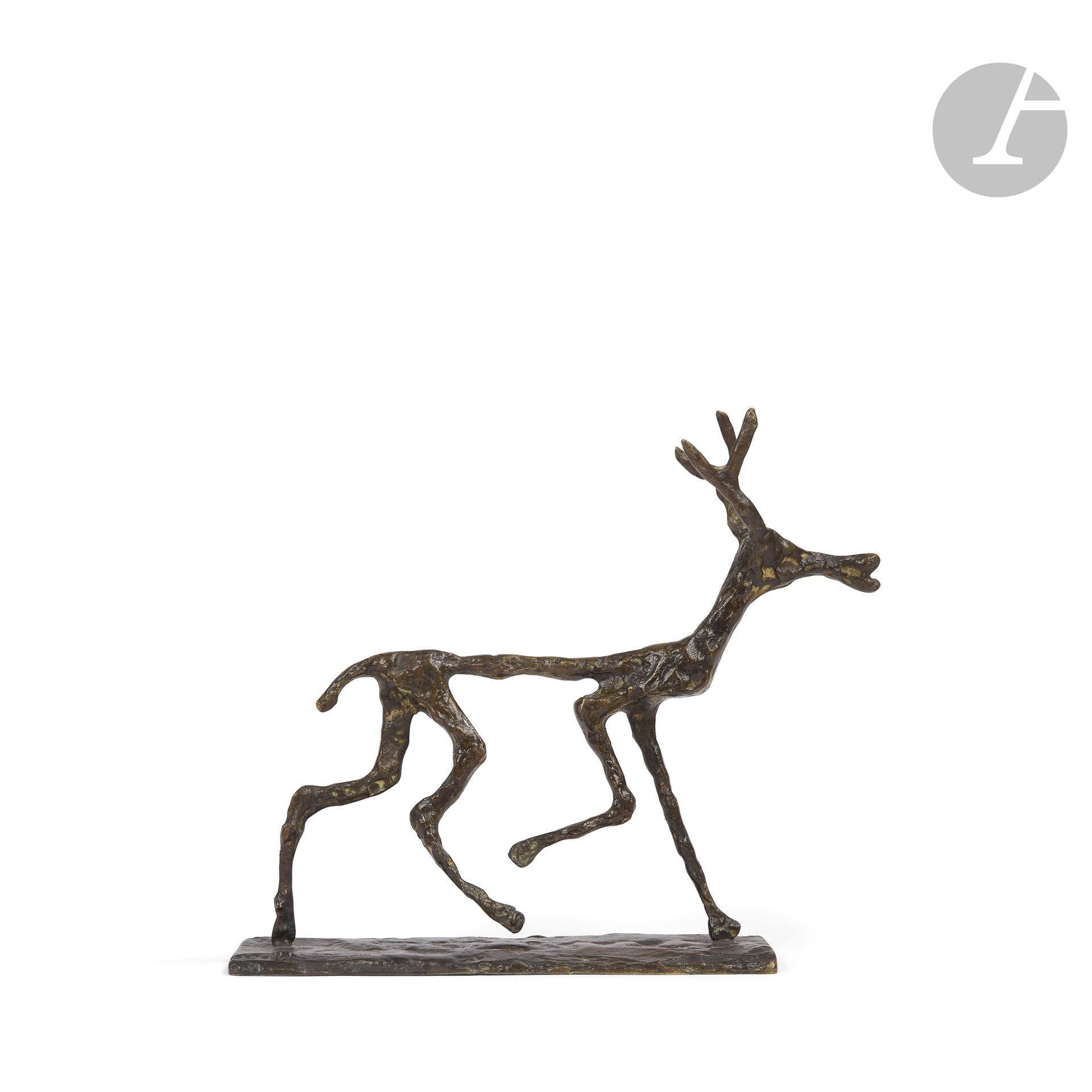
Le Cerf, model created circa [1972].
Sculpture.
Proof in patinated bronze.
Signed DIEGO and monogrammed on the left on the terrace.
Height: 17.5 cm
Terrace: 16.7 x 4.7 cm
Important note:
This work has been authenticated in accordance with the process established by the Diego Giacometti Estate.
Provenance and history :
- Collection of Me R. I., a lawyer specializing in intellectual and artistic property, whose clients have included leading artists.
- Me F. I., son of the previous owner, work held since 2005 as part of his father's estate.
Bibliography :
- Collectif - Diego Giacometti - Catalogue de l'œuvre - Éditions Eolia, Paris, 1986. A proof of our model of Cerf reproduced in this work (without pagination).
- Le Bestiaire de Diego Giacometti - Exhibition catalog, Galerie L'Arc en seine, Paris, September 24-December 20, 1997, gallery edition. A proof of our Deer model reproduced on page 69 and described on page 68.
- Christian Boutonnet and Rafael Ortiz, preface by James Lord - Diego Giacometti - Catalogue d'exposition, Galerie L'Arc en seine, Paris, 2003, Les Éditions de l'Amateur, 2003. A proof of our Cerf model is reproduced on page 101.
Please note
Resale rights on this work are the responsibility of the purchaser.
Diego Giacometti's bestiary
Swiss-born sculptor Diego Giacometti is renowned for his singular work, inspired by nature and punctuated by a bestiary of stylized animals that helped define his unique vision of artistic creation. The younger brother of Alberto Giacometti, he initially devoted his work to his brother's work, before developing his own sculptural language, marked by sensitivity and simplicity - with animals as the essential protagonists.
Diego Giacometti's recourse to the animal register seems to have its roots in his childhood, during which he carefully observed nature and the animals that populated the forest and mountain landscapes of his village of Borgonovo, in Switzerland. When it came to developing his personal works, he soon turned to them to "dress" his creations, as he would describe them, summoning up his fondest memories1.
His love of nature and the naivety of his view of the animal and plant world, which he retained throughout his life, are reflected in the simplicity of his modelling. Far from strict realism, his fine, delicate figures, which retain the mark of his fingers, adopt a refined but no less subtle line, so much so do they evoke, through their dynamism and texture, the image of animals more or less familiar to us - in all their vitality. Diego's animals are not simply decorative motifs; they breathe life into his objects, which were originally designed to be functional. Indeed, the artist created his small animal sculptures in isolation, before adding them to the sober structures of his furniture, installing them on their ends or crosspieces2. His creations were gradually transformed into veritable furniture-sculptures, animated by these symbolic creatures that have become emblematic of his work3.
Diego Giacometti built up a veritable animal repertoire, in which birds, dogs and cats are the main protagonists. He captured the very essence of animals, their instincts and behaviors, and integrated them into his singular imagination. Like a big child, he regularly twists his figures with a touch of humor. His dogs behave like dogs, and while one waters a tree, the other sniffs it out4. And the fox, mischievous and cunning, is already spying on the doe hiding on the other side of the tree that separates them; even if the canine doesn't really manage to frighten the spectators of the scene, so much does he seem charged with the naivety that the artist has passed on to him. With Diego Giacometti, each animal transcends its simple representation to become an allegory of freedom and dreams. By integrating these creatures into everyday objects, he gives his creations a dreamlike dimension, where each piece is charged with poetry and timeless charm.
1- Jean Leymarie in Daniel Marchessau - Diego Giacometti - Éditions Hermann, Paris, 1987, p. 19.
2- Ibid.
3- Christian Boutonnet, Rafael Ortiz & James Lord - Diego Giacometti - Éditions de l'Amateur/Galerie de l'Arc en Seine, Paris, 2003, p. 94.
4- Ibid. p. 95
Sale
Wednesday 4 December 2024・14:00 (Europe/Paris)
Salle 1-7 - Hôtel Drouot
9, rue Drouot
75009 Paris