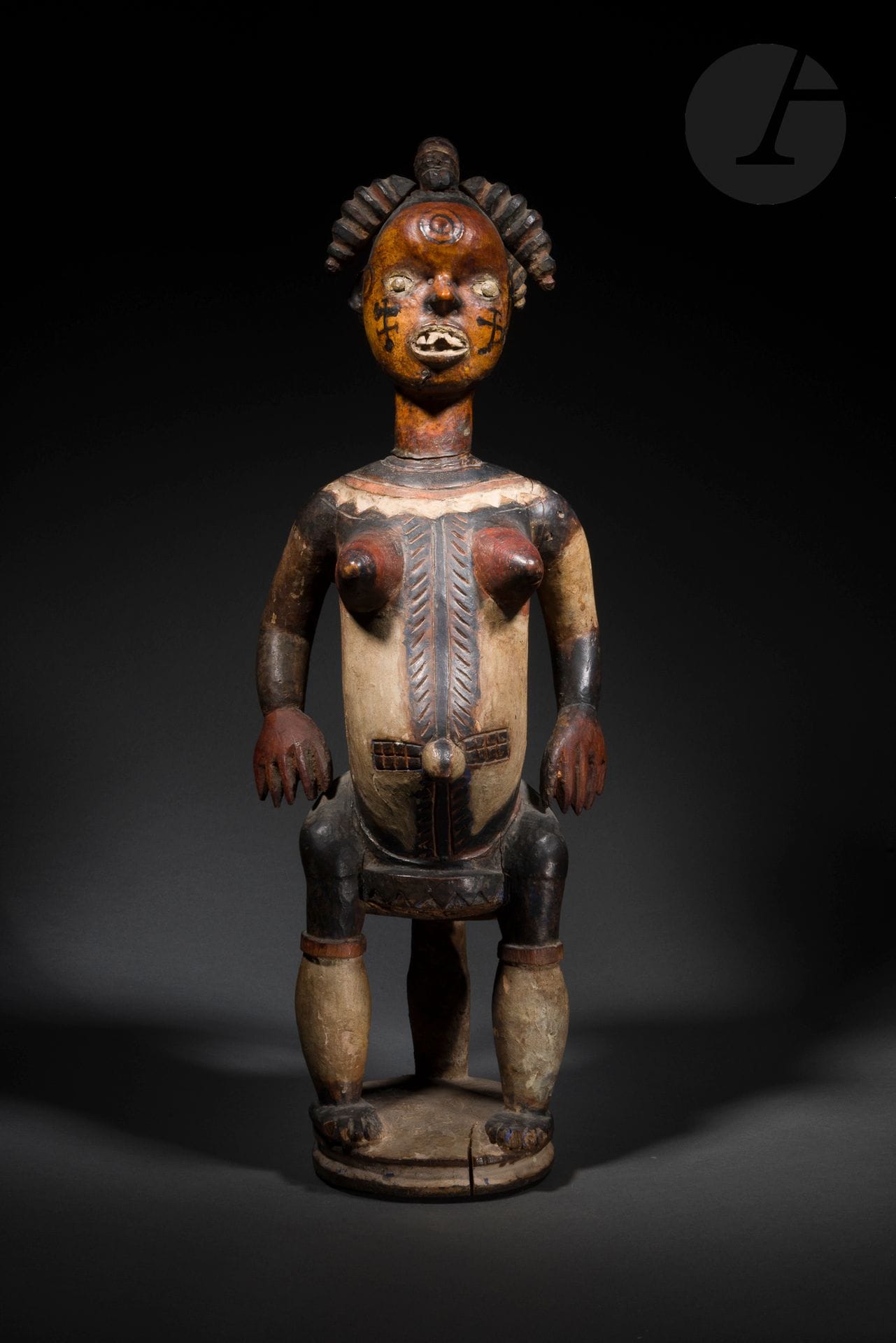
A rare and important representation of a woman seated on a stool, her intensely present head is covered in antelope hide, her headdress is made up of multiple braids, carved independently and attached. Her body is adorned not only with engraved representations of ritual scarification, but also with beautiful ancient polychrome decoration. The numerous leather-covered crest-head carvings of the Ejagham people (called Ekoï by the Efik) are well known and represent a unique contribution to the history of art, but there are hardly any wooden statues of this type with antelope leather-covered heads. The tradition of leather-covered crests is shared by many other groups, but credit for the invention of these creations goes to the Ejagham Fulani. This rare sculpture was chosen by Marie Louise Bastin to illustrate her chapter on the Ekoï in her book Introduction aux Arts d'Afrique Noire, which remains one of the great reference works on African art to this day. An important detail that contributes to the extreme rarity and importance of this work is the presence on the face (in addition to the concentric circles of scarification) of tattoos representing nsibidi ideograms, an ancient script used in sacred and profane circumstances, and which survives in the initiation and funeral rituals of important members of Ngbe society. Ejagham (Ekoï), Nigeria Wood, nails, leather and red, white, black and blue pigments, old cracks and wear, very fine old patina. Height: 72cm Provenance: Antonio Segui Collection, Paris Antonio Segui Collection, Paris Passed on by descent Publication: Bastin, Introduction aux Arts de l'Afrique noire, 1984, p.231, n°235
Estimate
€5,000 - €6,000
Result
€8,450
Buyer's premium
30%
A rare and important representation of a woman seated on a stool, her intensely present head is covered in antelope hide, her headdress is made up of multiple braids, carved independently and attached. Her body is adorned not only with engraved representations of ritual scarification, but also with beautiful ancient polychrome decoration. The numerous leather-covered crest-head carvings of the Ejagham people (called Ekoï by the Efik) are well known and represent a unique contribution to the history of art, but there are hardly any wooden statues of this type with antelope leather-covered heads. The tradition of leather-covered crests is shared by many other groups, but credit for the invention of these creations goes to the Ejagham Fulani. This rare sculpture was chosen by Marie Louise Bastin to illustrate her chapter on the Ekoï in her book Introduction aux Arts d'Afrique Noire, which remains one of the great reference works on African art to this day. An important detail that contributes to the extreme rarity and importance of this work is the presence on the face (in addition to the concentric circles of scarification) of tattoos representing nsibidi ideograms, an ancient script used in sacred and profane circumstances, and which survives in the initiation and funeral rituals of important members of Ngbe society.
Ejagham (Ekoï), Nigeria
Wood, nails, leather and red, white, black and blue pigments, old cracks and wear, very fine old patina.
Height: 72cm
Provenance: Antonio Segui Collection, Paris
Antonio Segui Collection, Paris
Passed on by descent
Publication:
Bastin, Introduction aux Arts de l'Afrique noire, 1984, p.231, n°235
Sale
Thursday 28 November 2024・14:00 (Europe/Paris)
Salle 9 - Hôtel Drouot
9, rue Drouot
75009 Paris