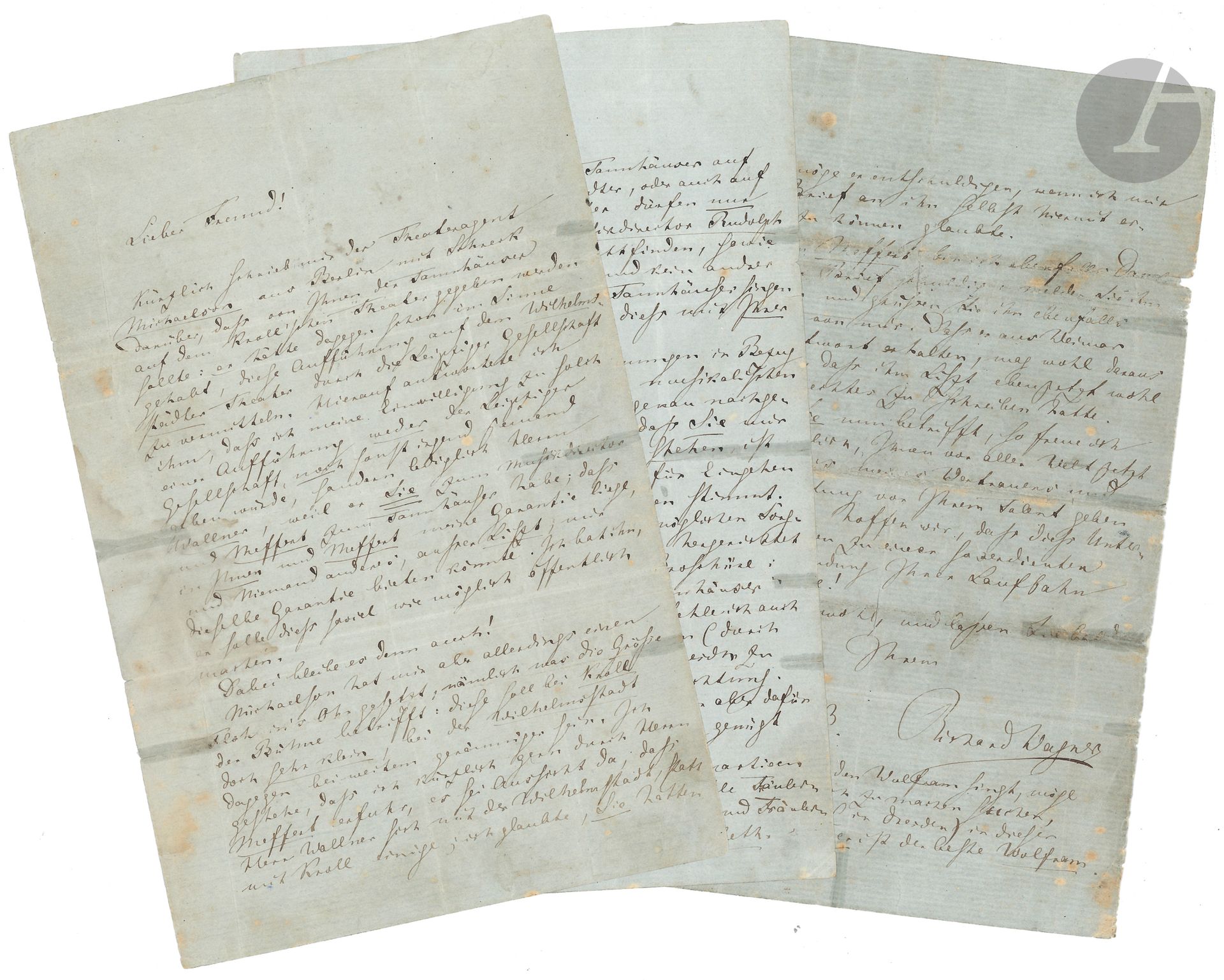
Richard WAGNER (1813-1883). L.A.S., Zurich May 2, 1853, [to conductor Rudolf Schöneck in Posen]; 6pages in-8 filled with small handwriting on bluish paper (light soiling, wetness and foxing, restored tears at folds); in German. Important letter about a planned performance of Tannhäuser in Berlin. [These performances of Tannhäuser in Berlin by Wallner's troupe under Schöneck's direction did not take place in the end, the Berlin intendant having taken measures against this company, and also as a result of a rupture between Schöneck and Wallner]. Wagner was informed by the Berlin theatrical agent Michaelson that Tannhäuser should be given under Schöneck's direction at the Kroll Theater, and that he had considered having it performed at the Wilhelmstadt Theater by the Leipzig company. But Wagner replied that he would only give his consent to Mr. Wallner, because he had Schöneck as conductor, and Meffert as Tannhäuser, and he would only give his guarantee to them, and to no one else, with the exception of Liszt.... Wagner was concerned about the size of the stage, the Kroll being very small, and the Wilhelmstadt having more space. And he had believed that Wallner was negotiating with the Wilhelmstadt... Wagner would not go back on his word. Authorization for Tannhäuser in Berlin this summer was given only to Wallner; the Royal Theater could acquire these rights in the future. Wagner formally expressed his wish that this performance should preferably take place at the Wilhelmstadt, and, if this was not possible, on the Kroll stage despite its reduced dimensions. He will sign with Walner on the conditions set out in 6 points 1. The performance of Tannhäuser at the Friedrich Wilhelmstadt or the Kroll Theater is to take place only under the musical direction of Rudolf Schöneck, and only with Meffert in the role of Tannhäuser, unless Schöneck agrees to another arrangement. 2. Schöneck must put together a rigorous and meticulous musical ensemble, and vouch for good execution; it is on this condition alone that Wagner agrees to this undertaking. 3. The stage must be provided with all the necessary facilities in accordance with the guidelines set out in his brochure on the performance of Tannhäuser; he recommends the sketches of the Dresden decorators... 4. The female roles should be well cast, and Wagner recommends Mlle Fastlinger from Leipzig for Venus, and Mlle Bamberger from Schwerin for Elisabeth. 5. Subject to fulfillment of these conditions, Director Wallner will be authorized to give Tannhäuser in Berlin as often as he wishes (provisionally for the year), and Wagner undertakes not to give this authorization to any other Berlin theater director, with the sole exception of the Intendant of the Royal Theater. The 6th point concerns the fees Wallner is to pay Wagner, with an advance of 30 friedrich d'or on the first five performances. Wallner must also ensure the sale of the libretto at the box office, and obtain it from the publisher C. F. Mesen in Dresden, who is obliged to offer theater managers a 25% discount on the libretto, as well as to take back any unsold copies. Wagner placed the matter in Schöneck's hands, who was to ensure that Wallner fulfilled these conditions. He has every confidence in him, and is delighted to be able to demonstrate to everyone his loyalty and regard for his talent; he hopes that this undertaking will be useful to the conductor, and represent a turning point in his career! He adds that, if Meffert has not received a reply from Weimar, it is probably because Liszt had precisely nothing good to write to him; and he recommends, for the role of Wolfram, Mitterwürzer (from Dresden): he is the best Wolfram. "Kürzlich schrieb mir der Theateragent Michaelson aus Berlin mit Schreck darüber, daß von Ihnen der Tannhäuser auf dem Krollschen Theater gegeben werden sollte: er hätte dagegen schon im Sinne gehabt, diese Aufführung auf dem Wilhelmstädter Theater durch die Leipziger Gesellschaft zu vermitteln. Hierauf antwortete ich ihm, daß ich meine Eiwilligung zu solch einer Aufführung weder der Leipziger Gesellschaft noch sonst irgend jemand geben würde, sondern lediglich Herrn Wallner, weil er Sie zum Musikdirektor und Meffert zum Tannhäuser habe; daß in Ihnen und Meffert meine Garantie liege, und niemand anders, außer Liszt, mir dieselbe Garantie bieten könnte. Ich bat ihn, er solle dies soviel wie möglich öffentlich machen. [...] Michaelson hat mir allerdings einen Floh ins Ohr gesetzt, nämlich was die Größe der Bühne betrifft: diese soll bei Kroll doch sehr klein, bei der Wilhelmsstadt dagegen bei weitem geräumig
Estimate
€4,000 - €5,000
Result
€7,150
Buyer's premium
30%
Richard WAGNER (1813-1883). L.A.S., Zurich May 2, 1853, [to conductor Rudolf Schöneck in Posen]; 6pages in-8 filled with small handwriting on bluish paper (light soiling, wetness and foxing, restored tears at folds); in German.
Important letter about a planned performance of Tannhäuser in Berlin.
[These performances of Tannhäuser in Berlin by Wallner's troupe under Schöneck's direction did not take place in the end, the Berlin intendant having taken measures against this company, and also as a result of a rupture between Schöneck and Wallner].
Wagner was informed by the Berlin theatrical agent Michaelson that Tannhäuser should be given under Schöneck's direction at the Kroll Theater, and that he had considered having it performed at the Wilhelmstadt Theater by the Leipzig company. But Wagner replied that he would only give his consent to Mr. Wallner, because he had Schöneck as conductor, and Meffert as Tannhäuser, and he would only give his guarantee to them, and to no one else, with the exception of Liszt....
Wagner was concerned about the size of the stage, the Kroll being very small, and the Wilhelmstadt having more space. And he had believed that Wallner was negotiating with the Wilhelmstadt...
Wagner would not go back on his word. Authorization for Tannhäuser in Berlin this summer was given only to Wallner; the Royal Theater could acquire these rights in the future. Wagner formally expressed his wish that this performance should preferably take place at the Wilhelmstadt, and, if this was not possible, on the Kroll stage despite its reduced dimensions. He will sign with Walner on the conditions set out in 6 points
1. The performance of Tannhäuser at the Friedrich Wilhelmstadt or the Kroll Theater is to take place only under the musical direction of Rudolf Schöneck, and only with Meffert in the role of Tannhäuser, unless Schöneck agrees to another arrangement.
2. Schöneck must put together a rigorous and meticulous musical ensemble, and vouch for good execution; it is on this condition alone that Wagner agrees to this undertaking.
3. The stage must be provided with all the necessary facilities in accordance with the guidelines set out in his brochure on the performance of Tannhäuser; he recommends the sketches of the Dresden decorators...
4. The female roles should be well cast, and Wagner recommends Mlle Fastlinger from Leipzig for Venus, and Mlle Bamberger from Schwerin for Elisabeth.
5. Subject to fulfillment of these conditions, Director Wallner will be authorized to give Tannhäuser in Berlin as often as he wishes (provisionally for the year), and Wagner undertakes not to give this authorization to any other Berlin theater director, with the sole exception of the Intendant of the Royal Theater.
The 6th point concerns the fees Wallner is to pay Wagner, with an advance of 30 friedrich d'or on the first five performances. Wallner must also ensure the sale of the libretto at the box office, and obtain it from the publisher C. F. Mesen in Dresden, who is obliged to offer theater managers a 25% discount on the libretto, as well as to take back any unsold copies.
Wagner placed the matter in Schöneck's hands, who was to ensure that Wallner fulfilled these conditions. He has every confidence in him, and is delighted to be able to demonstrate to everyone his loyalty and regard for his talent; he hopes that this undertaking will be useful to the conductor, and represent a turning point in his career!
He adds that, if Meffert has not received a reply from Weimar, it is probably because Liszt had precisely nothing good to write to him; and he recommends, for the role of Wolfram, Mitterwürzer (from Dresden): he is the best Wolfram.
"Kürzlich schrieb mir der Theateragent Michaelson aus Berlin mit Schreck darüber, daß von Ihnen der Tannhäuser auf dem Krollschen Theater gegeben werden sollte: er hätte dagegen schon im Sinne gehabt, diese Aufführung auf dem Wilhelmstädter Theater durch die Leipziger Gesellschaft zu vermitteln. Hierauf antwortete ich ihm, daß ich meine Eiwilligung zu solch einer Aufführung weder der Leipziger Gesellschaft noch sonst irgend jemand geben würde, sondern lediglich Herrn Wallner, weil er Sie zum Musikdirektor und Meffert zum Tannhäuser habe; daß in Ihnen und Meffert meine Garantie liege, und niemand anders, außer Liszt, mir dieselbe Garantie bieten könnte. Ich bat ihn, er solle dies soviel wie möglich öffentlich machen. [...] Michaelson hat mir allerdings einen Floh ins Ohr gesetzt, nämlich was die Größe der Bühne betrifft: diese soll bei Kroll doch sehr klein, bei der Wilhelmsstadt dagegen bei weitem geräumig
Sale
Monday 17 June 2024・14:00 (Europe/Paris)
Sale location coming soon
3, rue Favart
75002 Paris