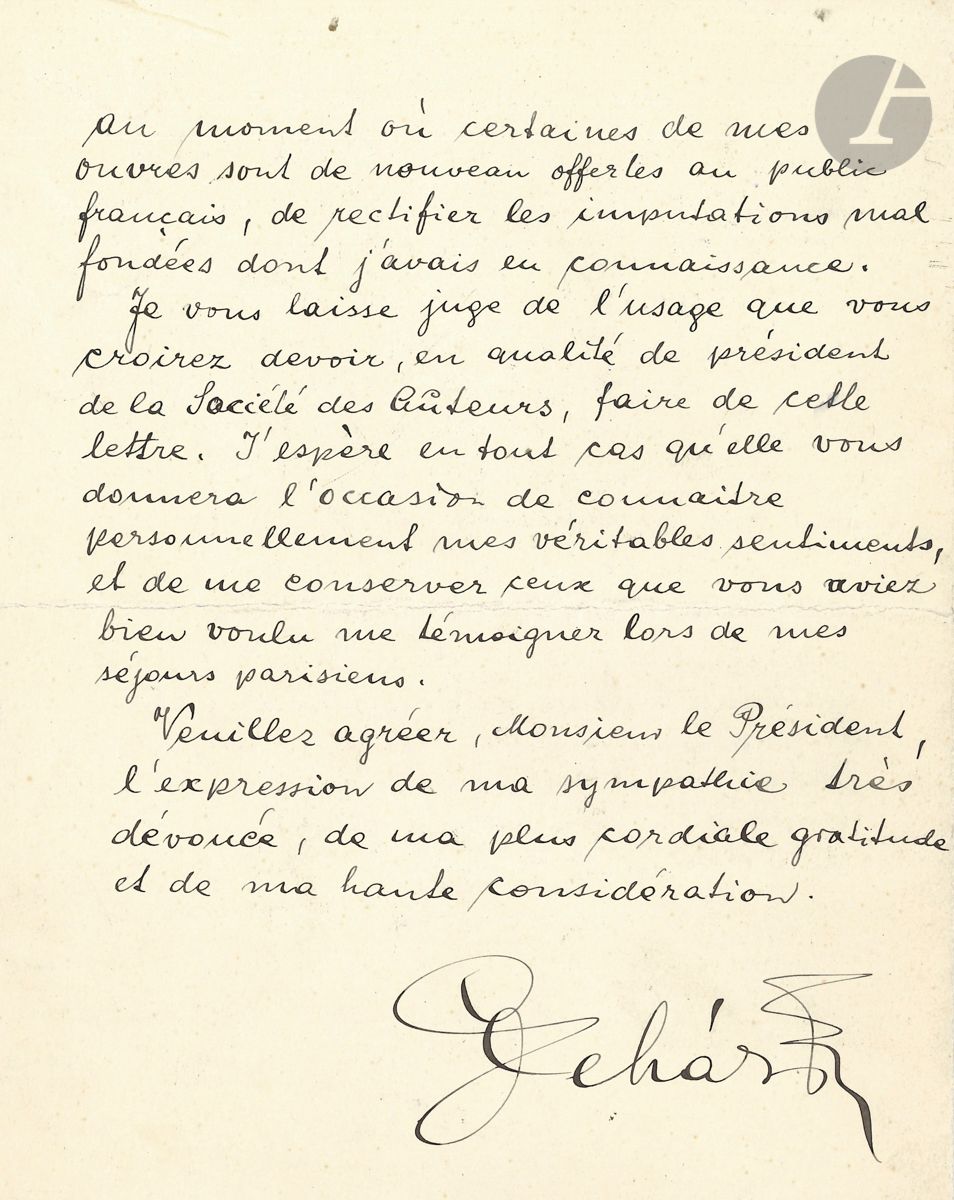
Franz LEHÁR (1870-1948). L.A.S., Wien February 12, 1922, to Robert de Flers; 4 pages in-8 on his letterhead; in French. Protest against slander and attacks against him by Henri Christiné. [Robert de Flers, then President of the Société des Auteurs et Compositeurs dramatiques, had written the French adaptation of the libretti for two famous Lehar operettas, La Veuve Joyeuse and Le Comte de Luxembourg]. He learned that various slanderous rumors were being spread against me in France, and that certain newspapers had even echoed attacks on my person and my honor as an artist. It is not my place here to defend the cause of the so-called Viennese operetta; I can only speak of my own, and if my music displeases the distinguished author of Phi-Phi [Christiné], I am sorry, but it is better for both of us if his and mine are different enough for the public to realize this easily. As for his attitude during the war, he denies having given his signature to any political manifesto directed against France, and he was not mobilized against France; at most he was, at the beginning of his career, a military music conductor ... As for my nationality, I have never changed it, and it was not I who divided up the former Austria-Hungary, which was my great homeland. My father came from Sternberg (Moravia, now Czechoslovakia), and that's where I always had my birthright. I was born in Komárom, a town in the Kingdom of Hungary, now Czechoslovakia ....
Estimate
€300 - €400
Result
€390
Buyer's premium
28%
Franz LEHÁR (1870-1948). L.A.S., Wien February 12, 1922, to Robert de Flers; 4 pages in-8 on his letterhead; in French. Protest against slander and attacks against him by Henri Christiné. [Robert de Flers, then President of the Société des Auteurs et Compositeurs dramatiques, had written the French adaptation of the libretti for two famous Lehar operettas, La Veuve Joyeuse and Le Comte de Luxembourg]. He learned that various slanderous rumors were being spread against me in France, and that certain newspapers had even echoed attacks on my person and my honor as an artist. It is not my place here to defend the cause of the so-called Viennese operetta; I can only speak of my own, and if my music displeases the distinguished author of Phi-Phi [Christiné], I am sorry, but it is better for both of us if his and mine are different enough for the public to realize this easily. As for his attitude during the war, he denies having given his signature to any political manifesto directed against France, and he was not mobilized against France; at most he was, at the beginning of his career, a military music conductor ... As for my nationality, I have never changed it, and it was not I who divided up the former Austria-Hungary, which was my great homeland. My father came from Sternberg (Moravia, now Czechoslovakia), and that's where I always had my birthright. I was born in Komárom, a town in the Kingdom of Hungary, now Czechoslovakia ....
Sale
Wednesday 28 February 2024・14:00 (Europe/Paris)
Sale location coming soon
3, rue Favart
75002 Paris