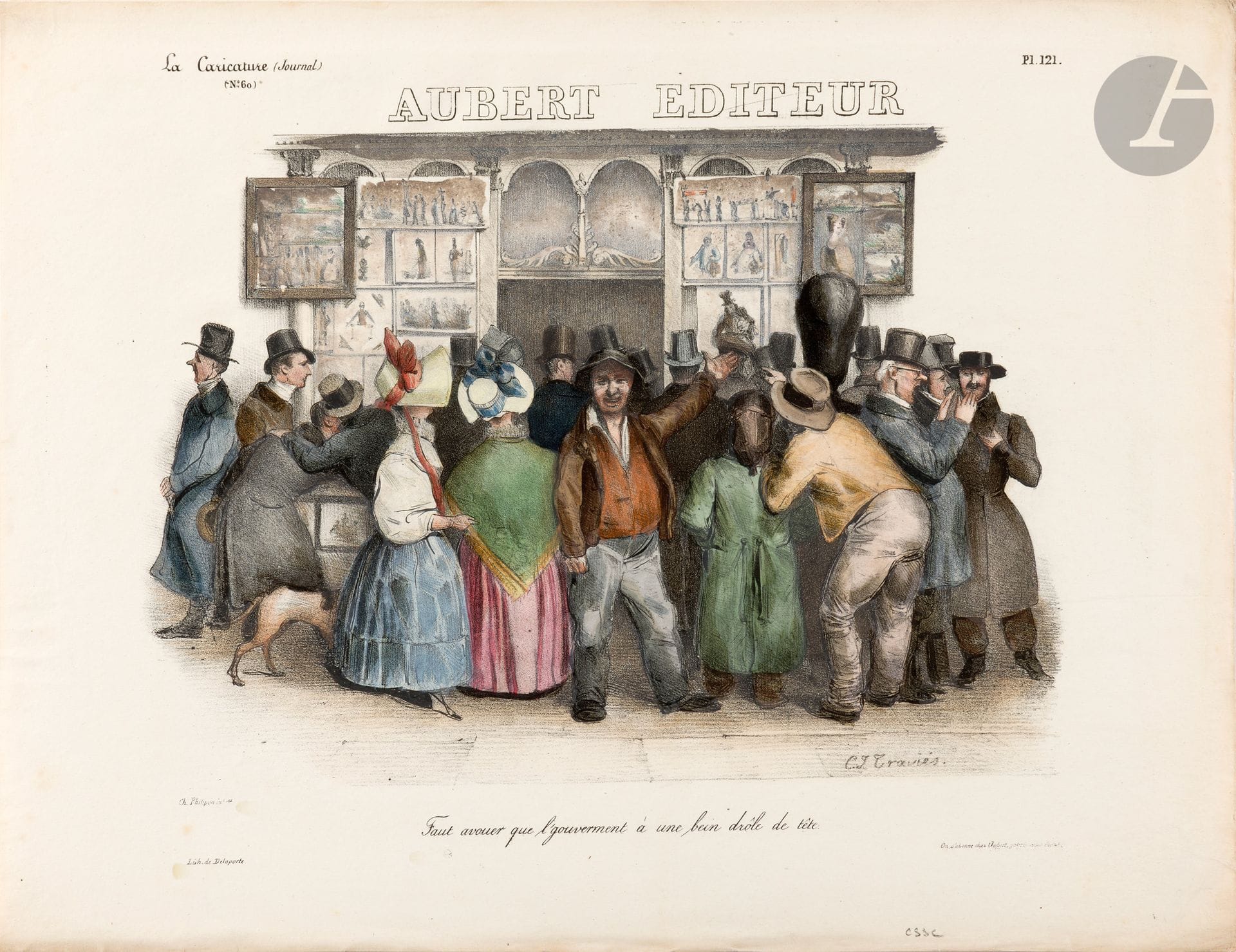
Charles-Joseph Traviès de Villers, known as Traviès (1804-1859) Faut avouer que l'gouvernement à une bein drôle de tête (Aubert's window). 1831. Lithograph. 267 x 192. Beraldi, vol. XII, p. 149; Coll. de Vinck 13264. Very fine proof on white vellum, in beautiful gummed colors. Slight oxidation to the edges of the folio. Full margins. Plate published in La Caricature, no. 60 (pl. 121, December 22, 1831). "The Auberts joined forces with Charles Philipon to publish prints on December 14, 1829, and soon put on sale, first in collaboration with Hautecoeur Martinet, an album for children, then lithographs of the light-hearted nature Philipon had been producing for several years [...]. From August 1830, this production took on a political character, attacking the fallen regime, and then, in January 1831, that of Louis-Philippe. At the "magasin des Caricatures d'Aubert", Aubert managed subscriptions and marketed lithographs for the satirical magazines run by Philipon: La Caricature (November 30, 1830), then Le Charivari (October 1832), of lesser material quality, but more aggressive. As such, in 1831-1832, he found himself indicted 4 times, along with the authors of the cartoons, and Delaporte the printer. Although Aubert and Delaporte were acquitted at the first trials, as the courts became increasingly severe towards the satirical press after the "pear" affair, Aubert was sentenced along with Daumier and Delaporte to 6 months' imprisonment (not served for Aubert) and a 500 F fine on January 7, 1832 for a lithograph published in La Caricature, depicting Louis-Philippe as Gargantua swallowing the money of the poor. Philipon himself, but also Monnier, Grandville, Alophe, Raffet, Daumier, Traviès, Pigal multiplied the satirical charges printed by Langlumé and above all his successor Delaporte, Ratier and his successor Delaunois, Becquet." (École Nationale des Chartes, online, Dictionnaire des imprimeurs-lithographes du XIXe siècle, article Aubert Gabriel). "Like Charlet, with whom he was close and who influenced him, and Daumier, with whom he was linked, Traviès was so interested in the lithographic medium that he made the print store the subject of one of his drawings: Faut avouer que l'gouvernement a une bein drôle de tête was published in La Caricature in December 1831, a period of political unrest and press freedom. The plate shows a crowd in front of Aubert's famous store, Galerie Véro-Dodat. Aubert was the brother-in-law and nominee of Charles Philipon, director of La Caricature and Le Charivari. Philipon signed the lithograph in question with Traviès, whose title alludes to Philipon's famous sketch of Louis-Philippe in a pear, during his trial on November 14, 1831, a drawing that was reproduced in a lithograph published in La Caricature. In the Traviès print window, we recognize two famous caricatures by Grandville, another of his friends and Philipon's spadassins, L'ordre règne à Varsovie and L'ordre public règne aussi à Paris, put on sale following the repression of the Polish revolution by Russian troops and the fall of Warsaw on September 3, 1831, followed by riots in Paris against the government's inaction." (Antoine Compagnon, "Traviès de Villers, 'prince du guignon'", in Colloque Baudelaire et les arts, Académie des beaux-arts, online).
Estimate
€200 - €300
Result
€448
Buyer's premium
28%
Charles-Joseph Traviès de Villers, known as Traviès (1804-1859)
Faut avouer que l'gouvernement à une bein drôle de tête (Aubert's window). 1831. Lithograph. 267 x 192. Beraldi, vol. XII, p. 149; Coll. de Vinck 13264. Very fine proof on white vellum, in beautiful gummed colors. Slight oxidation to the edges of the folio. Full margins.
Plate published in La Caricature, no. 60 (pl. 121, December 22, 1831).
"The Auberts joined forces with Charles Philipon to publish prints on December 14, 1829, and soon put on sale, first in collaboration with Hautecoeur Martinet, an album for children, then lithographs of the light-hearted nature Philipon had been producing for several years [...]. From August 1830, this production took on a political character, attacking the fallen regime, and then, in January 1831, that of Louis-Philippe. At the "magasin des Caricatures d'Aubert", Aubert managed subscriptions and marketed lithographs for the satirical magazines run by Philipon: La Caricature (November 30, 1830), then Le Charivari (October 1832), of lesser material quality, but more aggressive. As such, in 1831-1832, he found himself indicted 4 times, along with the authors of the cartoons, and Delaporte the printer. Although Aubert and Delaporte were acquitted at the first trials, as the courts became increasingly severe towards the satirical press after the "pear" affair, Aubert was sentenced along with Daumier and Delaporte to 6 months' imprisonment (not served for Aubert) and a 500 F fine on January 7, 1832 for a lithograph published in La Caricature, depicting Louis-Philippe as Gargantua swallowing the money of the poor. Philipon himself, but also Monnier, Grandville, Alophe, Raffet, Daumier, Traviès, Pigal multiplied the satirical charges printed by Langlumé and above all his successor Delaporte, Ratier and his successor Delaunois, Becquet." (École Nationale des Chartes, online, Dictionnaire des imprimeurs-lithographes du XIXe siècle, article Aubert Gabriel).
"Like Charlet, with whom he was close and who influenced him, and Daumier, with whom he was linked, Traviès was so interested in the lithographic medium that he made the print store the subject of one of his drawings: Faut avouer que l'gouvernement a une bein drôle de tête was published in La Caricature in December 1831, a period of political unrest and press freedom. The plate shows a crowd in front of Aubert's famous store, Galerie Véro-Dodat. Aubert was the brother-in-law and nominee of Charles Philipon, director of La Caricature and Le Charivari. Philipon signed the lithograph in question with Traviès, whose title alludes to Philipon's famous sketch of Louis-Philippe in a pear, during his trial on November 14, 1831, a drawing that was reproduced in a lithograph published in La Caricature. In the Traviès print window, we recognize two famous caricatures by Grandville, another of his friends and Philipon's spadassins, L'ordre règne à Varsovie and L'ordre public règne aussi à Paris, put on sale following the repression of the Polish revolution by Russian troops and the fall of Warsaw on September 3, 1831, followed by riots in Paris against the government's inaction." (Antoine Compagnon, "Traviès de Villers, 'prince du guignon'", in Colloque Baudelaire et les arts, Académie des beaux-arts, online).
Sale
Wednesday 29 November 2023・14:00 (Europe/Paris)
Sale location coming soon
3, rue Favart
75002 Paris