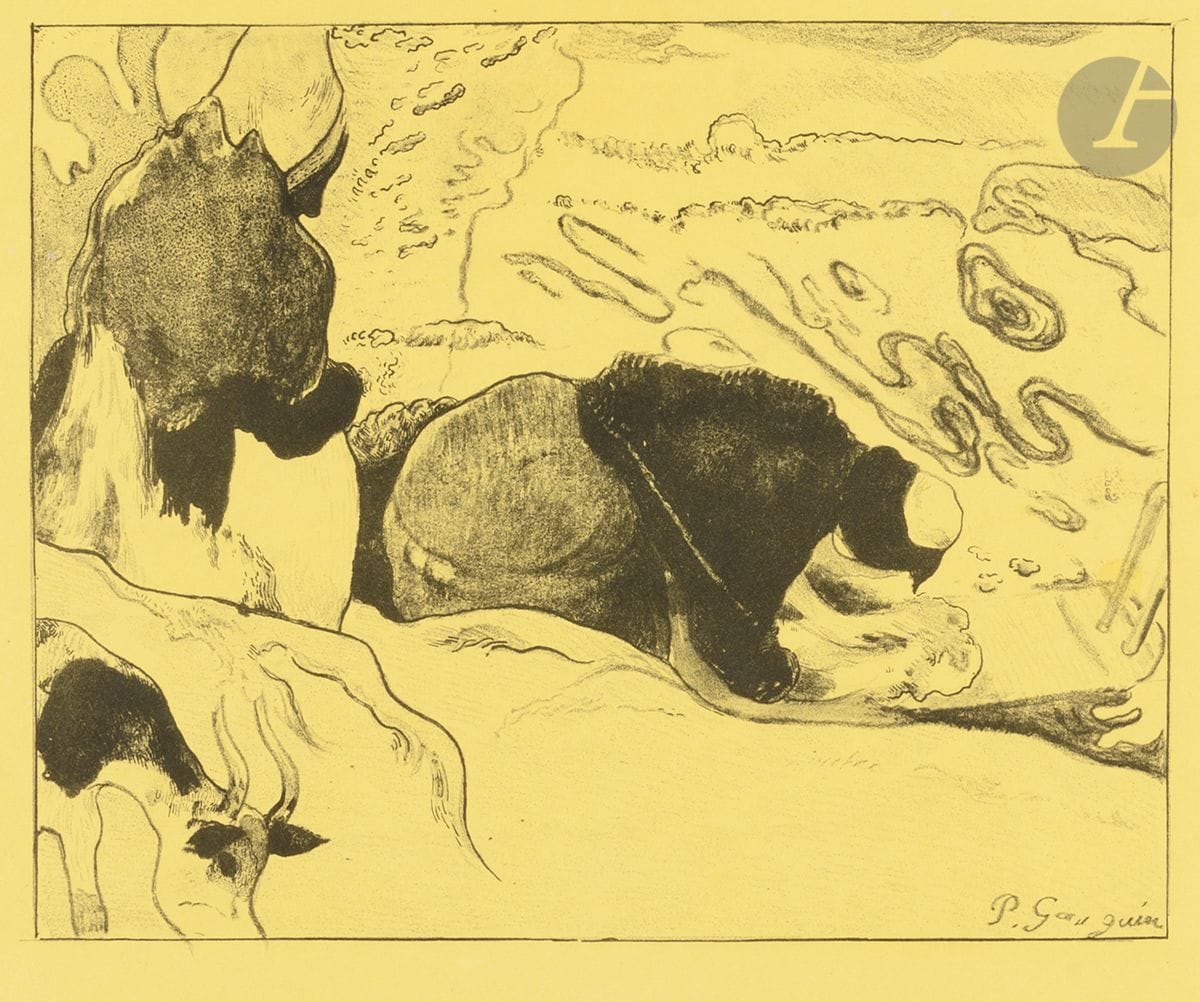
Paul Gauguin (1848-1903) The Washerwomen. 1889. Zinc print. 260 x 208. Mongan, Kornfeld and Joachim 10. A very fine proof of the 1st edition made by Ancourt, on canary yellow vellum. Two light marginal foxings. A small fractured indentation in the upper margin. Short tear at right edge. Full margins [630 x 478]. Edition indeterminate (30 or 50 proofs). Stamp R. T. This print appeared in the following exhibitions: Cent ans d'estampes en Bretagne, Le Faouët, 1998 (reproduced in the catalog under no. 160); Before and After Gauguin, Atlanta, 2008. "On his return to Paris [after his stay in Arles with Van Gogh], Gauguin began a series of prints destined for publication. In mid-February 1889, he returned to Pont-Aven and stayed there until mid-April, when he returned to Paris to prepare for the Impressionist and Symbolist exhibition at the Café Volpini. He presented seventeen canvases, as well as a joint album of zincographs with Emile Bernard, "available on request". In June, he returned to Pont-Aven...". (M. Grivel, ed., Gauguin et l'École de Pont-Aven, exhibition catalog, Paris, Bibliothèque nationale, 1989, p. 29). "The very conception of the album of lithographs, exhibited "on request" at the Café Volpini in 1889, can be compared with the revival of the "album" in the 1880s-1900s, in the style of the lithographic albums of the 1820s-1830s. Following Odilon Redon and his Tentation de saint Antoine (1888), Gauguin presents a suite of eleven Dessins lithographiques. He explains his purpose very well in a letter written to Vincent Van Gogh on January 20 (?) 1889, three weeks after the tragedy in Arles: "Now that I have a studio in which to sleep [25, avenue de Montsouris], I'm going to get down to work. I've started a series of lithographs to be published in order to make myself known. It is after the advice and under the auspices of your brother. [...]: he thus sees printmaking as a means of conveying his ideas, rather than as an original work in itself. Around February 20, he completed his album [...] It was printed by Edward Ancourt, born in 1842 and based at 8, rue du Faubourg Saint-Denis, with an edition of around fifty proofs. Gauguin chose a brilliant canary-yellow paper. The choice of this rather garish medium has been likened to the commercial posters published in the 1870s and 1880s. And perhaps Gauguin's desire to advertise in his zincographs was clearly to promote his work...". (M. Grivel, ed., Gauguin et l'École de Pont-Aven, exhibition catalog, Paris, Bibliothèque nationale, 1989, p. 31).
Estimate
€6,000 - €8,000
Result
€17,280
Buyer's premium
28%
Paul Gauguin (1848-1903)
The Washerwomen. 1889. Zinc print. 260 x 208. Mongan, Kornfeld and Joachim 10. A very fine proof of the 1st edition made by Ancourt, on canary yellow vellum. Two light marginal foxings. A small fractured indentation in the upper margin. Short tear at right edge. Full margins [630 x 478]. Edition indeterminate (30 or 50 proofs). Stamp R. T.
This print appeared in the following exhibitions: Cent ans d'estampes en Bretagne, Le Faouët, 1998 (reproduced in the catalog under no. 160); Before and After Gauguin, Atlanta, 2008.
"On his return to Paris [after his stay in Arles with Van Gogh], Gauguin began a series of prints destined for publication. In mid-February 1889, he returned to Pont-Aven and stayed there until mid-April, when he returned to Paris to prepare for the Impressionist and Symbolist exhibition at the Café Volpini. He presented seventeen canvases, as well as a joint album of zincographs with Emile Bernard, "available on request". In June, he returned to Pont-Aven...". (M. Grivel, ed., Gauguin et l'École de Pont-Aven, exhibition catalog, Paris, Bibliothèque nationale, 1989, p. 29).
"The very conception of the album of lithographs, exhibited "on request" at the Café Volpini in 1889, can be compared with the revival of the "album" in the 1880s-1900s, in the style of the lithographic albums of the 1820s-1830s. Following Odilon Redon and his Tentation de saint Antoine (1888), Gauguin presents a suite of eleven Dessins lithographiques. He explains his purpose very well in a letter written to Vincent Van Gogh on January 20 (?) 1889, three weeks after the tragedy in Arles: "Now that I have a studio in which to sleep [25, avenue de Montsouris], I'm going to get down to work. I've started a series of lithographs to be published in order to make myself known. It is after the advice and under the auspices of your brother. [...]: he thus sees printmaking as a means of conveying his ideas, rather than as an original work in itself. Around February 20, he completed his album [...] It was printed by Edward Ancourt, born in 1842 and based at 8, rue du Faubourg Saint-Denis, with an edition of around fifty proofs. Gauguin chose a brilliant canary-yellow paper. The choice of this rather garish medium has been likened to the commercial posters published in the 1870s and 1880s. And perhaps Gauguin's desire to advertise in his zincographs was clearly to promote his work...". (M. Grivel, ed., Gauguin et l'École de Pont-Aven, exhibition catalog, Paris, Bibliothèque nationale, 1989, p. 31).
Sale
Wednesday 20 September 2023・14:30 (Europe/Paris)
Sale location coming soon
3, rue Favart
75002 Paris