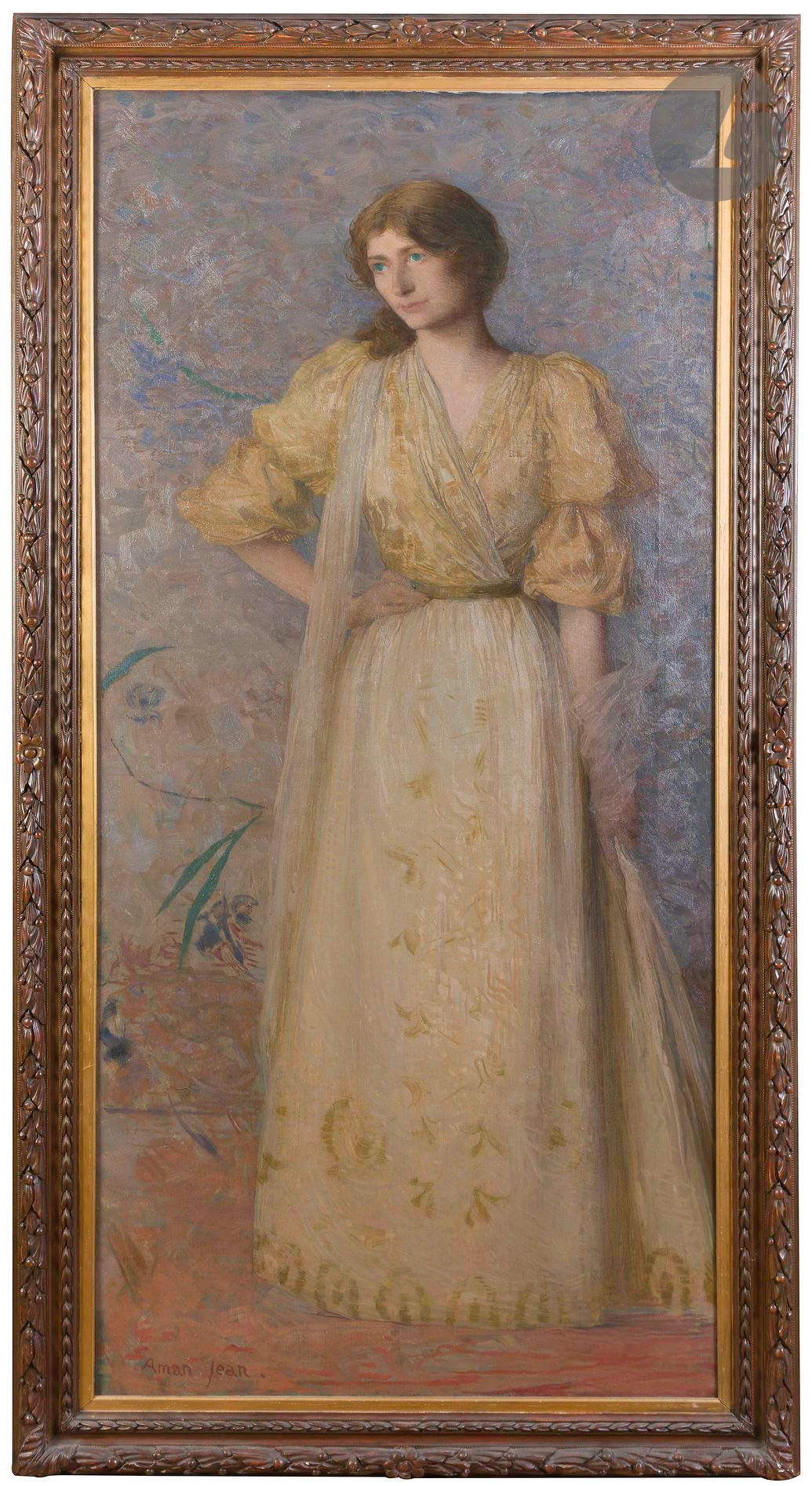
Edmond AMAN-JEAN (Chevry-Cossigny, 1860 - Paris, 1936) Young girl with a dress and a veil Oil on canvas. Signed lower left. 178 x 79,5 cm Exhibitions : - Salon de la Société Nationale des Beaux-Arts, Paris, 1893, n° 11. - Internationalen Kunst-Austellung des Vereins bildener Künstler Münchens (A.V.) " Secession ", Munich, 1893, n° 6b (fragment of label on the back). Bibliography: - Raoul Sertat, Revue artistique. Le Salon du Champ de mars, Revue Encyclopédique, recueil documentaire et illustré, Paris, June 1, 1893, reproduced on pp. 325-326. - Henri Bouchot, Les Salons de 1893, Gazette des Beaux-Arts, 1 June 1893, reproduced on p. 479. - Georges Cochet, La Peinture à Munich, Sécession, L'œuvre d'art, 20 September 1893, reproduced p. 2 - Patrick-Gilles Persin, Aman-Jean: peintre de la femme, Paris, Solange Thierry Editeur/Bibliothèque des Arts, 1993, n° 118, reproduced p. 93. Aman-Jean was a student of Henri Lehmann at the École des Beaux-Arts in Paris. There he met Alphonse Osbert, Alexandre Séon and Georges Seurat, who left several portraits of him and with whom he shared a studio. Thanks to a travel grant obtained in 1886, Aman-Jean visited Italy where Henri Martin and Ernest Laurent accompanied him. The discovery of the Ancients oriented his art and favored a taste for decoration that was further reinforced by his proximity to Puvis de Chavannes. A sense of monumentality, subdued chromaticism and idealist inspiration characterize his first period, influenced by the blossoming of the symbolist movement. Aman-Jean exhibited at the Salon but also participated from the outset in the Salons de la Rose+Croix organized from 1892 to 1897 by the "Sâr" Joséphin Péladan. Considered a "painter of the soul", he frequented literary circles and left one of the most beautiful portraits of Paul Verlaine. Interested in the neo-impressionist theories of Seurat, Aman-Jean then practiced a very personal art, which combines chromatic research and allegories. He participated in the Munich Secession in 1893. Although the painter subsequently produced several monumental decorations, his art evolved towards a greater intimacy. Paintings and pastels evoke a feminine universe full of reverie and charm where one recognizes his loved ones transcended by a very "Verlainian" poetry. This large painting representing a young girl standing seems to be more a symbolist evocation than a simple portrait. Aman-Jean expresses more an emotion and an age of life than he wishes to represent a model in particular. When commenting in the Gazette des Beaux-Arts on the painter's submission to the Salon, Henri Bouchot praised: "the tenderized and respectful thought of Aman-Jean, the immaterial charm and the soft and almost uniform practice" and described "figures preserved just to mark the soul." Very close by its invoice of The Young Woman with the Peacock (1895) preserved in the Museum of Decorative Arts in Paris, this canvas is indeed part of an aesthetic inspired by the fresco: attenuation of the depth, decorative research and chromatic subtlety contribute to a "painting of the soul" freed from any anecdote.
Estimate
€10,000 - €15,000
Result
€12,800
Buyer's premium
28%
Edmond AMAN-JEAN (Chevry-Cossigny, 1860 - Paris, 1936)
Young girl with a dress and a veil
Oil on canvas.
Signed lower left.
178 x 79,5 cm
Exhibitions :
- Salon de la Société Nationale des Beaux-Arts, Paris, 1893, n° 11.
- Internationalen Kunst-Austellung des Vereins bildener Künstler Münchens (A.V.) " Secession ", Munich, 1893, n° 6b (fragment of label on the back).
Bibliography:
- Raoul Sertat, Revue artistique. Le Salon du Champ de mars, Revue Encyclopédique, recueil documentaire et illustré, Paris, June 1, 1893, reproduced on pp. 325-326.
- Henri Bouchot, Les Salons de 1893, Gazette des Beaux-Arts, 1 June 1893, reproduced on p. 479.
- Georges Cochet, La Peinture à Munich, Sécession, L'œuvre d'art, 20 September 1893, reproduced p. 2
- Patrick-Gilles Persin, Aman-Jean: peintre de la femme, Paris, Solange Thierry Editeur/Bibliothèque des Arts, 1993, n° 118, reproduced p. 93.
Aman-Jean was a student of Henri Lehmann at the École des Beaux-Arts in Paris. There he met Alphonse Osbert, Alexandre Séon and Georges Seurat, who left several portraits of him and with whom he shared a studio. Thanks to a travel grant obtained in 1886, Aman-Jean visited Italy where Henri Martin and Ernest Laurent accompanied him. The discovery of the Ancients oriented his art and favored a taste for decoration that was further reinforced by his proximity to Puvis de Chavannes. A sense of monumentality, subdued chromaticism and idealist inspiration characterize his first period, influenced by the blossoming of the symbolist movement. Aman-Jean exhibited at the Salon but also participated from the outset in the Salons de la Rose+Croix organized from 1892 to 1897 by the "Sâr" Joséphin Péladan. Considered a "painter of the soul", he frequented literary circles and left one of the most beautiful portraits of Paul Verlaine. Interested in the neo-impressionist theories of Seurat, Aman-Jean then practiced a very personal art, which combines chromatic research and allegories. He participated in the Munich Secession in 1893. Although the painter subsequently produced several monumental decorations, his art evolved towards a greater intimacy. Paintings and pastels evoke a feminine universe full of reverie and charm where one recognizes his loved ones transcended by a very "Verlainian" poetry.
This large painting representing a young girl standing seems to be more a symbolist evocation than a simple portrait. Aman-Jean expresses more an emotion and an age of life than he wishes to represent a model in particular. When commenting in the Gazette des Beaux-Arts on the painter's submission to the Salon, Henri Bouchot praised: "the tenderized and respectful thought of Aman-Jean, the immaterial charm and the soft and almost uniform practice" and described "figures preserved just to mark the soul." Very close by its invoice of The Young Woman with the Peacock (1895) preserved in the Museum of Decorative Arts in Paris, this canvas is indeed part of an aesthetic inspired by the fresco: attenuation of the depth, decorative research and chromatic subtlety contribute to a "painting of the soul" freed from any anecdote.
Sale
Tuesday 21 March 2023・14:00 (Europe/Paris)
Salle 9 - Hôtel Drouot
9, rue Drouot
75009 Paris