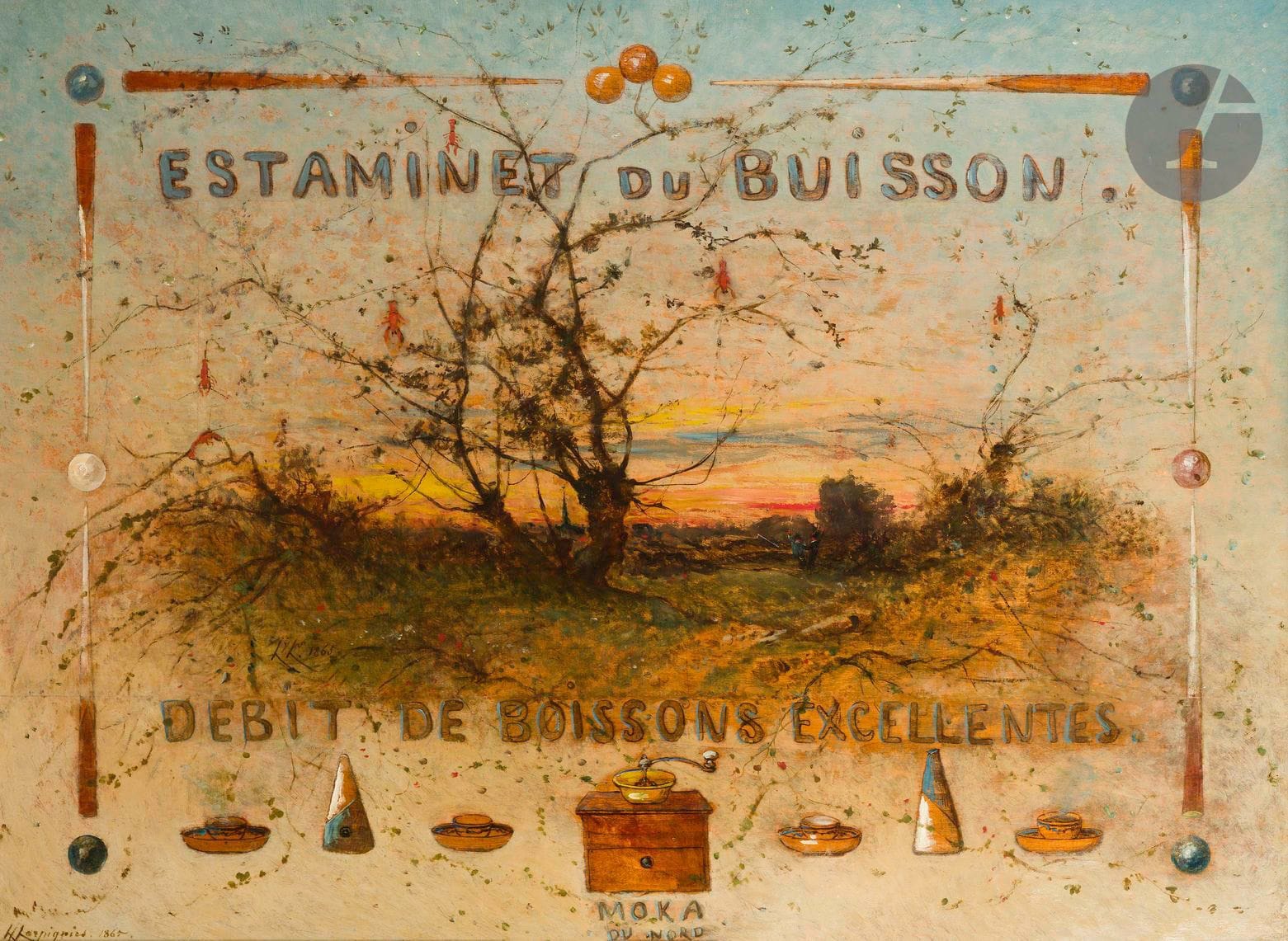
Henri-Joseph HARPIGNIES (Valenciennes, 1819 - Saint-Privé, 1916) Sign of the Estaminet du Buisson, 1865 Oil, pen and brown ink on panel. Signed and dated lower left. Monogrammed and dated in the landscape, lower left. 78 x 105,5 cm Provenance : - Charles Freund-Deschamps (1846-1921). - His sale, Hôtel Drouot, Paris, May 10-11, 1912, n° 33. Bibliography : - Figaro, Paris, Monday, December 9, 1901, p. 1. - I. Errera, Répertoire des peintures datées, Brussels, 1921, [CR}tome II, p. 757. We thank Mr. Jean-Pierre Cappoen for the information that he transmitted to us. "This sign was that of a café run by a gentleman named Duisson. Harpignies painted a bush with crayfish hanging from its branches; around it, as a frame, cues and billiard balls, a coffee mill and other accessories remind us of the estaminet in question" in Catalogue de vente Charles Freund-Deschamps, Hotel Drouot, Paris, 10-11 May 1912, n°33. In 1865, on his return from Italy, Harpignies decided to spend the summer with his nanny in Maresches. The activity of this small town near Valenciennes was based on the sugar industry. Every year, about twenty drinking establishments welcomed hundreds of seasonal workers who came to harvest the beets. It was probably for one of these establishments, run by a certain Mr. du Buisson, that the local boy painted this sign, the design of which he had sketched the previous year in a preparatory drawing; it summarizes the specialties of the house: billiards, coffee, as well as crayfish tasting, which was very popular at the time, and to which the painting Crayfish Seekers, exhibited in 1859, had already alluded. Harpignies did not disdain decorative works, such as these projects of fans, lampshades or firewalls, whose Japanese inspiration can be seen here in the spidery play of the brambles removed from the twilight sky. He was also responsible for the decorative panels for the Opera and the Senate staircase. This sign, unique in the artist's work, is not an isolated case. Without going back to Watteau (another Valencian!) or Chardin, we know that Prud'hon, David d'Angers, Géricault or Millet, driven by interest or friendship, have made remarkable ones. But it is the optician's sign imagined by Gérôme in 1902 on the occasion of a contest he was the instigator of, that should be compared to our painting. The central subject is surrounded by the attributes of commercial activity, and is joined by a pun that plays on the name of the establishment: in our painting, the crayfish bush, a specialty of northern France.
Estimate
€8,000 - €12,000
Result
€10,880
Buyer's premium
28%
Henri-Joseph HARPIGNIES (Valenciennes, 1819 - Saint-Privé, 1916)
Sign of the Estaminet du Buisson, 1865
Oil, pen and brown ink on panel.
Signed and dated lower left.
Monogrammed and dated in the landscape, lower left.
78 x 105,5 cm
Provenance :
- Charles Freund-Deschamps (1846-1921).
- His sale, Hôtel Drouot, Paris, May 10-11, 1912, n° 33.
Bibliography :
- Figaro, Paris, Monday, December 9, 1901, p. 1.
- I. Errera, Répertoire des peintures datées, Brussels, 1921, [CR}tome II, p. 757.
We thank Mr. Jean-Pierre Cappoen for the information that he transmitted to us.
"This sign was that of a café run by a gentleman named Duisson. Harpignies painted a bush with crayfish hanging from its branches; around it, as a frame, cues and billiard balls, a coffee mill and other accessories remind us of the estaminet in question" in Catalogue de vente Charles Freund-Deschamps, Hotel Drouot, Paris, 10-11 May 1912, n°33.
In 1865, on his return from Italy, Harpignies decided to spend the summer with his nanny in Maresches. The activity of this small town near Valenciennes was based on the sugar industry. Every year, about twenty drinking establishments welcomed hundreds of seasonal workers who came to harvest the beets. It was probably for one of these establishments, run by a certain Mr. du Buisson, that the local boy painted this sign, the design of which he had sketched the previous year in a preparatory drawing; it summarizes the specialties of the house: billiards, coffee, as well as crayfish tasting, which was very popular at the time, and to which the painting Crayfish Seekers, exhibited in 1859, had already alluded. Harpignies did not disdain decorative works, such as these projects of fans, lampshades or firewalls, whose Japanese inspiration can be seen here in the spidery play of the brambles removed from the twilight sky. He was also responsible for the decorative panels for the Opera and the Senate staircase.
This sign, unique in the artist's work, is not an isolated case. Without going back to Watteau (another Valencian!) or Chardin, we know that Prud'hon, David d'Angers, Géricault or Millet, driven by interest or friendship, have made remarkable ones. But it is the optician's sign imagined by Gérôme in 1902 on the occasion of a contest he was the instigator of, that should be compared to our painting. The central subject is surrounded by the attributes of commercial activity, and is joined by a pun that plays on the name of the establishment: in our painting, the crayfish bush, a specialty of northern France.
Sale
Tuesday 21 March 2023・14:00 (Europe/Paris)
Salle 9 - Hôtel Drouot
9, rue Drouot
75009 Paris