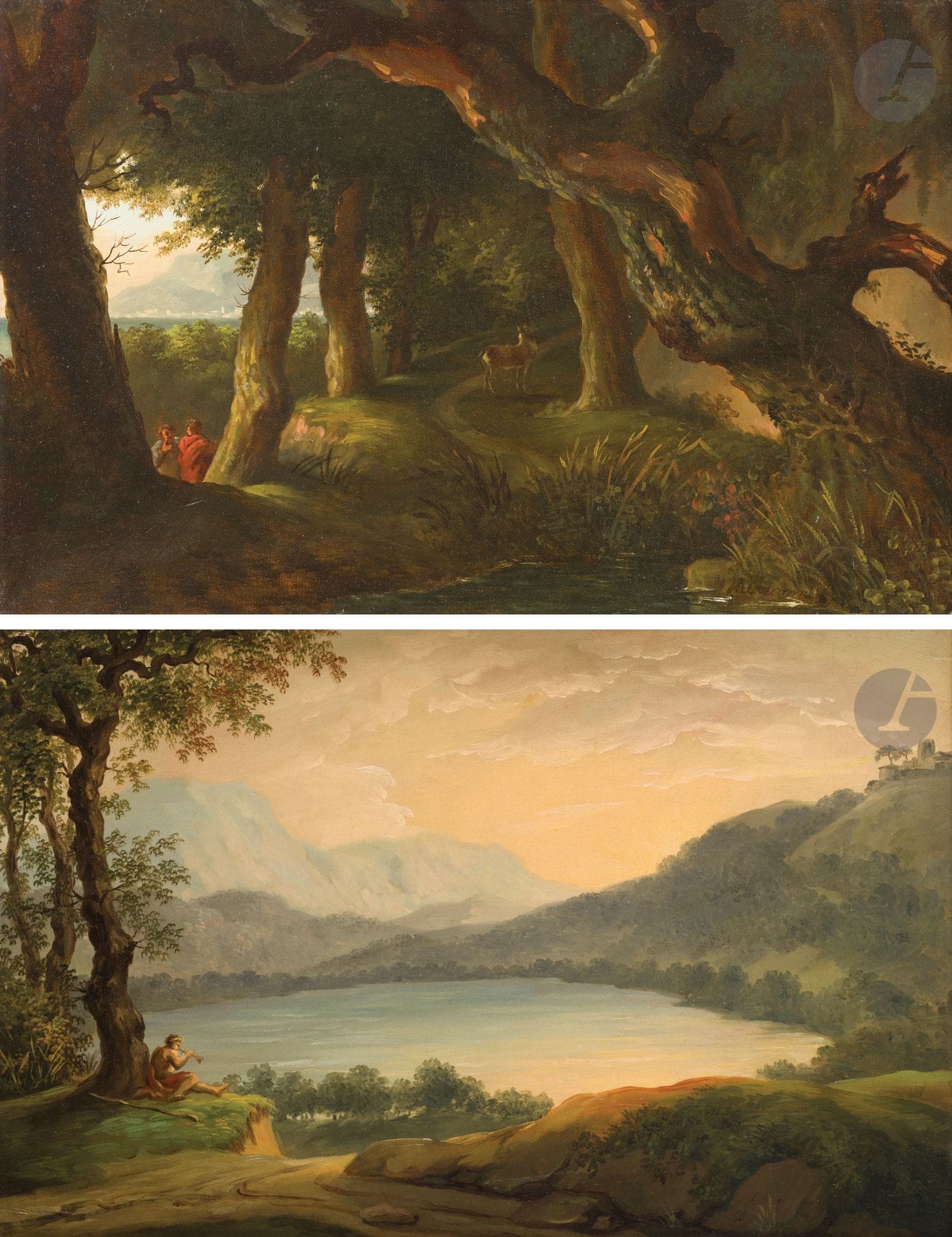
Pierre-Henri de VALENCIENNES (Toulouse, 1750 - Paris, 1819) Deer on a wooded path with two figures; View of Lake Nemi with flute player Pair of papers mounted on panels Signed lower right: Valenciennes 28,6 x 43,8 cm Handwritten label on the back on the frame: "P.H. de Valenciennes, 2 pendants belonging to Mr and Mrs Valenciennes". Provenance: - Sale of the artist's studio, Paris, April 26, 1819, part of no. 15. - Sotheby's sale, New York, 28 June 2001 (the pair) n° 182. Recognized by his contemporaries as the greatest landscape painter of his time, Pierre-Henri de Valenciennes was trained at the Toulouse Academy by Jean-Baptiste Despax and the miniaturist Guillaume Bouton. The young artist travelled through Gascony and the Pyrenees in search of picturesque sites. His early interest in ruins was due to the presence of the Dutchman Henry Ferguson in Toulouse at the beginning of the 18th century, his first stay in Italy in 1769 and his meeting with Hubert Robert in Chanteloup. After a period in Gabriel Doyen's studio, Valenciennes went back to Italy: he stayed in Rome, Naples and Sicily. Back in Paris, he met Joseph Vernet. After a third and final trip to Italy, Valenciennes settled permanently in Paris where he was admitted to the Academy (1807). From then on, he regularly presented his "historical landscapes" at the Salons. In 1812, he was appointed professor of perspective at the École des Beaux-Arts in Paris, where he created the "Historical Landscape" prize, the first winner of which was his pupil Michallon, the future master of Corot. Our painting, Stag on a Wooded Path with Two Figures, is an "adjusted" landscape as Valenciennes defines it. We can see Monte Cavo in the left background while the right part of the painting probably derives from studies made in the vicinity of Nemi (Louvre Museum, inventory RF 3016).
Estimate
€15,000 - €20,000
Result
Not sold
Buyer's premium
28%
Pierre-Henri de VALENCIENNES (Toulouse, 1750 - Paris, 1819)
Deer on a wooded path with two figures; View of Lake Nemi with flute player
Pair of papers mounted on panels
Signed lower right: Valenciennes
28,6 x 43,8 cm
Handwritten label on the back on the frame: "P.H. de Valenciennes, 2 pendants belonging to Mr and Mrs Valenciennes".
Provenance:
- Sale of the artist's studio, Paris, April 26, 1819, part of no. 15.
- Sotheby's sale, New York, 28 June 2001 (the pair) n° 182.
Recognized by his contemporaries as the greatest landscape painter of his time, Pierre-Henri de Valenciennes was trained at the Toulouse Academy by Jean-Baptiste Despax and the miniaturist Guillaume Bouton. The young artist travelled through Gascony and the Pyrenees in search of picturesque sites. His early interest in ruins was due to the presence of the Dutchman Henry Ferguson in Toulouse at the beginning of the 18th century, his first stay in Italy in 1769 and his meeting with Hubert Robert in Chanteloup. After a period in Gabriel Doyen's studio, Valenciennes went back to Italy: he stayed in Rome, Naples and Sicily. Back in Paris, he met Joseph Vernet. After a third and final trip to Italy, Valenciennes settled permanently in Paris where he was admitted to the Academy (1807). From then on, he regularly presented his "historical landscapes" at the Salons. In 1812, he was appointed professor of perspective at the École des Beaux-Arts in Paris, where he created the "Historical Landscape" prize, the first winner of which was his pupil Michallon, the future master of Corot.
Our painting, Stag on a Wooded Path with Two Figures, is an "adjusted" landscape as Valenciennes defines it. We can see Monte Cavo in the left background while the right part of the painting probably derives from studies made in the vicinity of Nemi (Louvre Museum, inventory RF 3016).
Sale
Tuesday 21 March 2023・14:00 (Europe/Paris)
Salle 9 - Hôtel Drouot
9, rue Drouot
75009 Paris