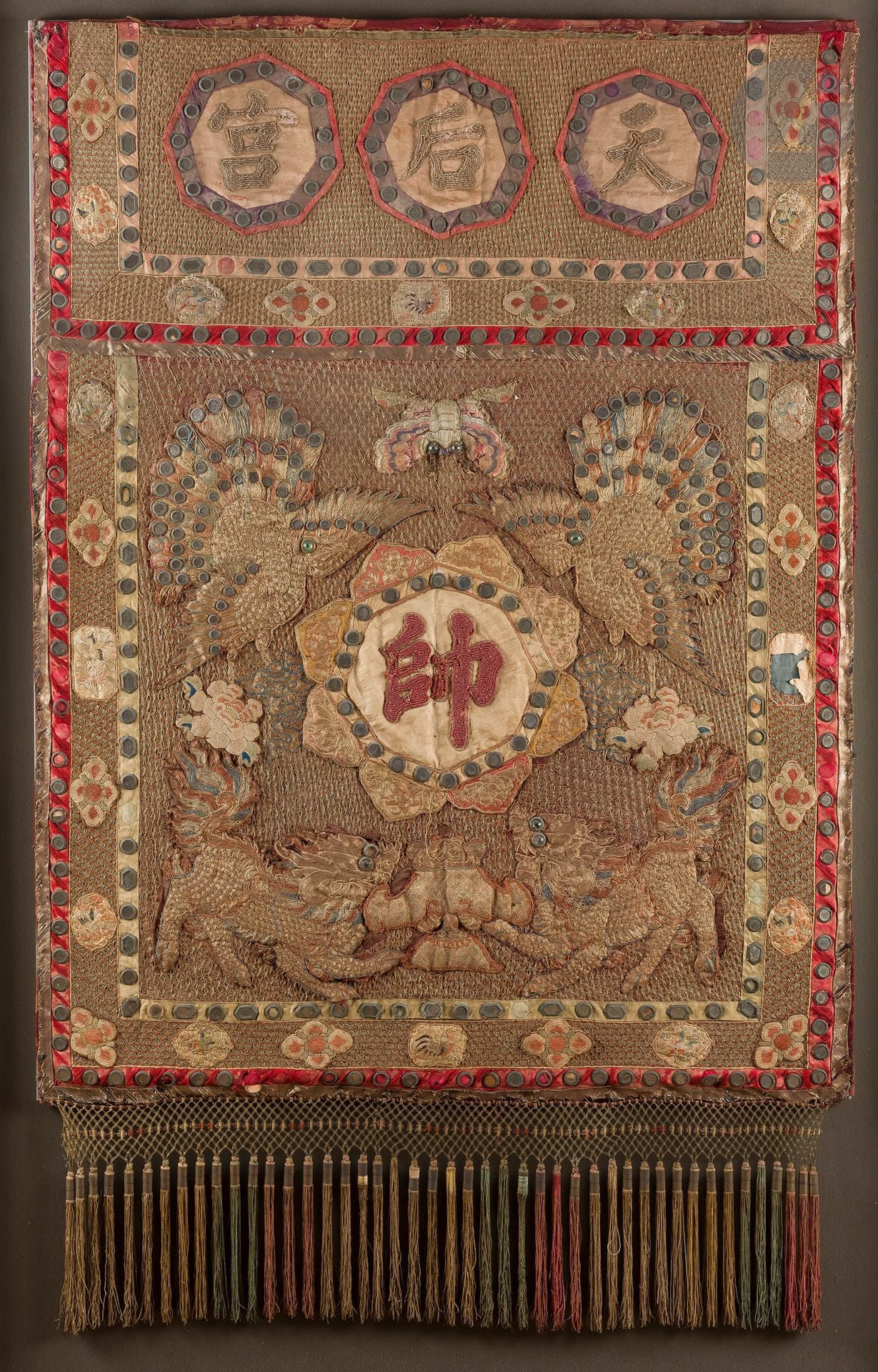
Embroidered silk high banner for Mazu worship-妈祖, Canton, China, late 19th-early 20th centuryIt is formed of two parts embroidered with gold metallic threads and polychrome silks. The upper part shows three octagonal-shaped cartouches enclosing the three characters 天 后 宫 - Tian hou gong, "Temple (Palace) of the Queen of Heaven (Mazu)", formed by small white glass beads, strung and embroidered. The lower part is embroidered in the center with an eight-petal flower with the character 帅 - shuai (army general) in the middle in small red glass beads. All around, two qilin, two peony flowers, two peacocks and a butterfly. The eyes of the animals, the plumage of the peacocks, the flower and the borders of the banner are embellished with half-spheres of colored glass or small mirrors circled with metal. The borders of the textile are decorated with medallions of various birds and flowers and the bottom with a beige silk net from which are suspended tassels of multicolored silk. This banner was probably used in temples during representations related to the Mazu cult. 143 x 90 cmWear , discoloration and missing parts . Fixed on a panel in a frame. Originally the protector of sailors, Mazu is a Chinese goddess who originated in the 10th century and whose cult extends mainly along the southern and eastern coasts of China as well as in Macao, Taiwan and Hong Kong. At the center of a multitude of beliefs and customs, including oral traditions, religious ceremonies and traditional practices, the Mazu cult is inscribed on the Representative List of Intangible Cultural Heritage of Humanity. 十九世纪晚期-二十世纪早期 彩金线刺绣钉珠丝织天后宫帅旗
Estimate
€600 - €800
Result
€1,152
Buyer's premium
28%
Embroidered silk high banner for Mazu worship-妈祖, Canton, China, late 19th-early 20th centuryIt
is formed of two parts embroidered with gold metallic threads and polychrome silks. The upper part shows three octagonal-shaped cartouches enclosing the three characters 天 后 宫 - Tian hou gong, "Temple (Palace) of the Queen of Heaven (Mazu)", formed by small white glass beads, strung and embroidered. The lower part is embroidered in the center with an eight-petal flower with the character 帅 - shuai (army general) in the middle in small red glass beads. All around, two qilin, two peony flowers, two peacocks and a butterfly. The eyes of the animals, the plumage of the peacocks, the flower and the borders of the banner are embellished with half-spheres of colored glass or small mirrors circled with metal. The borders of the textile are decorated with medallions of various birds and flowers and the bottom with a beige silk net from which are suspended tassels of multicolored silk. This banner was probably used in temples during representations related to the Mazu cult.
143 x 90 cmWear
, discoloration and missing parts
.
Fixed on a panel in a frame.
Originally the protector of sailors, Mazu is a Chinese goddess who originated in the 10th century and whose cult extends mainly along the southern and eastern coasts of China as well as in Macao, Taiwan and Hong Kong. At the center of a multitude of beliefs and customs, including oral traditions, religious ceremonies and traditional practices, the Mazu cult is inscribed on the Representative List of Intangible Cultural Heritage of Humanity.
十九世纪晚期-二十世纪早期 彩金线刺绣钉珠丝织天后宫帅旗
Sale
Tuesday 18 October 2022・14:00 (Europe/Paris)
Salle 4 - Hôtel Drouot
9, rue Drouot
75009 Paris