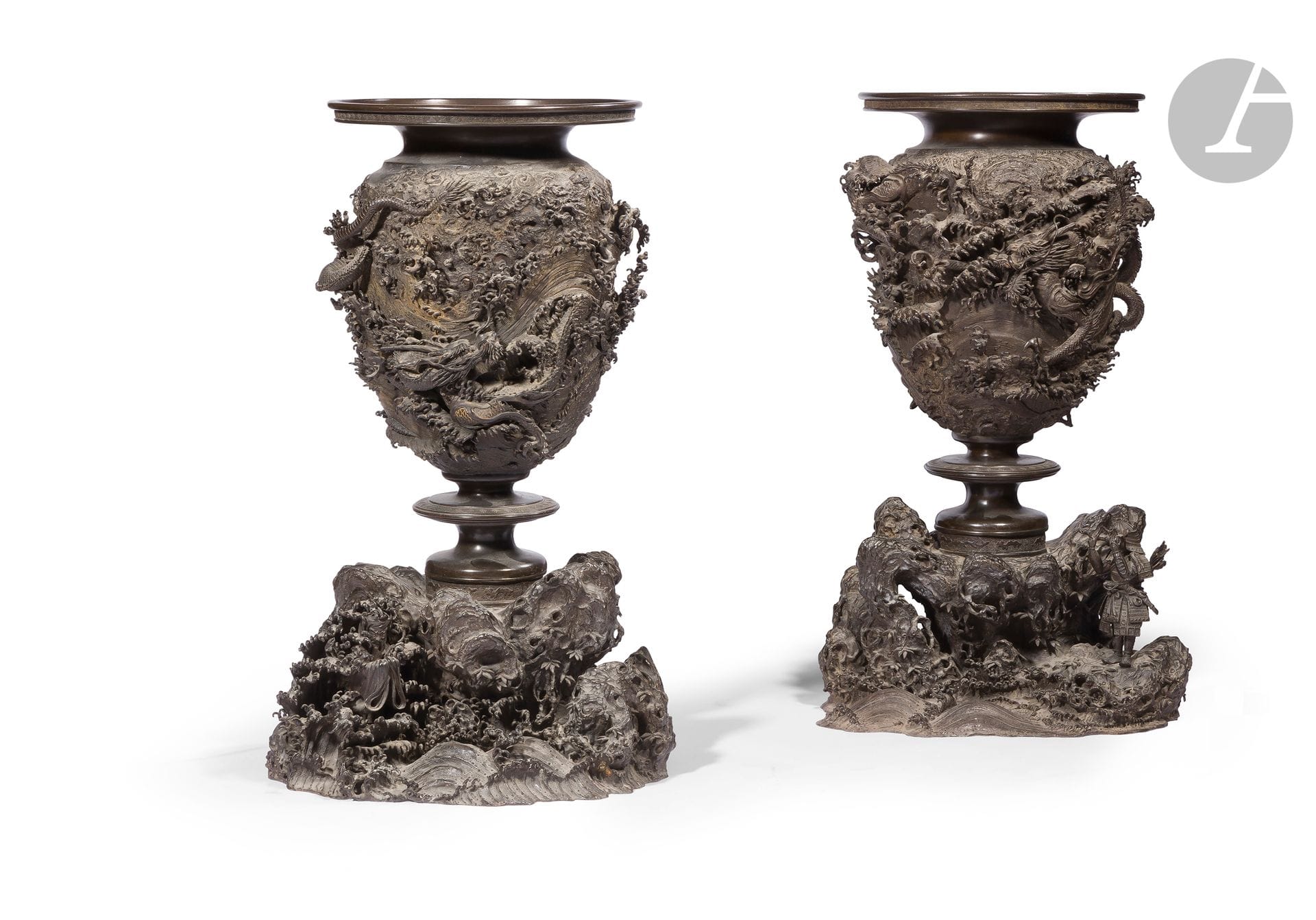
Pair of large copper alloy urns with brown patina decorated with the legend of Nitta no Yoshimasa, Japan, Meiji period (1868-1912 )Each urn is made in three parts, the top is made of a flat pavilion whose rim is decorated with a frieze of greek figures. It surmounts an ovoid body with a very high relief decoration of three dragons in the foaming waves, resting on a base made of a disc on a pedestal decorated with a frieze of Greek and stylized dragons, the whole fixed on a base in the shape of rocks and vegetation emerging from the foaming waves. In the middle of the waves on the left we recognize Ryujin, the king of the sea, while on the base of the other urn, Nitta no Yoshimasa in Inamuragasaki appears in his armor holding his sword in front of his forehead as he is about to throw it into the sea as an offering to Ryujin, in the hope of a victory against the Hôjô. The set has two signatures, one behind a rock on the bottom: Kinryusaï Gidô - 金龍斎義道造 (Suhara Yoshimichi) and another Judô (Hisamichi) zo - 壽 道造 - "made by Judô" in tensho (sigillary) characters below the top. Total height: 59 cmSome missing, one bottom resealed. Engaging in the Kamakura campaign of 1333 to defeat the Hôjô clan on the orders of Emperor Go-Daigo (1288-1339), Nitta Yoshisada (1301-1338) found himself in an insurmountable impasse. Blocked by the natural fortress constituted by the vertiginous slopes of Kamakura and the Hôjô fleet spread along the capes, obeying the order of the emperor required an extraordinary event. Yoshisada stood on the shore and looked out into the ocean, praying to the dragon god Ryujin, the all-powerful ruler of the seas. He then threw his sword into the water. Answering his call, the dragon god split the sea, allowing Yoshisada to reach the Hôjô fortress.
Estimate
€2,000 - €3,000
Result
€3,840
Buyer's premium
28%
Pair of large copper alloy urns with brown patina decorated with the legend of Nitta no Yoshimasa, Japan, Meiji period (1868-1912
)Each urn is made in three parts, the top is made of a flat pavilion whose rim is decorated with a frieze of greek figures. It surmounts an ovoid body with a very high relief decoration of three dragons in the foaming waves, resting on a base made of a disc on a pedestal decorated with a frieze of Greek and stylized dragons, the whole fixed on a base in the shape of rocks and vegetation emerging from the foaming waves. In the middle of the waves on the left we recognize Ryujin, the king of the sea, while on the base of the other urn, Nitta no Yoshimasa in Inamuragasaki appears in his armor holding his sword in front of his forehead as he is about to throw it into the sea as an offering to Ryujin, in the hope of a victory against the Hôjô. The set has two signatures, one behind a rock on the bottom: Kinryusaï Gidô - 金龍斎義道造 (Suhara Yoshimichi) and another Judô (Hisamichi) zo - 壽 道造 - "made by Judô" in tensho (sigillary) characters below the top.
Total height: 59 cmSome
missing, one bottom resealed.
Engaging in the Kamakura campaign of 1333 to defeat the Hôjô clan on the orders of Emperor Go-Daigo (1288-1339), Nitta Yoshisada (1301-1338) found himself in an insurmountable impasse. Blocked by the natural fortress constituted by the vertiginous slopes of Kamakura and the Hôjô fleet spread along the capes, obeying the order of the emperor required an extraordinary event. Yoshisada stood on the shore and looked out into the ocean, praying to the dragon god Ryujin, the all-powerful ruler of the seas. He then threw his sword into the water. Answering his call, the dragon god split the sea, allowing Yoshisada to reach the Hôjô fortress.
Sale
Tuesday 18 October 2022・14:00 (Europe/Paris)
Salle 4 - Hôtel Drouot
9, rue Drouot
75009 Paris