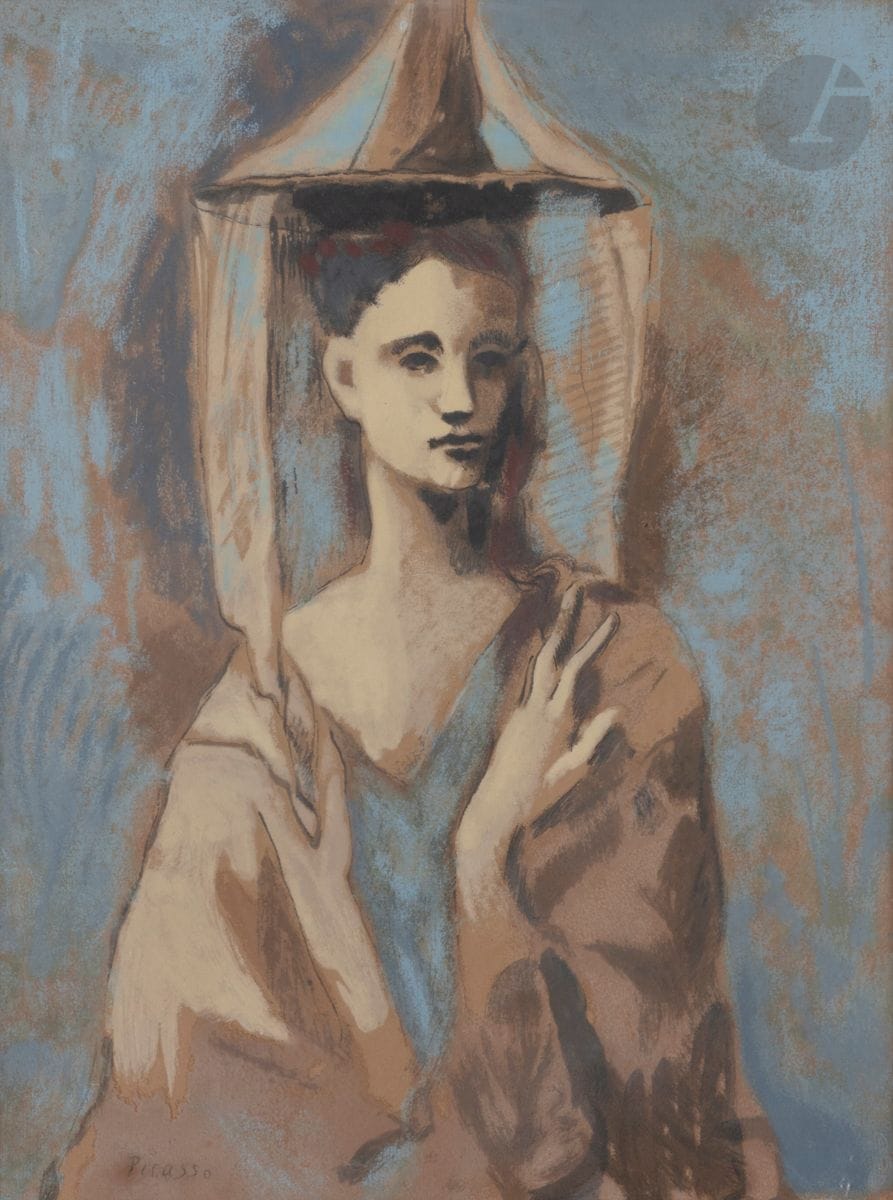
*Pablo Picasso (1881-1973) (after) Young woman of Majorca. 1954. Callichromy after a gouache by the artist in the National Museum of Fine Arts in Moscow. Sight: 59 x 45 cm. Nice proof on beige laid paper, in its original frame with a typographed proof on the back of the sheet, numbered with the compositor and initialed by the engraver Jean Bruller. Edition of 550 proofs. Label of the publisher Braun et Cie on the back of the frame. This print, intended to render the effect of the painted picture as faithfully as possible, evokes the Aeply process developed a few years earlier by Jean Fautrier and his wife Janine Aeply, which combined printmaking and flat pigment printing by means of stencils or screens as well as by hand. Henri Goetz explains how his friend, the writer Jean Bruller, known as Vercors, an engraver like himself, invented callichromy, a more elaborate variant of silkscreen printing: "For Goldschmidt, we also designed serigraphs that were printed and even executed by Vercors who became, thus, the great friend that he still is. The author of The Silence of the Sea, a former engraver and draftsman, had created a silk-screen printing company, which he perfected and named callichromy to avoid the old name of hybrid etymological origin. It was intended for his twin sons, to whom he thought a manual profession would be suitable, but callichromy did not please them. Vercors, who had always loved to work with his hands (which is exceptional for an intellectual), had produced numerous editions of prints based on works by famous artists. I am flattered to have been able to facilitate the publication of the one that reproduced a painting by Picasso, particularly successful. I was the intermediary. We were at Picasso's house, rue des Grands-Augustins, when Vercors had brought a number of prints, mounted on stretchers like the original. He spread them out at the foot of the wall and asked us to choose the original. We agreed on our choice and were convinced that the work chosen was by Picasso. We laughed a lot when we learned that he had only shown us his reproductions. He told us how Fernand Léger had examined the gouache he had brought back, remarking that he had not damaged it. Léger had had the same reaction as we did when he learned that the work he was holding in his hands was only a "callichromie" by Vercors" ("Henri Goetz par lui-même", Catalogue raisonné, tome I, first published in Les Cahiers du Musée National d'Art Moderne, 1982, Centre Georges Pompidou, Beaubourg, Paris, and on www.henrigoetz.com). See also Nathalie Gibert-Joly, " Jean Bruller-Vercors et l'imprimerie ", in Alain Riffaud (dir.), L'Écrivain et l'imprimeur, Rennes, Presses Universitaires de Rennes, Coll. Interférences, 2010, p. 337-358. ATTENTION: this lot is subject to an additional 5.5% temporary import tax.
Estimate
€1,000 - €1,200
Result
€1,280
Buyer's premium
28%
*Pablo Picasso (1881-1973) (after)
Young woman of Majorca. 1954.
Callichromy after a gouache by the artist in the National Museum of Fine Arts in Moscow. Sight: 59 x 45 cm.
Nice proof on beige laid paper, in its original frame with a typographed proof on the back of the sheet, numbered with the compositor and initialed by the engraver Jean Bruller. Edition of 550 proofs. Label of the publisher Braun et Cie on the back of the frame.
This print, intended to render the effect of the painted picture as faithfully as possible, evokes the Aeply process developed a few years earlier by Jean Fautrier and his wife Janine Aeply, which combined printmaking and flat pigment printing by means of stencils or screens as well as by hand.
Henri Goetz explains how his friend, the writer Jean Bruller, known as Vercors, an engraver like himself, invented callichromy, a more elaborate variant of silkscreen printing:
"For Goldschmidt, we also designed serigraphs that were printed and even executed by Vercors who became, thus, the great friend that he still is. The author of The Silence of the Sea, a former engraver and draftsman, had created a silk-screen printing company, which he perfected and named callichromy to avoid the old name of hybrid etymological origin. It was intended for his twin sons, to whom he thought a manual profession would be suitable, but callichromy did not please them. Vercors, who had always loved to work with his hands (which is exceptional for an intellectual), had produced numerous editions of prints based on works by famous artists. I am flattered to have been able to facilitate the publication of the one that reproduced a painting by Picasso, particularly successful. I was the intermediary. We were at Picasso's house, rue des Grands-Augustins, when Vercors had brought a number of prints, mounted on stretchers like the original. He spread them out at the foot of the wall and asked us to choose the original. We agreed on our choice and were convinced that the work chosen was by Picasso. We laughed a lot when we learned that he had only shown us his reproductions. He told us how Fernand Léger had examined the gouache he had brought back, remarking that he had not damaged it. Léger had had the same reaction as we did when he learned that the work he was holding in his hands was only a "callichromie" by Vercors" ("Henri Goetz par lui-même", Catalogue raisonné, tome I, first published in Les Cahiers du Musée National d'Art Moderne, 1982, Centre Georges Pompidou, Beaubourg, Paris, and on www.henrigoetz.com). See also Nathalie Gibert-Joly, " Jean Bruller-Vercors et l'imprimerie ", in Alain Riffaud (dir.), L'Écrivain et l'imprimeur, Rennes, Presses Universitaires de Rennes, Coll. Interférences, 2010, p. 337-358.
ATTENTION: this lot is subject to an additional 5.5% temporary import tax.
Sale
Thursday 30 June 2022・14:00 (Europe/Paris)
Salle 2 - Hôtel Drouot
9, rue Drouot
75009 Paris