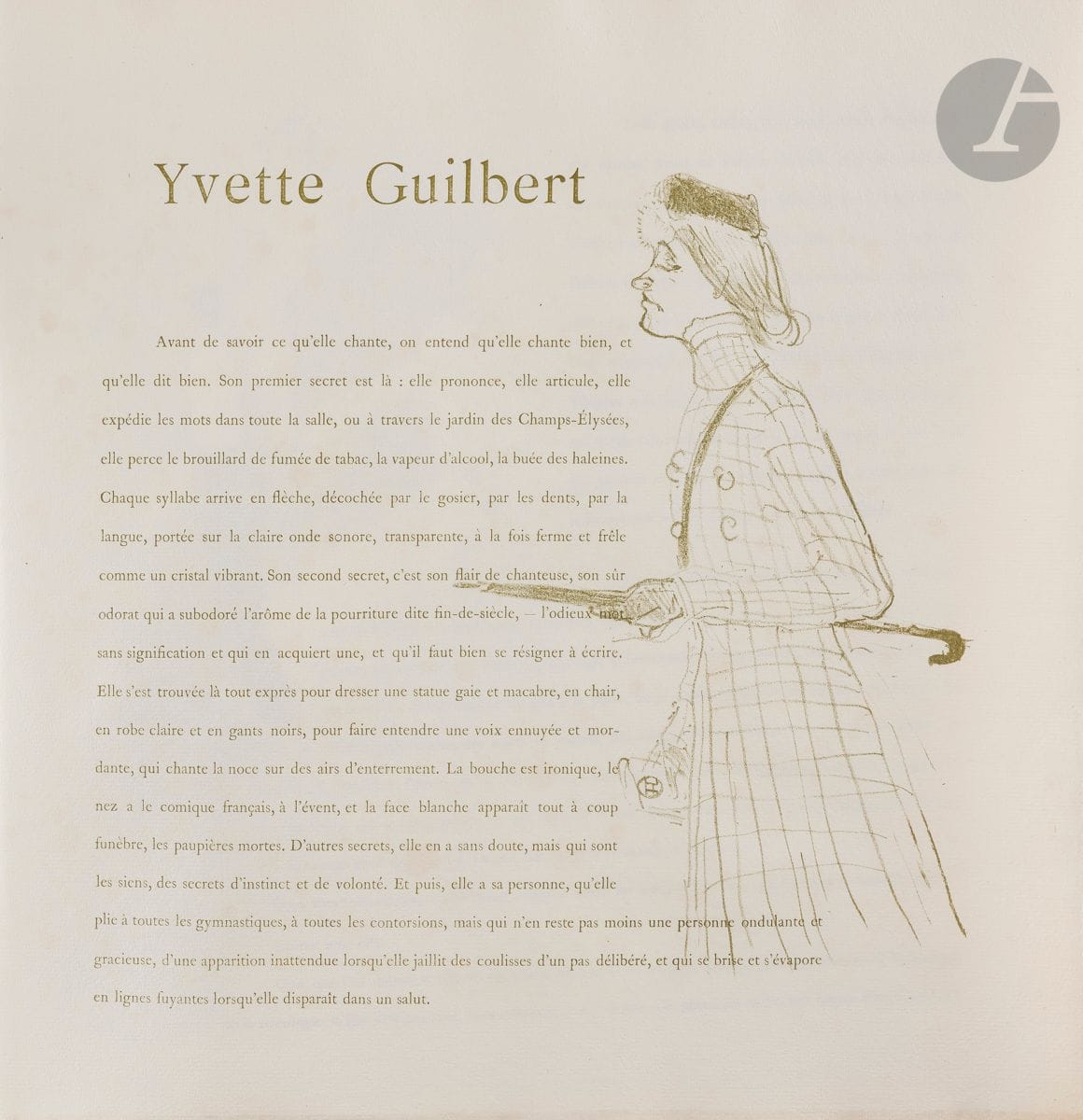
Henri de Toulouse-Lautrec (1864-1901 )Yvette Guilbert - text by G. Geffroy decorated by H. de Toulouse-Lautrec. Paris, éd. de L'Estampe originale, 1894. A large album in-4 [390 x 410], illustrated with 16 in-text lithographs printed in olive green (as is the typographed text). Delteil 79 to 85; Wittrock 69 to 85. Copy on laid paper, apart from the edition of 100 copies, bearing the typographic mention "exemplaire d'auteur", numbered in blue pencil "N° 7" and initialed by André Marty, director of L'Estampe originale. The filled leaves maintained by the original knotted ribbon. Very fresh inside. Hardcover illustrated with an olive black lithograph (faded, formerly restored )..../....../ .. . Yvette Guilbert (1865-1944) was a famous figure of the café-concert of the Belle Époque. She was a singer and reciter of realist texts written by Bruant, Donnay, Xanrof... She performed on stage wearing a long, low-cut, pale dress and long black gloves that became her trademark. It was the critic Gustave Geffroy who introduced Yvette Guilbert to Lautrec during a boating trip on the Marne. Lautrec's plates for this album "form a rather free sequence, the first showing [Yvette's arrival] at the café-concert, the last her call-back. Taken as a whole, they capture the richness of her act: the face like a mask, adaptable to multiple emotions, the neck stretched, bizarre, the eyes cunning, the whole body expressing only one gesture, describing exactly one mood." (Richard Thomson, "Observations on the Themes of Toulouse-Lautrec's Prints," in Wittrock, vol. 1, p. 30). The album was a scandalous success. The public was indignant that a café-concert diva was devoted to it. The artist's family was incensed by the performance of Yvette. "Goncourt received the album on September 2 [1894]; Geffroy and Frantz Jourdain came to give it to him, and Jean Lorrain, who was present at the time, in a very nasty article in the Echo de Paris of October 15, recalled Goncourt's "appalled expression" and assured Lautrec that "one does not have the right to push the cult of the ugly to such an extreme. I know very well that Mlle Guilbert is not a pretty woman, but to have agreed to let these portraits be published is [...] an infamy. The love of advertising has blinded Mlle Guilbert, but what has become of her self-respect and the modesty of a woman [...] You accepted, Yvette, these drawings imitated from those on the walls of the Châtelet. This print in goose-poop green and these shadows that smear your nose and chin with shit... I came home very saddened, a little disgusted, with the vague unworthy uneasiness one has when meeting a very pretty woman on the arm of a hideous lover." Yvette Guilbert was shaken by this article, which corresponded to her family's reproaches, but she let Geffroy convince her and signed the hundred copies of the album." (Adhémar, p. XIX). Other critics were favorable to Lautrec, and the artist professed his admiration for Yvette, announcing that he wanted to "make her into an antique Diana" - which made the actress laugh.
Estimate
€8,000 - €10,000
Result
€10,000
Buyer's premium
28%
Henri de Toulouse-Lautrec (1864-1901
)Yvette Guilbert - text by G. Geffroy decorated by H. de Toulouse-Lautrec. Paris, éd. de L'Estampe originale, 1894. A large album in-4 [390 x 410], illustrated with 16 in-text lithographs printed in olive green (as is the typographed text). Delteil 79 to 85; Wittrock 69 to 85. Copy on laid paper, apart from the edition of 100 copies, bearing the typographic mention "exemplaire d'auteur", numbered in blue pencil "N° 7" and initialed by André Marty, director of L'Estampe originale. The filled leaves maintained by the original knotted ribbon. Very fresh inside. Hardcover illustrated with an olive black lithograph (faded, formerly restored
)..../....../
..
.
Yvette Guilbert (1865-1944) was a famous figure of the café-concert of the Belle Époque. She was a singer and reciter of realist texts written by Bruant, Donnay, Xanrof... She performed on stage wearing a long, low-cut, pale dress and long black gloves that became her trademark. It was the critic Gustave Geffroy who introduced Yvette Guilbert to Lautrec during a boating trip on the Marne.
Lautrec's plates for this album "form a rather free sequence, the first showing [Yvette's arrival] at the café-concert, the last her call-back. Taken as a whole, they capture the richness of her act: the face like a mask, adaptable to multiple emotions, the neck stretched, bizarre, the eyes cunning, the whole body expressing only one gesture, describing exactly one mood." (Richard Thomson, "Observations on the Themes of Toulouse-Lautrec's Prints," in Wittrock, vol. 1, p. 30).
The album was a scandalous success. The public was indignant that a café-concert diva was devoted to it. The artist's family was incensed by the performance of Yvette. "Goncourt received the album on September 2 [1894]; Geffroy and Frantz Jourdain came to give it to him, and Jean Lorrain, who was present at the time, in a very nasty article in the Echo de Paris of October 15, recalled Goncourt's "appalled expression" and assured Lautrec that "one does not have the right to push the cult of the ugly to such an extreme. I know very well that Mlle Guilbert is not a pretty woman, but to have agreed to let these portraits be published is [...] an infamy. The love of advertising has blinded Mlle Guilbert, but what has become of her self-respect and the modesty of a woman [...] You accepted, Yvette, these drawings imitated from those on the walls of the Châtelet. This print in goose-poop green and these shadows that smear your nose and chin with shit... I came home very saddened, a little disgusted, with the vague unworthy uneasiness one has when meeting a very pretty woman on the arm of a hideous lover." Yvette Guilbert was shaken by this article, which corresponded to her family's reproaches, but she let Geffroy convince her and signed the hundred copies of the album." (Adhémar, p. XIX). Other critics were favorable to Lautrec, and the artist professed his admiration for Yvette, announcing that he wanted to "make her into an antique Diana" - which made the actress laugh.
Sale
Thursday 12 May 2022・14:00 (Europe/Paris)
Sale location coming soon
3, rue Favart
75002 Paris