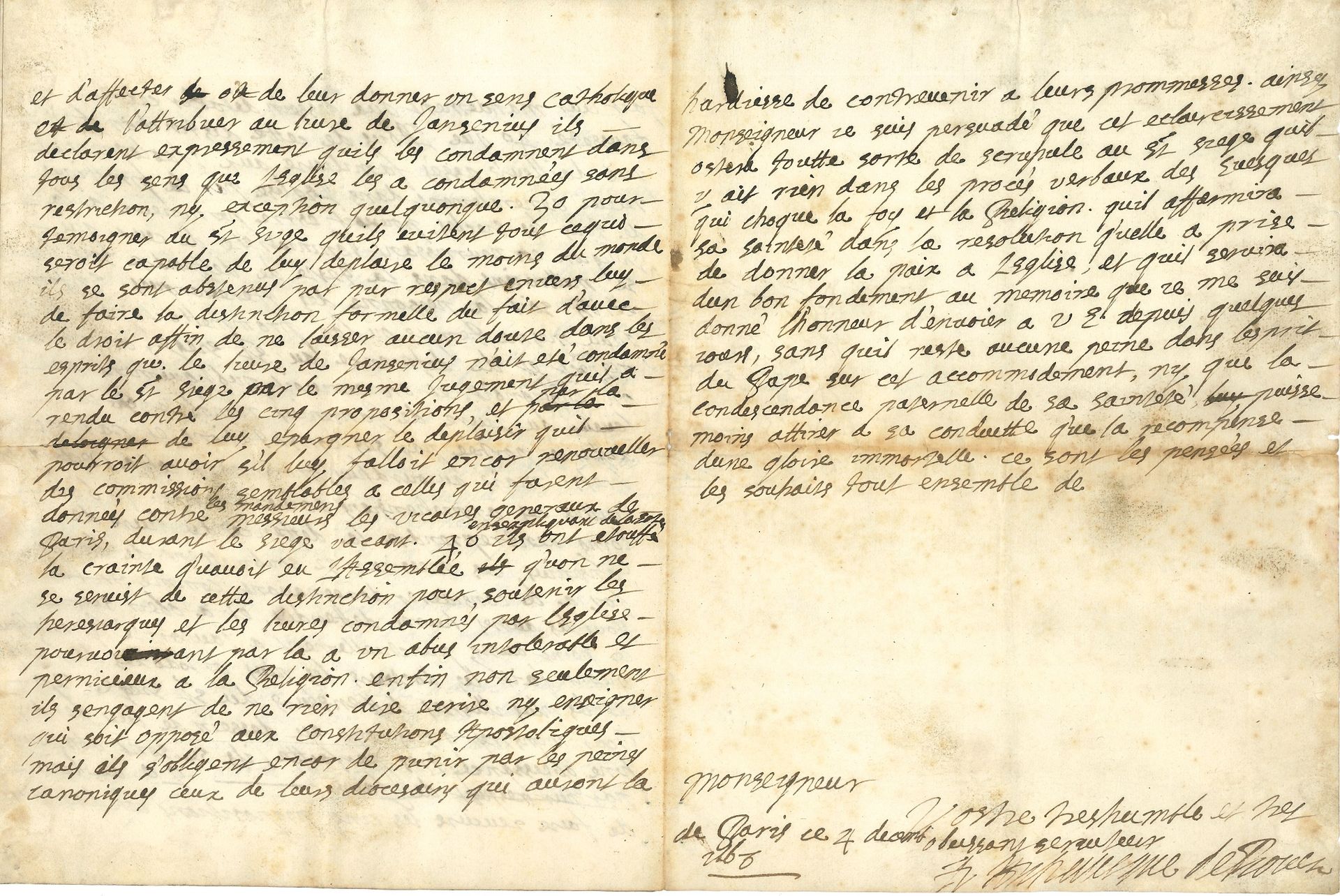
François III de HARLAY (1625-1695) prelate, archbishop of Rouen and then of Paris, he fought against the Jansenists and inspired the anti-protestant policy of Louis XIV, whose secret marriage with Mme de Maintenon he celebrated. L.A.S. as archbishop of Rouen, Paris December 4, 1666, to an Eminence; 7 pages in-4 (slight wetness, one edge of the 1st leaf slightly frayed, small cracks in the fold). Long and interesting letter concerning "the affair of the four bishops". [The bishops of Angers, Beauvais, Alet and Pamiers - Arnaud, Buzenval, Pavillon and Caulet respectively - had initially refused to sign the form of Alexander VI, supported by Louis XIV, explicitly condemning five propositions on grace of the Augustinus of Jansenius]. "Monsieur de Lyonne gave me advice in the evening by a bill that the Pope, before deciding entirely on the affair of the four bishops, would like to know more precisely if it were possible [to know] the truth of what happened in their synods"; he was able to obtain a declaration signed by the bishop of Châlons and Arnaud, which Harlay read carefully: "I would never have believed that the defenders of the book of Jansenius had come so far. I witnessed the astonishment of Monsieur de Lyonne in the conference I had with him afterwards, in the presence of the nuncio, and I could not help telling him that he had rendered one of the most signal services to the Holy See and even to the whole Church that one could ever have wished for. In fact, my lord, it seems to me that by this clarification the faith of the Church is entirely covered, and that almost nothing can be added to the honour which is rendered by this to the Holy See. For since these gentlemen protest in their Declaration that they condemn the five propositions in all the senses in which the Church has condemned them without making any exception or restriction whatsoever, there is no reason to believe that their intention is to defend them in any particular sense to the prejudice of the very terms of the said Declaration, which means that the subject of the disputes is absolutely finished and that the faith thereby preserves its safeguard and its security And as on the other hand it renders to the judgment of the Holy See even on the book of Jansenius all the submission and lobeissance which are due to it"... Etc. If in 1660, when Harlay presided over the General Assembly of the Clergy of France, such a declaration had been placed in his hands, it would have happily ended the matter. But this is far from being the case, and Harlay sets out in four points the situation with regard to the five propositions and the book of Jansenius... "Today, at the time of this Declaration, all these apprehensions must cease"... Thus, His Holiness must be confirmed in his resolution to "give peace to the Church", without feeling any pain as to this accommodation, "ny that the paternal condescension of His Holiness can attract less from his conduct than the reward of an immortal glory"...
Estimate
€400 - €500
Result
Not sold
Buyer's premium
28%
François III de HARLAY (1625-1695) prelate, archbishop of Rouen and then of Paris, he fought against the Jansenists and inspired the anti-protestant policy of Louis XIV, whose secret marriage with Mme de Maintenon he celebrated. L.A.S. as archbishop of Rouen, Paris December 4, 1666, to an Eminence; 7 pages in-4 (slight wetness, one edge of the 1st leaf slightly frayed, small cracks in the fold).
Long and interesting letter concerning "the affair of the four bishops". [The bishops of Angers, Beauvais, Alet and Pamiers - Arnaud, Buzenval, Pavillon and Caulet respectively - had initially refused to sign the form of Alexander VI, supported by Louis XIV, explicitly condemning five propositions on grace of the Augustinus of Jansenius].
"Monsieur de Lyonne gave me advice in the evening by a bill that the Pope, before deciding entirely on the affair of the four bishops, would like to know more precisely if it were possible [to know] the truth of what happened in their synods"; he was able to obtain a declaration signed by the bishop of Châlons and Arnaud, which Harlay read carefully: "I would never have believed that the defenders of the book of Jansenius had come so far. I witnessed the astonishment of Monsieur de Lyonne in the conference I had with him afterwards, in the presence of the nuncio, and I could not help telling him that he had rendered one of the most signal services to the Holy See and even to the whole Church that one could ever have wished for. In fact, my lord, it seems to me that by this clarification the faith of the Church is entirely covered, and that almost nothing can be added to the honour which is rendered by this to the Holy See. For since these gentlemen protest in their Declaration that they condemn the five propositions in all the senses in which the Church has condemned them without making any exception or restriction whatsoever, there is no reason to believe that their intention is to defend them in any particular sense to the prejudice of the very terms of the said Declaration, which means that the subject of the disputes is absolutely finished and that the faith thereby preserves its safeguard and its security And as on the other hand it renders to the judgment of the Holy See even on the book of Jansenius all the submission and lobeissance which are due to it"... Etc. If in 1660, when Harlay presided over the General Assembly of the Clergy of France, such a declaration had been placed in his hands, it would have happily ended the matter. But this is far from being the case, and Harlay sets out in four points the situation with regard to the five propositions and the book of Jansenius... "Today, at the time of this Declaration, all these apprehensions must cease"... Thus, His Holiness must be confirmed in his resolution to "give peace to the Church", without feeling any pain as to this accommodation, "ny that the paternal condescension of His Holiness can attract less from his conduct than the reward of an immortal glory"...
Sale
Wednesday 23 February 2022・14:00 (Europe/Paris)
Sale location coming soon
3, rue Favart
75002 Paris