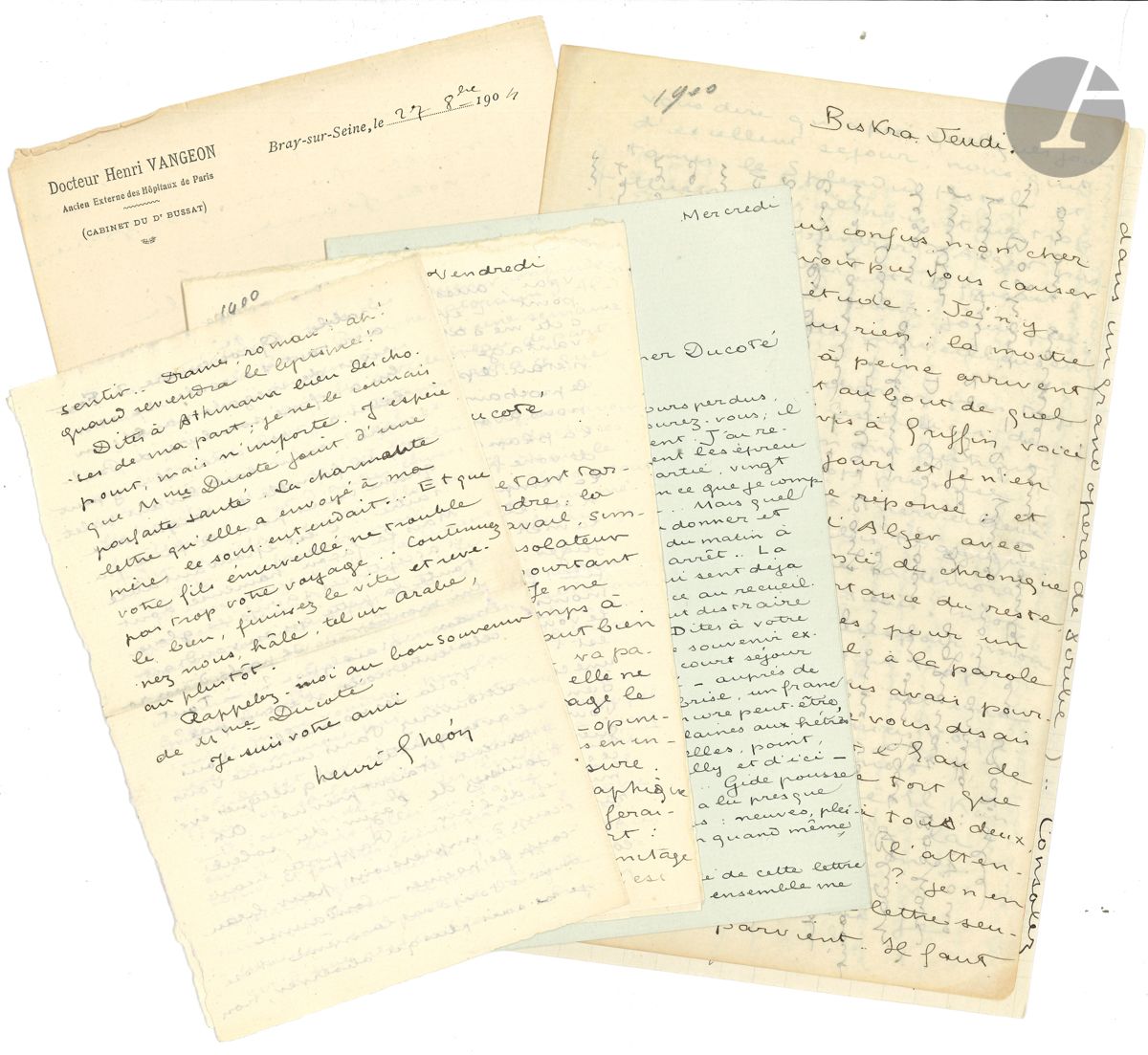
Henri GHÉON (1875-1944). 35 L.A.S., 1895-1915, to Édouard Ducoté; 86 pages in various formats. Interesting literary correspondence to the director of the review L'Ermitage. Ghéon evokes his trip to Algeria, his relationship with Gide, his collaboration to L'Ermitage, the death of his mother, his installation in Bray-sur-Seine as a doctor (one letter bears his letterhead Doctor Henri Vangeon), the mobilization and the war, etc. We can only give a quick overview (Ducoté has indicated in pencil the year). 1895. He thanks Ducoté and L'Ermitage for having "opened its doors" to him by publishing his "study on Griffin"... 1897. He received Ducoté's books, and makes a very laudatory critical study of them. 1898. He thanks him for sending his manuscript Calypso and explains what he likes in this work: "Your tragedy is not strictly speaking a work of theater but a treatise like those of Gide, in a more continuous dialogical form"... 1899. Organization of a meeting in Normandy: "My mother and my sister are looking forward to spending the day with your charming wife [...] At the same time I receive a letter from Gide who tells me that his wife cannot think of meeting us in Cabourg. But he adds [...] that he will perhaps take his bicycle one of these days to come and surprise you with his brother-in-law and that he will telegraph me to meet him at your place [...] We will take the 10:08 train at Trouville and we will be at 11:30 at your Bretèche"... 1900. News of his writing, of the friends who surround him, of Paul Fort's difficulties in getting published, and of the trip with Gide to Algeria (one on the letterhead of the Grand Hôtel in Constantine). 1901. He settles in Bray-sur-Seine as a country doctor; he visits his patients in a cart. He continues his literary work: "a long chronicle in which I had undertaken to judge Wagner", and "l'eau de vie qui à nouveau distille". He makes sure that the magazine does not run out of material to print. He gives news of the friends who come to see him, whom he prefers to his acquaintances in Bray... 1902. He evokes the survey of the Hermitage with two hundred literary personalities, on the question: which is the greatest poet of the XlXth century. He deplores the difficulties of Ducoté to produce his play and gives news of his own production. 1903. "I hope to return to Paris this winter [...] I wish I had Paris at hand and most of my free time. That will come"... 1904. He is still in Bray. It is perhaps the last year of publication of the Hermitage and the last poems and chronicles that he sends. 1905. He deplores: "the intrusion of Van Bever, Léautaud in the Hermitage is a sad thing! Would the next issue contain five pages of my verses? In any case I send them to you"... "I deplore the loss of the Hermitage [...] It would have been necessary to produce more to fill the place. The place was taken, too bad"... 1908. January 2: "You know that I become painter: I expose to the Independents, without prejudice of the literature: a half scandalous novel whose second half is active"... 1911. "I used up my vacations between my sister's business [...] and the rehearsals of Bread which have absorbed me entirely for two weeks [...] The overwork of a new kind overwhelms me [...] After several attempts I finally have my Frankish Peter: Karl, the Dimitri of the Karamazovs"... 1912. He tells the accidental death of his mother. 1913. It is now Ducoté who proposes his book for a column in an issue of the NRF. "As soon as Gide returns I will ask about your book [...] without committing the magazine yet. 1915. January 10 (on a military postcard), he sends his greetings to the Ducotés and his address at the front, he is "aide major 29th Artillery": "I do not regret my trip, I live dangerously (not too much, but a little) and happily". On April 13, he recounts his experience as a doctor on the Somme front (which will contribute to his conversion): "We live at the front under "the fatum" it strikes a little more often, that's all, but "grace" also has its own people, and it is in this hope that we must live [...] They say the end of the war is near. Why? We do not know"... Etc. 2 autograph poems are attached: Lied in free verse (1 p.1/2 in-8, signed), and Le Potager (5 ½ pages in-4), July 1897.
Estimate
€1,000 - €1,500
Result
Not sold
Buyer's premium
28%
Henri GHÉON (1875-1944). 35 L.A.S., 1895-1915, to Édouard Ducoté; 86 pages in various formats.
Interesting literary correspondence to the director of the review L'Ermitage. Ghéon evokes his trip to Algeria, his relationship with Gide, his collaboration to L'Ermitage, the death of his mother, his installation in Bray-sur-Seine as a doctor (one letter bears his letterhead Doctor Henri Vangeon), the mobilization and the war, etc. We can only give a quick overview (Ducoté has indicated in pencil the year).
1895. He thanks Ducoté and L'Ermitage for having "opened its doors" to him by publishing his "study on Griffin"... 1897. He received Ducoté's books, and makes a very laudatory critical study of them. 1898. He thanks him for sending his manuscript Calypso and explains what he likes in this work: "Your tragedy is not strictly speaking a work of theater but a treatise like those of Gide, in a more continuous dialogical form"... 1899. Organization of a meeting in Normandy: "My mother and my sister are looking forward to spending the day with your charming wife [...] At the same time I receive a letter from Gide who tells me that his wife cannot think of meeting us in Cabourg. But he adds [...] that he will perhaps take his bicycle one of these days to come and surprise you with his brother-in-law and that he will telegraph me to meet him at your place [...] We will take the 10:08 train at Trouville and we will be at 11:30 at your Bretèche"... 1900. News of his writing, of the friends who surround him, of Paul Fort's difficulties in getting published, and of the trip with Gide to Algeria (one on the letterhead of the Grand Hôtel in Constantine). 1901. He settles in Bray-sur-Seine as a country doctor; he visits his patients in a cart. He continues his literary work: "a long chronicle in which I had undertaken to judge Wagner", and "l'eau de vie qui à nouveau distille". He makes sure that the magazine does not run out of material to print. He gives news of the friends who come to see him, whom he prefers to his acquaintances in Bray... 1902. He evokes the survey of the Hermitage with two hundred literary personalities, on the question: which is the greatest poet of the XlXth century. He deplores the difficulties of Ducoté to produce his play and gives news of his own production. 1903. "I hope to return to Paris this winter [...] I wish I had Paris at hand and most of my free time. That will come"... 1904. He is still in Bray. It is perhaps the last year of publication of the Hermitage and the last poems and chronicles that he sends. 1905. He deplores: "the intrusion of Van Bever, Léautaud in the Hermitage is a sad thing! Would the next issue contain five pages of my verses? In any case I send them to you"... "I deplore the loss of the Hermitage [...] It would have been necessary to produce more to fill the place. The place was taken, too bad"... 1908. January 2: "You know that I become painter: I expose to the Independents, without prejudice of the literature: a half scandalous novel whose second half is active"... 1911. "I used up my vacations between my sister's business [...] and the rehearsals of Bread which have absorbed me entirely for two weeks [...] The overwork of a new kind overwhelms me [...] After several attempts I finally have my Frankish Peter: Karl, the Dimitri of the Karamazovs"... 1912. He tells the accidental death of his mother. 1913. It is now Ducoté who proposes his book for a column in an issue of the NRF. "As soon as Gide returns I will ask about your book [...] without committing the magazine yet. 1915. January 10 (on a military postcard), he sends his greetings to the Ducotés and his address at the front, he is "aide major 29th Artillery": "I do not regret my trip, I live dangerously (not too much, but a little) and happily". On April 13, he recounts his experience as a doctor on the Somme front (which will contribute to his conversion): "We live at the front under "the fatum" it strikes a little more often, that's all, but "grace" also has its own people, and it is in this hope that we must live [...] They say the end of the war is near. Why? We do not know"... Etc.
2 autograph poems are attached: Lied in free verse (1 p.1/2 in-8, signed), and Le Potager (5 ½ pages in-4), July 1897.
Sale
Tuesday 22 February 2022・14:00 (Europe/Paris)
Sale location coming soon
3, rue Favart
75002 Paris