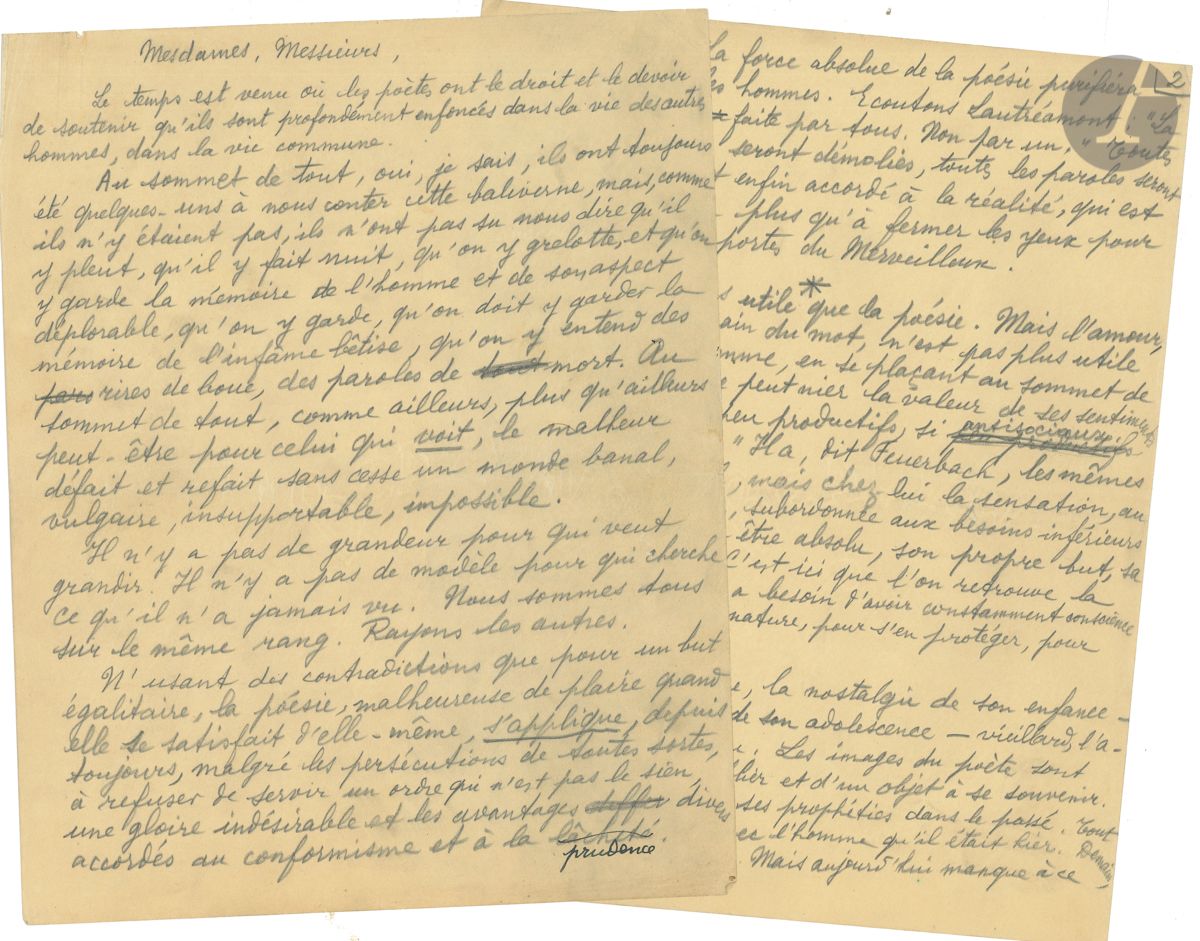
Paul ELUARD (1895-1952). Autograph manuscript; 12 pages in-4, in pencil and black ink. Conference on surrealist poetry. The manuscript has numerous erasures and corrections. Éluard wants to demonstrate that poets are now "deeply embedded in the life of other men, in the common life." The poetry "applies, since always [...] to refuse to serve an order which is not his. [...] Pure poetry? The force of poetry will purify the men, all the men ". Imagination " never lies [...] The poet is the one who inspires much more than the one who is inspired [...] Everything is to the poet object to sensations, and consequently to feelings. All the concrete becomes then the food of its imagination " The surrealist poetry expresses itself by words, but also by the painting: " the surrealist painters, who are poets, always think of something else. The unusual is familiar to them, the unknown premeditation". They join the imagination to the nature, considering "all that is possible as real, to show us that there is no dualism between the imagination and the reality" Those who do not understand the surrealist poetry, written or painted, and are indignant, "are the same ones that tortured Galileo, burned the books of Swift and Rousseau"...He dwells at length on the Marquis de Sade "who wanted to give back to civilized man the strength of his primitive instincts, and wanted to free the amorous imagination from its own objects. He believed that, from there, and only from there, equality would be born". And Sade, "justifying the men who carry the singularity in the things of the love, rises against all those who recognize it indispensable only to perpetuate their dirty race. [...] It is his perfect pessimism that gives him the coldest reason. The surrealist poetry, the poetry of always, never obtained anything else. They are dark truths that appear in the work of the true poets, but they are truths and almost all the rest is lie ". Sade and Lautréamont, "these two fantastic and revolutionary writers" of which we do not have any portrait, have led the fight "against all the traps that this false and laborious reality that lowers the man sets for us. To the formula: "You are what you are" they added: "You can be something else". For Éluard, "surrealism, which is an instrument of knowledge, of acquisition [...] works to reduce the differences which exist between the men, and for that, it refuses to serve an absurd order based on the inequality, on the deception, on the cowardice". From surrealism to communism, there is only one step: with Max Ernst, his enemy in 1917, become his friend in 1925, he supports "the slogan of fraternization of the French communist party" and fights "against our common enemy, the International of profit. [...] Poets worthy of the name, like proletarians, refuse to be exploited. [True poetry is included in everything that frees man from this terrible good that has the face of death. The poetry is everywhere, in the work of Sade, Picasso, Rimbaud or Freud, in the invention of the radio, in the strikes and the revolutions. The poets went "in the streets, they insulted their masters, they do not have any more gods, they dare to kiss the beauty and the love on the mouth, they learned the songs of revolt of the unhappy crowd and, without being repulsed, try to learn them theirs"...
Estimate
€1,500 - €2,000
Result
Not sold
Buyer's premium
28%
Paul ELUARD (1895-1952). Autograph manuscript; 12 pages in-4, in pencil and black ink.
Conference on surrealist poetry. The manuscript has numerous erasures and corrections. Éluard wants to demonstrate that poets are now "deeply embedded in the life of other men, in the common life." The poetry "applies, since always [...] to refuse to serve an order which is not his. [...] Pure poetry? The force of poetry will purify the men, all the men ". Imagination " never lies [...] The poet is the one who inspires much more than the one who is inspired [...] Everything is to the poet object to sensations, and consequently to feelings. All the concrete becomes then the food of its imagination " The surrealist poetry expresses itself by words, but also by the painting: " the surrealist painters, who are poets, always think of something else. The unusual is familiar to them, the unknown premeditation". They join the imagination to the nature, considering "all that is possible as real, to show us that there is no dualism between the imagination and the reality" Those who do not understand the surrealist poetry, written or painted, and are indignant, "are the same ones that tortured Galileo, burned the books of Swift and Rousseau"...He dwells at length on the Marquis de Sade "who wanted to give back to civilized man the strength of his primitive instincts, and wanted to free the amorous imagination from its own objects. He believed that, from there, and only from there, equality would be born". And Sade, "justifying the men who carry the singularity in the things of the love, rises against all those who recognize it indispensable only to perpetuate their dirty race. [...] It is his perfect pessimism that gives him the coldest reason. The surrealist poetry, the poetry of always, never obtained anything else. They are dark truths that appear in the work of the true poets, but they are truths and almost all the rest is lie ". Sade and Lautréamont, "these two fantastic and revolutionary writers" of which we do not have any portrait, have led the fight "against all the traps that this false and laborious reality that lowers the man sets for us. To the formula: "You are what you are" they added: "You can be something else". For Éluard, "surrealism, which is an instrument of knowledge, of acquisition [...] works to reduce the differences which exist between the men, and for that, it refuses to serve an absurd order based on the inequality, on the deception, on the cowardice". From surrealism to communism, there is only one step: with Max Ernst, his enemy in 1917, become his friend in 1925, he supports "the slogan of fraternization of the French communist party" and fights "against our common enemy, the International of profit. [...] Poets worthy of the name, like proletarians, refuse to be exploited. [True poetry is included in everything that frees man from this terrible good that has the face of death. The poetry is everywhere, in the work of Sade, Picasso, Rimbaud or Freud, in the invention of the radio, in the strikes and the revolutions. The poets went "in the streets, they insulted their masters, they do not have any more gods, they dare to kiss the beauty and the love on the mouth, they learned the songs of revolt of the unhappy crowd and, without being repulsed, try to learn them theirs"...
Sale
Tuesday 22 February 2022・14:00 (Europe/Paris)
Sale location coming soon
3, rue Favart
75002 Paris