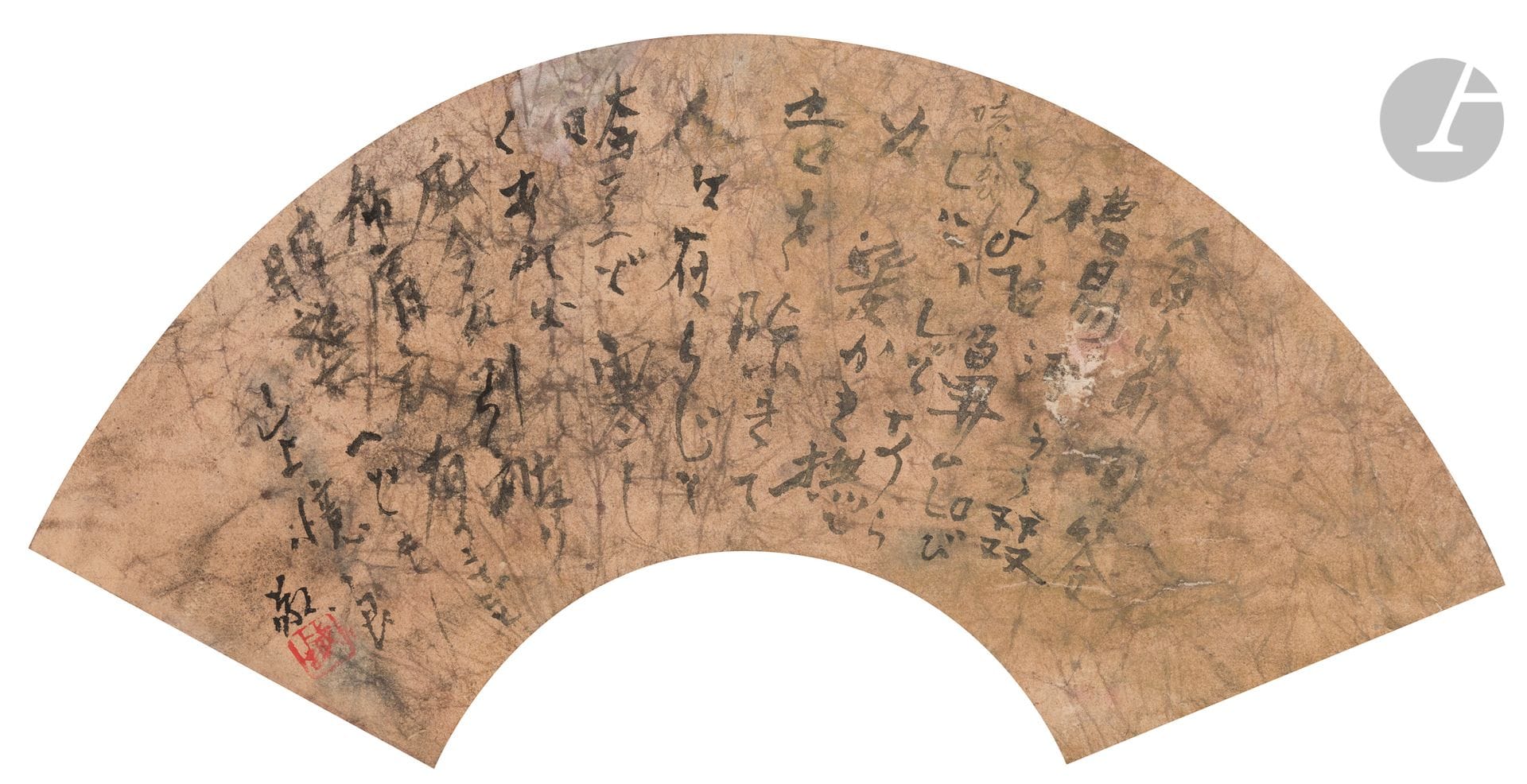
After Yamanoue no Okura (660-733) - 山上 憶良, Japan, 19th century Indian ink calligraphy on Japanese fan paper. Signed with the character Ø© - Jô followed by an illegible seal. The poem calligraphed here is an excerpt from the text "The Song of the Poor," Hinkyu mondo - 貧窮問答 from the Man'yōshū (waka anthology). It tells of the moods of a poor man in the cold winter: 糟湯酒 うちすすろひて しはぶかひ 鼻びしびしに しかとあらぬ 髭掻き撫でて 我れをおきて 人はあらじと 誇ろへど 寒くしあれば 麻衾 引き被り 布肩衣 ありのことごと 着襲へども" Sipping a bad sake, coughing as my nose runs, I sniffle as I brush the hairs of my lengthening beard, and feel proud of myself. It's so cold, I cover myself with my linen bedding and cloth robe, and I'll wear whatever I can." Length : 51,5 cmSoiling , average condition. Provenance : Michel Tapié Collection. By descent. Yamanoue no Okura was a Japanese poet of the Nara period, whose poetry was mainly about children and little people. He was part of one of the Japanese missions in Tang China, and his texts are greatly influenced by Chinese Buddhism and Confucianism. He participated in the development of the Man'yōshū (万葉集),literally collection of ten thousand leaves which was the first waka anthology (genre of Japanese poetry).
Estimate
€100 - €150
Result
Not sold
Buyer's premium
28%
After Yamanoue no Okura (660-733) -
山上 憶良, Japan, 19th century
Indian ink calligraphy on Japanese fan paper. Signed with the character Ø© - Jô followed by an illegible seal.
The poem calligraphed here is an excerpt from the text "The Song of the Poor," Hinkyu mondo - 貧窮問答 from the Man'yōshū (waka anthology). It tells of the moods of a poor man in the cold winter:
糟湯酒 うちすすろひて しはぶかひ 鼻びしびしに しかとあらぬ 髭掻き撫でて 我れをおきて 人はあらじと 誇ろへど 寒くしあれば 麻衾 引き被り 布肩衣 ありのことごと
着襲へども" Sipping a bad sake, coughing as my nose runs, I sniffle as I brush the hairs of my lengthening beard, and feel proud of myself. It's so cold, I cover myself with my linen bedding and cloth robe, and I'll wear whatever I can."
Length : 51,5 cmSoiling
, average condition.
Provenance :
Michel Tapié Collection. By descent.
Yamanoue no Okura was a Japanese poet of the Nara period, whose poetry was mainly about children and little people. He was part of one of the Japanese missions in Tang China, and his texts are greatly influenced by Chinese Buddhism and Confucianism. He participated in the development of the Man'yōshū (万葉集),literally collection of ten thousand leaves which was the first waka anthology (genre of Japanese poetry).
Sale
Friday 25 February 2022・14:00 (Europe/Paris)
Salle 2 - Hôtel Drouot
9, rue Drouot
75009 Paris