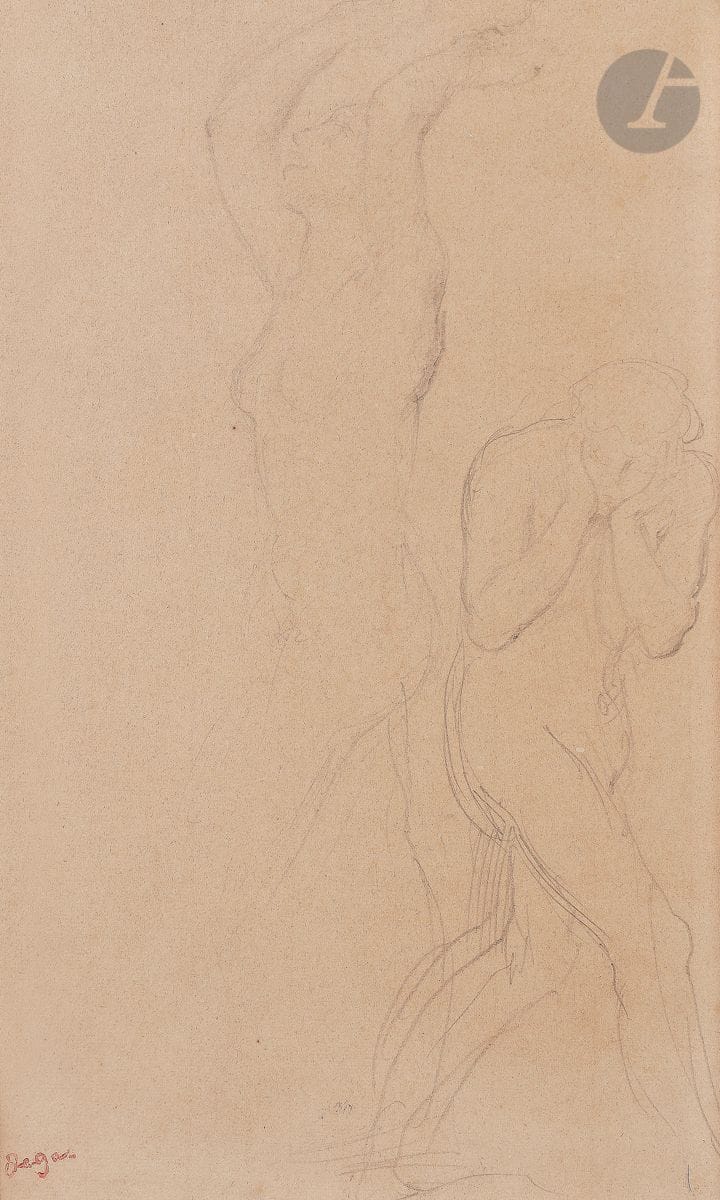
Edgar DEGAS (1834 -1917 )Two full-length studies of women on the same sheetBlack pencil on buff paper. Stamp of the sale of the studio in the lower left corner (Lugt 658). Old label on the reverse "this drawing was part of the lot of drawings sold at the first Degas sale/n° 62 of the catalogue on which appears the following mention 62. Young Spartans/b. Sketches or studies for the above painting" (see catalogue of the first sale of the studio, 1918, p.36, n° 62b.). 31.7 x 19 cmProvenance : - First Degas sale, Paris, Galerie Georges Petit, 6-7-8 May 1918, part of no. 6b . - Collection of Mr and Mrs Z., Alpes-Maritimes. The woman on the right is preparatory for a figure in the background of The Daughter of Jephthah, dated between 1861 and 1865, and kept in Northampton, Smith College Museum of Art, Inv. 1933.9. The figure on the left is preparatory to a figure on the right of the painting, whose arms can be seen raised. On his return from Italy in 1859, Degas set about painting his largest and probably most ambitious historical composition: "The Daughter of Jephthah". In the time of the Judges, a valiant warrior named Jephthah was called to command the Israelites in the war against the Ammonites. On the eve of the battle, he pledged to God, in exchange for victory, to sacrifice "whosoever shall come forth out of the gates of my house before me, when I return. When the battle was won, "behold, his daughter came out to meet him with tambourines and dances; she was but a child. The scene represents the return of Jephthah, a warrior tearing his clothes as his daughter approaches to welcome him.
Estimate
€10,000 - €15,000
Result
Not sold
Buyer's premium
28%
Edgar DEGAS (1834 -1917
)Two full-length studies of women on the same
sheetBlack
pencil
on buff paper.
Stamp of the sale of the studio in the lower left corner (Lugt 658).
Old label on the reverse "this drawing was part of the lot of drawings sold at the first Degas sale/n° 62 of the catalogue on which appears the following mention 62. Young Spartans/b. Sketches or studies for the above painting" (see catalogue of the first sale of the studio, 1918, p.36, n° 62b.).
31.7 x 19 cmProvenance
:
- First Degas sale, Paris, Galerie Georges Petit, 6-7-8 May 1918, part of no. 6b
.
- Collection of Mr and Mrs Z., Alpes-Maritimes.
The woman on the right is preparatory for a figure in the background of The Daughter of Jephthah, dated between 1861 and 1865, and kept in Northampton, Smith College Museum of Art, Inv. 1933.9. The figure on the left is preparatory to a figure on the right of the painting, whose arms can be seen raised. On his return from Italy in 1859, Degas set about painting his largest and probably most ambitious historical composition: "The Daughter of Jephthah". In the time of the Judges, a valiant warrior named Jephthah was called to command the Israelites in the war against the Ammonites. On the eve of the battle, he pledged to God, in exchange for victory, to sacrifice "whosoever shall come forth out of the gates of my house before me, when I return. When the battle was won, "behold, his daughter came out to meet him with tambourines and dances; she was but a child. The scene represents the return of Jephthah, a warrior tearing his clothes as his daughter approaches to welcome him.
Sale
Friday 5 November 2021・14:00 (Europe/Paris)
Salle 5 - Hôtel Drouot
9, rue Drouot
75009 Paris