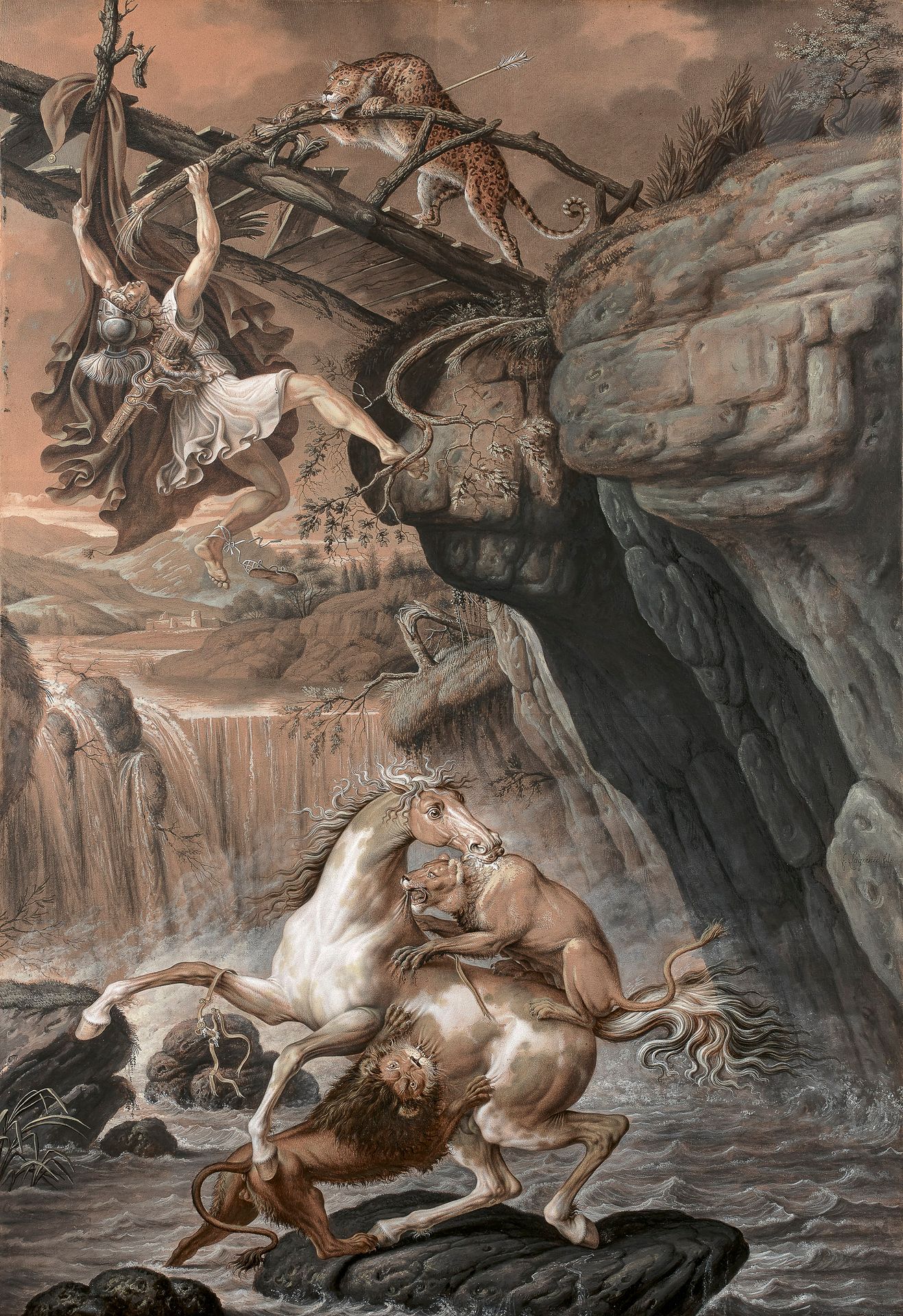
Anthelme-François LAGRENÉE the son (Paris 1774 - 1832) Greek warrior and his horse attacked by a cheetah, a lion and a lioness Gouache, watercolor, pen and brown ink, black pencil on four sheets mounted on a frame. Signed lower left: "f Lagrenée fils". 102.5 x 70 cm (Two fine folds from gluing and trace of joints of the leaves, small stains on the edges). First a pupil of his father Louis-Jean-François Lagrenée the elder, director of the École de Rome and then rector of the Académie, Anthelme was then a pupil of François-André Vincent. This heir to a dynasty whose career was already mapped out wanted to forge his own destiny in the turmoil of the revolution: he joined the army in 1793. He resumed his artistic life shortly before 1800, as a painter and miniaturist. He exhibited at the Salon from 1799 to 1831. In 1800, he showed "painting under glass" which could be "adapted to all kinds of furniture, such as cabarets, pedestal tables, friezes of apartments and carriages", as well as miniatures and cameos. His cold style hides the fire under the ice. His first known miniatures, dated 1789, "Sculpteur carving a skeleton" and "Faune faisant danser un squelette" (Paris, Musée des Arts Décoratifs), show a grating spirit. He mellowed a little during the Empire and produced elegant, somewhat sharp portraits. In 1823, the spirit of adventure took him back and he went to Saint Petersburg, where he portrayed the imperial family and the Court. He then returned to Paris and died of cholera in 1832 (see Nathalie Lemoine-Bouchard, "Les Peintres en miniatures", Paris, Les éditions de l'Amateur, 2008, p. 321). Our drawing, exceptional in its size, represents a Greek warrior in a more than extreme situation: having wounded a cheetah with one of his arrows, he has embarked on a wooden footbridge over a waterfall, which has given way under the weight of his horse. He clings to a railing that hangs in the void, unable to climb back up because threatened by the cheetah at bay. In the stream below, the horse is attacked by a lioness and a lion. The fierce struggle between the wild animals on one side and the man and his domesticated horse on the other is described with the precision of a miniaturist artist with a lynx eye... The subject is similar to the lion hunt by Bénigne Gagnereaux. The very neoclassical technique may date from the artist's early years, between 1789 and 1793, as does the subject matter, which recalls the revolutionary clashes.
Estimate
€40,000 - €60,000
Result
€38,400
Buyer's premium
28%
Anthelme-François LAGRENÉE the son (Paris 1774 - 1832)
Greek warrior and his horse attacked by a cheetah, a lion and a lioness
Gouache, watercolor, pen and brown ink, black pencil on four sheets mounted on a frame.
Signed lower left: "f Lagrenée fils".
102.5 x 70 cm
(Two fine folds from gluing and trace of joints of the leaves, small stains on the edges).
First a pupil of his father Louis-Jean-François Lagrenée the elder, director of the École de Rome and then rector of the Académie, Anthelme was then a pupil of François-André Vincent. This heir to a dynasty whose career was already mapped out wanted to forge his own destiny in the turmoil of the revolution: he joined the army in 1793. He resumed his artistic life shortly before 1800, as a painter and miniaturist. He exhibited at the Salon from 1799 to 1831. In 1800, he showed "painting under glass" which could be "adapted to all kinds of furniture, such as cabarets, pedestal tables, friezes of apartments and carriages", as well as miniatures and cameos. His cold style hides the fire under the ice. His first known miniatures, dated 1789, "Sculpteur carving a skeleton" and "Faune faisant danser un squelette" (Paris, Musée des Arts Décoratifs), show a grating spirit. He mellowed a little during the Empire and produced elegant, somewhat sharp portraits. In 1823, the spirit of adventure took him back and he went to Saint Petersburg, where he portrayed the imperial family and the Court. He then returned to Paris and died of cholera in 1832 (see Nathalie Lemoine-Bouchard, "Les Peintres en miniatures", Paris, Les éditions de l'Amateur, 2008, p. 321).
Our drawing, exceptional in its size, represents a Greek warrior in a more than extreme situation: having wounded a cheetah with one of his arrows, he has embarked on a wooden footbridge over a waterfall, which has given way under the weight of his horse. He clings to a railing that hangs in the void, unable to climb back up because threatened by the cheetah at bay. In the stream below, the horse is attacked by a lioness and a lion. The fierce struggle between the wild animals on one side and the man and his domesticated horse on the other is described with the precision of a miniaturist artist with a lynx eye...
The subject is similar to the lion hunt by Bénigne Gagnereaux. The very neoclassical technique may date from the artist's early years, between 1789 and 1793, as does the subject matter, which recalls the revolutionary clashes.
Sale
Friday 11 June 2021・14:00 (Europe/Paris)
Salle 6 - Hôtel Drouot
9, rue Drouot
75009 Paris