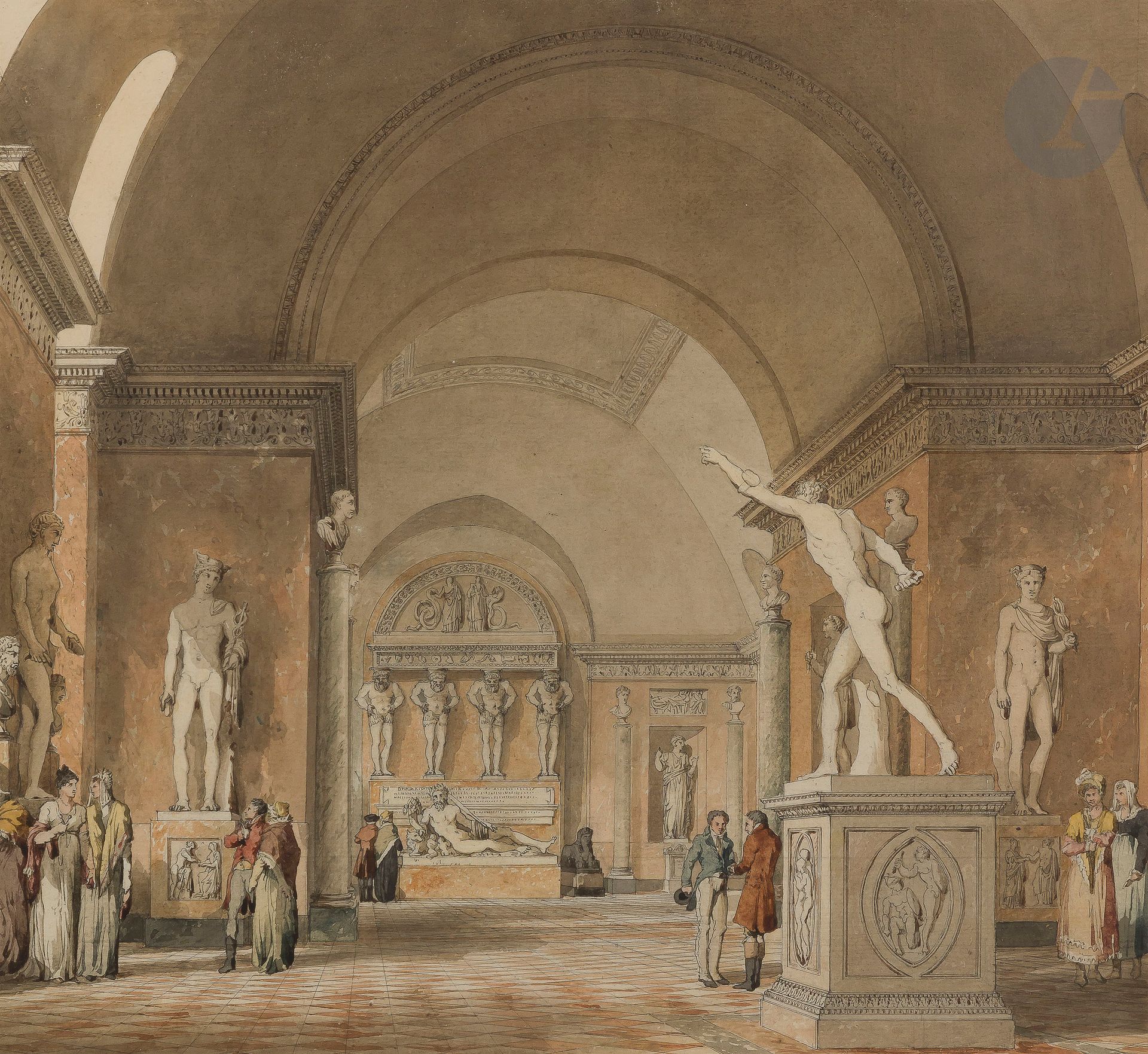
Pierre-François-Léonard FONTAINE (Pontoise 1762 - Paris 1853) Animated View of the Salle du Héros Combattant and the Tiber, Louvre, ca. 1817 Watercolour, pen and black ink 29,5 x 32,5 cm Provenance: - Pierre-François-Léonard Fontaine. - Bequest of all his drawings to his daughter Aimé-Sophie Dupuis (born in 1803), who married his pupil, the architect Louis-Symphorien Meunié. - His son Georges Meunié (1833-1927), then the latter's wife Félicie Meunié d'Hostel (1843-1936), who edited the drawings in albums drawings in albums; her ex-libris on the inside cover of the binding. - By descent, Dallemagne collection. This room was taken over by the architect Raymond in this wing of the Louvre in 1804-1805. Percier and Fontaine were commissioned to design it as part of the Napoleon Museum. The Hall of the Fighting Hero and the Tiber, in the extension of the Gallery of Melpomene, was opened in 1808. In 1815, it was only partially completed. After the withdrawal of sculptures following the fall of Napoleon and the Vienna Accords, the curator Visconti had to rearrange the rooms to fill in the gaps. Fontaine, still the architect of the Louvre Palace, was obviously in charge. The complex was inaugurated under Louis XVIII in 1817. In what was then called the Galerie Royale des Antiques, the Salle du Héros Combattant housed the famous Borghese Gladiator, a Greek antique found near Anzio in 1611. The jewel in the crown of the Borghese collection, it was bought by Napoleon from his brother-in-law Camille Borghese in 1807. Behind it, in the background, at the foot of the Atlanteans, you can see the Tiber, discovered in Rome in 1512. Ceded by the Pope at the Treaty of Tolentino in 1803, it was first exhibited in the Hall of Rivers before its counterpart, the Nile, was returned to the Vatican in 1815. The Musée du Louvre holds a "View of the Gallery of Melpomene after 1817" (RF 30628) describing the other end of this great enfilade, where a sumptuous niche housed the Medici Venus during the Empire, replaced in 1817 by a colossal statue of Melpomene. Other views of the ancient sculpture rooms of the Napoleon Museum were painted by Fontaine in 1815. These include "L'ancienne salle de l'Apollon du Belvédère" (Christie's, anonymous sale, Paris, Thursday 10 April 2008, no. 146, reproduced) and "La vue de la Salle des Empereurs romains et du Grand Vestibule" (Galerie Terrades, 2006, no. 8, reproduced).
Estimate
€30,000 - €40,000
Result
€44,800
Buyer's premium
28%
Pierre-François-Léonard FONTAINE (Pontoise 1762 - Paris 1853)
Animated View of the Salle du Héros Combattant and the Tiber, Louvre, ca. 1817
Watercolour, pen and black ink
29,5 x 32,5 cm
Provenance:
- Pierre-François-Léonard Fontaine.
- Bequest of all his drawings to his daughter Aimé-Sophie Dupuis (born in 1803), who married his pupil, the architect Louis-Symphorien Meunié.
- His son Georges Meunié (1833-1927), then the latter's wife Félicie Meunié d'Hostel (1843-1936), who edited the drawings in albums
drawings in albums; her ex-libris on the inside cover of the binding.
- By descent, Dallemagne collection.
This room was taken over by the architect Raymond in this wing of the Louvre in 1804-1805. Percier and Fontaine were commissioned to design it as part of the Napoleon Museum. The Hall of the Fighting Hero and the Tiber, in the extension of the Gallery of Melpomene, was opened in 1808. In 1815, it was only partially completed. After the withdrawal of sculptures following the fall of Napoleon and the Vienna Accords, the curator Visconti had to rearrange the rooms to fill in the gaps. Fontaine, still the architect of the Louvre Palace, was obviously in charge. The complex was inaugurated under Louis XVIII in 1817. In what was then called the Galerie Royale des Antiques, the Salle du Héros Combattant housed the famous Borghese Gladiator, a Greek antique found near Anzio in 1611. The jewel in the crown of the Borghese collection, it was bought by Napoleon from his brother-in-law Camille Borghese in 1807. Behind it, in the background, at the foot of the Atlanteans, you can see the Tiber, discovered in Rome in 1512. Ceded by the Pope at the Treaty of Tolentino in 1803, it was first exhibited in the Hall of Rivers before its counterpart, the Nile, was returned to the Vatican in 1815. The Musée du Louvre holds a "View of the Gallery of Melpomene after 1817" (RF 30628) describing the other end of this great enfilade, where a sumptuous niche housed the Medici Venus during the Empire, replaced in 1817 by a colossal statue of Melpomene. Other views of the ancient sculpture rooms of the Napoleon Museum were painted by Fontaine in 1815. These include "L'ancienne salle de l'Apollon du Belvédère" (Christie's, anonymous sale, Paris, Thursday 10 April 2008, no. 146, reproduced) and "La vue de la Salle des Empereurs romains et du Grand Vestibule" (Galerie Terrades, 2006, no. 8, reproduced).
Sale
Friday 11 June 2021・14:00 (Europe/Paris)
Salle 6 - Hôtel Drouot
9, rue Drouot
75009 Paris