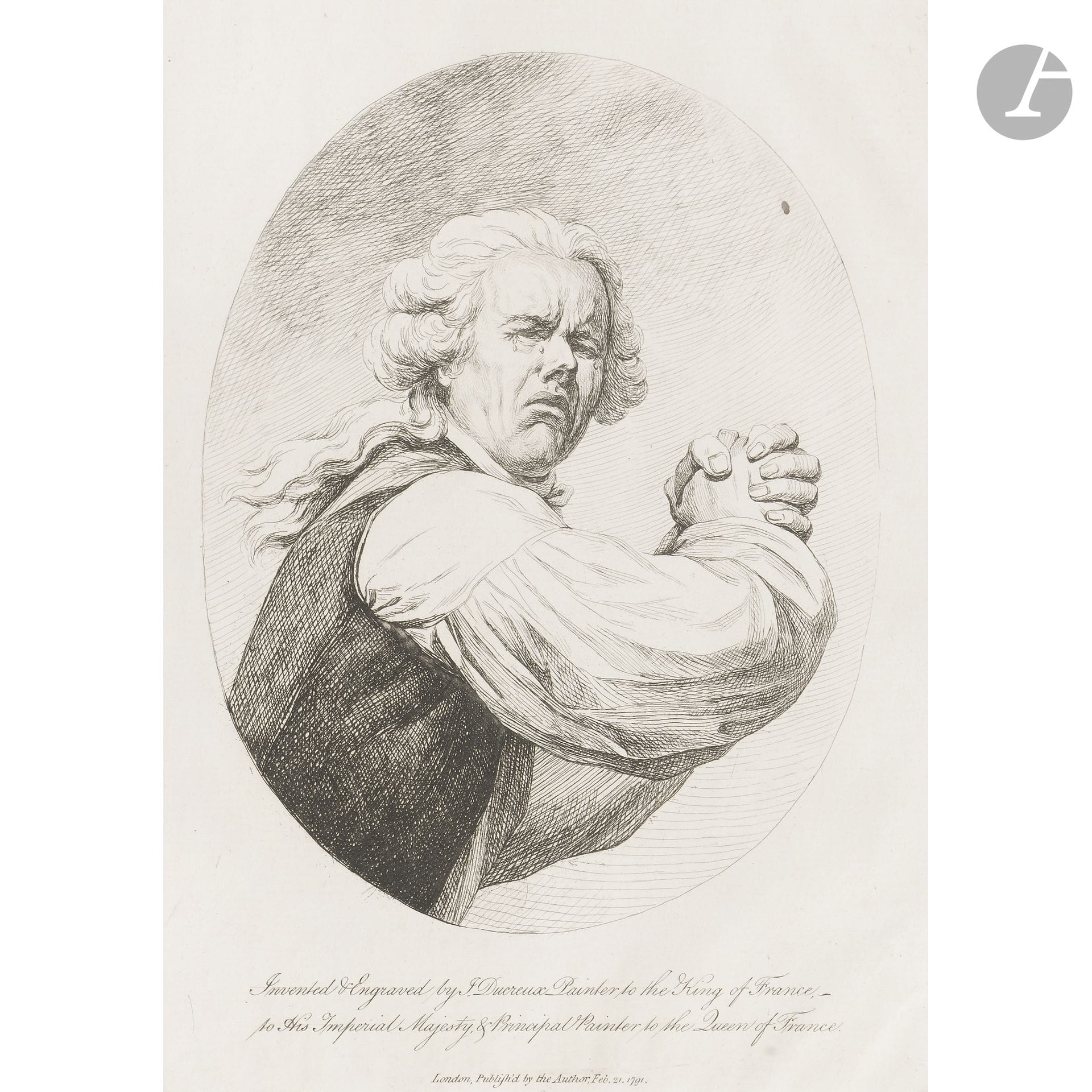
Joseph Ducreux (1735-1802) Autoportrait de l'artiste en larmes, se tordant les mains (Ducreux éploré ou Le Joueur éploré). 1791. Eau-forte. 212 x 293 [284 x 404 mm]. Baudicour 1 ; I.F.F. 1 ; V. Carlson et al., Regency to Empire, French Printmaking 1715-1814, The Baltimore Museum of Arts and The Minneapolis Institute of Arts, 1984, n° 106. Très belle épreuve sur vergé. Petite giclure d'encre sépia dans l'ovale au bord droit. Petits restes de colle au bord gauche au verso. Belles marges. Très rare. Timbre AABM (Lugt 3075). Ducreux a réalisé cette œuvre dans le cadre d'une série d'estampes physiognomoniques publiées à Londres à la fin du XVIIIe siècle. Grand adepte de la physiognomonie (l'étude de la forme et des traits du visage permettant d'identifier le caractère, fondée sur les écrits de Lavater), il cherchait à capturer l'extrême variété des émotions humaines. Dans cette même série, il s'est également représenté en rieur ou en homme discret. La BnF ne recense que 3 sujets gravés par lui : " Dans un moment de bonne humeur, il a tracé sur le cuivre, d'une pointe alerte, trois images humoristiques de lui-même ". (Inventaire du Fonds Français, XVIIIe siècle, tome 7, p. 490). " During the French Revolution, Ducreux emigrated to London, leaving Paris on 12 January 1791. While there, he exhibited five works at the Royal Academy, among them portraits entitled Surprise and Surprise mixed with Terror. But he found little favor in the English capital and soon returned to France on the fifteenth of August. His only three plates were etched during his stay in England, however. [...] It may be that Ducreux hoped to capitalize on the English taste for caricature, well established in the work of such artists as William Hogarth, James Gillray and Thomas Rowlandson. " (V. Carlson, in V. I. Carlson and J. W. Ittmann éd., Regency to Empire, French Printmaking 1715-1814, The Minneapolis Institute of Arts, 1984, p. 296).
Estimation
1 200 € - 1 500 €
Frais de vente
31,8%
Joseph Ducreux (1735-1802)
Autoportrait de l'artiste en larmes, se tordant les mains (Ducreux éploré ou Le Joueur éploré). 1791. Eau-forte. 212 x 293 [284 x 404 mm]. Baudicour 1 ; I.F.F. 1 ; V. Carlson et al., Regency to Empire, French Printmaking 1715-1814, The Baltimore Museum of Arts and The Minneapolis Institute of Arts, 1984, n° 106. Très belle épreuve sur vergé. Petite giclure d'encre sépia dans l'ovale au bord droit. Petits restes de colle au bord gauche au verso. Belles marges. Très rare. Timbre AABM (Lugt 3075).
Ducreux a réalisé cette œuvre dans le cadre d'une série d'estampes physiognomoniques publiées à Londres à la fin du XVIIIe siècle. Grand adepte de la physiognomonie (l'étude de la forme et des traits du visage permettant d'identifier le caractère, fondée sur les écrits de Lavater), il cherchait à capturer l'extrême variété des émotions humaines. Dans cette même série, il s'est également représenté en rieur ou en homme discret. La BnF ne recense que 3 sujets gravés par lui : " Dans un moment de bonne humeur, il a tracé sur le cuivre, d'une pointe alerte, trois images humoristiques de lui-même ". (Inventaire du Fonds Français, XVIIIe siècle, tome 7, p. 490).
" During the French Revolution, Ducreux emigrated to London, leaving Paris on 12 January 1791. While there, he exhibited five works at the Royal Academy, among them portraits entitled Surprise and Surprise mixed with Terror. But he found little favor in the English capital and soon returned to France on the fifteenth of August. His only three plates were etched during his stay in England, however. [...] It may be that Ducreux hoped to capitalize on the English taste for caricature, well established in the work of such artists as William Hogarth, James Gillray and Thomas Rowlandson. " (V. Carlson, in V. I. Carlson and J. W. Ittmann éd., Regency to Empire, French Printmaking 1715-1814, The Minneapolis Institute of Arts, 1984, p. 296).
Vente
mardi 24 novembre・14:00 (Europe/Paris)
Lieu de vente à venir
3, rue Favart
75002 Paris